
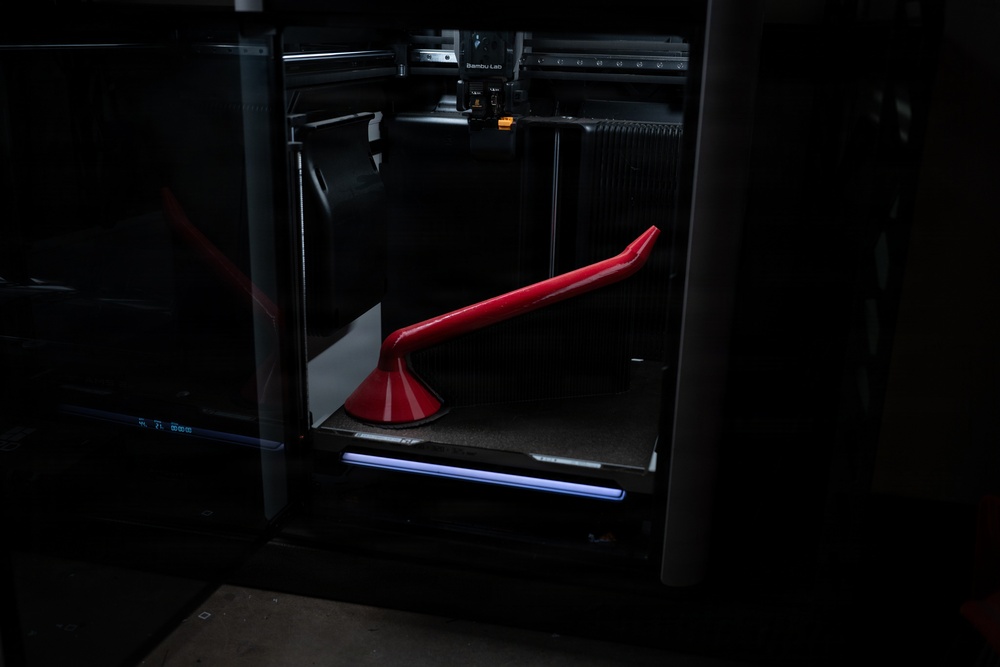
Photo By Airman Daniel Obi | A thermoplastic polyurethane (TPU) fuel funnel is developed using 3-D printing by the...... read more read more
 Subscribe
A brand new invention solves multiple KC-46A Pegasus engine servicing issues. Original invention straight out of McConnell Air Force Base Innovation Lab, a 3D-printed funnel for the KC-46A Pegasus has greatly reduced oil spillage and potential contamination, strengthening mission readiness. The funnel is used by the maintenance squadron in servicing the aircraft’s engine starter. "They were essentially using a turkey baster to service the KC-46 engine starter,” said Tech. Sgt. Brandon Branstetter, 22nd Aircraft Maintenance Squadron crew chief. “It was dripping oil onto the ground, and I knew there had to be a better way to solve the problem.” Using the dimensions of the new tool, Branstettter created a 3D-rendered model in the auto computer-aided design (CAD) software and produced the first prototype using the Bambu Lab H2D printer. After evaluating several materials, he selected thermoplastic polyurethane (TPU) because of its flexibility, durability and resistance to oil and fuel. These qualities make it well-suited for the application and extension of the funnel's service life. “Once I got the dimensions of it, I modeled it up in CAD and then decided to print it out of TPU after finding out the dimensions were correct,” Branstetter said. “We made it out of TPU because it is oil and fuel resistant, so it won't break down after continuous use.” No commercially-available product could meet the unit's requirements because of the funnel's unique design, as well as maneuverability needed to service the engine starter. Commercial products also have cost considerations that prove to be less beneficial than making it in-house. Each funnel can be produced using a 3D printer for less than $3, providing a low-cost solution to the problem. “For the test ones, I printed them out of Polylactic Acid (PLA), which costs about 30 cents each test print, but for the final product we used TPU, which costs about 2-3 dollars max,” mentioned Branstetter. Innovation will always come with specific challenges that will garner multiple trial and effort attempts. “It was a real specific design because of how the funnel needed to go across, but still be angled to where it could reach. It just had real specific and challenging dimensions,” said Branstetter. Although the funnel was designed to address a specific maintenance need, 3D printing has applications across many career fields at McConnell. The technology enables users to rapidly produce prototypes, custom tools, replacement parts and other specialized items while reducing material waste and keeping costs low. 3D printing has the ability to quickly produce tailored solutions, which makes it a valuable resource for units seeking to improve efficiency and solve unique operational challenges. “Almost any job can benefit from 3D printing. It's a cheap and convenient way to make readily available items to improve productivity,” Branstetter exclaimed. McConnell remains committed to fostering a culture of innovation across the installation and throughout the entire KC-46 fleet, as this innovation further increases the mission capability of the jet as a whole. Through the Innovation Lab, Airmen are expanding their perspectives and developing creative, mission-focused solutions that vastly increase readiness and improve operational effectiveness.
| Date Taken: | 07.17.2026 |
| Date Posted: | 07.21.2026 15:52 |
| Story ID: | 570214 |
| Location: | US |
| Web Views: | 25 |
| Downloads: | 0 |

This work, McConnell team member creates an innovative solution to a persistent problem, by Amn Daniel Obi, identified by DVIDS, must comply with the restrictions shown on https://www.dvidshub.net/about/copyright.


No keywords found.




