
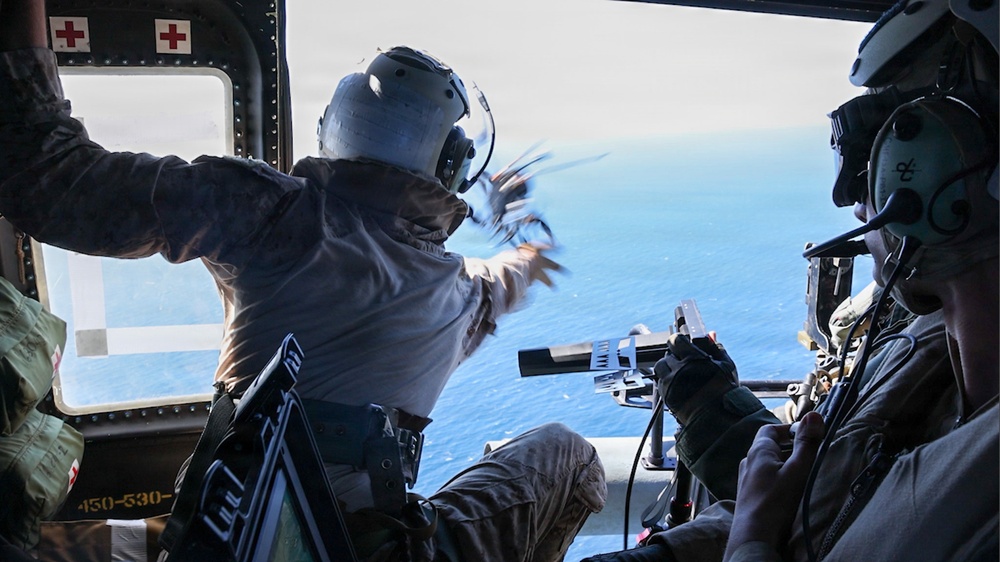
Photo By Lance Cpl. Carlo SouzaDeluca | U.S. Marines with 3rd Light Armored Reconnaissance, 1st Marine Division, Light Attack...... read more read more
 Subscribe
MARINE CORPS AIR STATION CAMP PENDLETON, Calif. —The Marine Corps is taking the next step forward in unmanned aircraft systems integration by deploying first-person view drones in maritime missions alongside infantry ground units. While previous testing focused strictly on proving the feasibility of operating drones from helicopters over land, this latest evolution integrates the FPV technology directly, utilizing the H-1 helicopter as a mobile, aerial control hub at sea.
During a recent exercise supporting a Marine Forces Special Operations Command (MARSOC) boarding team, Marines with Marine Light Attack Helicopter Squadron (HMLA) 169 and 3rd Light Armored Reconnaissance Battalion proved that an H-1 helicopter can effectively extend the reach of FPV technology to provide real-time reconnaissance for ground forces. This integration offers a crucial new capability for the Marine Air-Ground Task Force (MAGTF) and the broader Joint Force by establishing a scalable path to safely combine aviation, infantry, and unmanned systems during high-risk maritime interdictions.
This innovation significantly enhances the safety and effectiveness of Visit, Board, Search, and Seizure (VBSS) operations, a long-standing mission for H-1 squadrons. The exercise simulated a complex vessel boarding where, as the H-1 approached the target, a drone operating team inside the aircraft deployed and controlled a Neros Archer FPV drone.
Leveraging the helicopter’s capability to become a further reaching and mobile "command post," the team directed the drone to scout the ship’s deck and superstructure. This allowed them to identify potential threats and validate safe insertion points before any personnel were deployed to the vessel.
Traditionally, teams fast-roping onto hostile or uncooperative ships face significant risks due to limited visibility and uncertain threat conditions. By pairing the H-1’s endurance with the FPV drone's agility, commanders now have a cost-effective tool to survey a vessel, clear blind spots, and improve situational awareness without putting forces in harm's way.
The successful demonstration proved the viability of using the Neros Archer FPV drone, an existing system within the Marine Corps, as a remote extension of the helicopter’s own sensors. By enabling helicopter formations to scout, target, and provide overwatch from a safe distance, this integration reduces risk for the Marines boarding ships, making an intrinsically dangerous mission more controlled by reducing unknowns.
| Date Taken: | 07.17.2026 |
| Date Posted: | 07.17.2026 13:34 |
| Story ID: | 570191 |
| Location: | SAN DIEGO, CALIFORNIA, US |
| Web Views: | 457 |
| Downloads: | 2 |

This work, HMLA-169 and 3rd LAR Integrate Drones with MARSOC, by 1LT Connor Jenig, identified by DVIDS, must comply with the restrictions shown on https://www.dvidshub.net/about/copyright.

No keywords found.




