
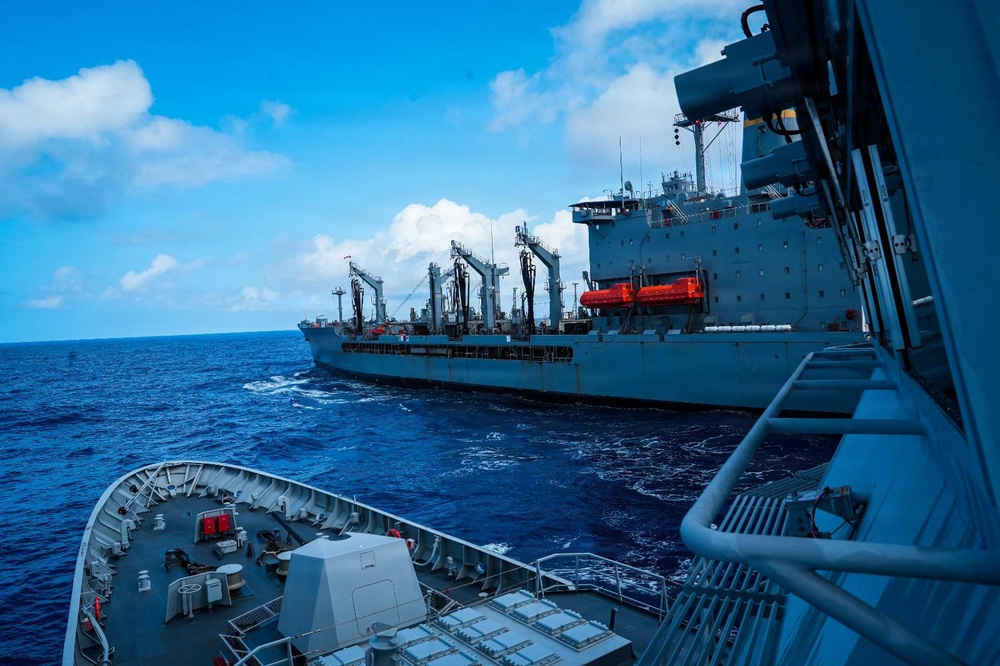
Photo By OF-2 Menoel Orpilla | Philippine Navy Miguel Malvar-class guided-missile frigate BRP Miguel Malvar (FFG06)...... read more read more
 Subscribe
In the bright, blue waters surrounding the Hawaiian Islands, Military Sealift Command (MSC) Combat Logistics Force (CLF) ships are providing the fuel, supplies, and sustainment that keep the world's largest international maritime exercise underway.
Fleet replenishment oiler USNS Guadalupe (T-AO 200) and dry cargo/ammunition ship USNS Washington Chambers (T-AKE 11) are supporting Exercise Rim of the Pacific 2026 by delivering aviation fuel, marine diesel fuel, food, equipment, and other supplies to the 36 U.S. and foreign Navy surface ships participating in the exercise. The ships are conducting multiple replenishment-at-sea (RAS) operations nearly every day, allowing participating forces to remain at sea and focused on mission objectives.
While RAS operations are routine for MSC's CLF ships, the pace of RIMPAC is anything but routine. Instead of servicing one or two ships in a day, Guadalupe and Washington Chambers often conduct multiple replenishments daily, with ships receiving fuel and cargo simultaneously on both sides.
"The ability to refuel and resupply ships at sea is the logistics backbone that keeps the exercise force sustained and ready," said Capt. Aaron Caputo, civil service master of Washington Chambers. "MSC's ability to deliver fuel, cargo, and logistics support allows U.S. and partner nation ships to remain on station and continue operations throughout RIMPAC."
One of RIMPAC's defining characteristics is its multinational participation, requiring MSC mariners to work closely with navies from around the world. Although the fundamentals of replenishment at sea remain the same, participating nations often have different procedures, communications practices, and measurement standards. For example, many partner navies use the metric system instead of the imperial system used by the U.S. Navy. Many of those differences are addressed during planning, but crews must still adapt to unexpected situations while underway.
"Working with foreign navies is different because our procedures and chains of command differ," said Capt. Kevin Sauls, civil service master of Guadalupe. "Everyone involved understands those differences and is eager to find common ground. We establish procedures everyone can agree on and move forward. Every experience working with partner navies builds knowledge that makes the next operation even smoother."
Despite the challenges, both captains said every RAS strengthens interoperability and reinforces the partnerships RIMPAC is designed to build.
Preparation for the exercise began well before ships arrived in Hawaii. Both crews reviewed lessons learned from previous RIMPAC exercises and analyzed expected operational demands.
For Washington Chambers, preparation included an accelerated return to operational service following a major overhaul at Vigor Marine Group Shipyard in Portland, Oregon. After getting underway for sea trials on June 14, the crew compressed months of training into a matter of weeks, completing required Navy assessments and certifications on an aggressive schedule.
The ship arrived in Hawaii on July 2 and achieved Ready for Tasking status on July 6, just in time for the exercise's underway phase.
"That accomplishment reflects far more than meeting a schedule," Caputo said. "It demonstrates what can be achieved when the ship's crew, Afloat Training Group, MSC Pacific, Program Management Office 6, the Port Engineer, and numerous supporting organizations are aligned toward a common operational objective.
"The real success story isn't measured by the number of replenishments completed during the opening days of the exercise. It's measured by the dedication and professionalism of a crew that transformed a ship coming directly out of a major overhaul into a fully mission-capable logistics platform ready to answer the fleet's call ahead of schedule."
For MSC's Civil Service Mariners (CIVMARs), RIMPAC provides operational experience difficult to replicate during routine CLF missions. Crews work in a complex multinational environment, sustain coalition forces at an elevated operational tempo, and gain firsthand experience supporting large-scale maritime operations.
"Even with the challenges and hard work that go into RIMPAC, there's a great deal of excitement among the crew, especially when working with multinational ships and their crews," said Nathan Wheeler, Washington Chambers' civil service operations officer. "While ashore, I've seen positive interactions between nations, and at sea there's an overall spirit of goodwill and cooperation expressed through memorabilia exchanges, command swag, and outstanding coordination during replenishment operations.
"This will be my third RIMPAC aboard Washington Chambers and my fourth overall. It's a lot of hard work, but I always leave with a strong sense of accomplishment and appreciation for our multinational maritime force."
The demanding operational tempo also makes crew morale a priority. Special meals, including Saturday pizza and wing nights and Sunday steak dinners, along with access to the ship's store and limited internet service, help provide welcome comforts during long periods at sea.
Sauls said visiting crews have also contributed to morale by sharing traditions and entertainment. During one replenishment, sailors from a Chilean ship performed Elvis Presley and Freddie Mercury impersonations, while another crew entertained with a KISS-themed air band performance. Ship memorabilia exchanges have also become a favorite tradition.
"My ship's ball cap collection has gotten exponentially larger," Sauls said with a laugh.
Whether the lasting memory comes from overcoming the challenges of multinational operations, maintaining the demanding pace of replenishment schedules, or returning a ship to operational status after a major overhaul, RIMPAC leaves a lasting impression on those who participate.
"I've participated in several RIMPAC exercises during my MSC career," Sauls said. "It never gets old."
Guadalupe and Washington Chambers will continue providing logistics support throughout RIMPAC 2026 until the exercise concludes in August.
Hosted biennially by Commander, U.S. Pacific Fleet and executed by U.S. 3rd Fleet, RIMPAC is the world's largest international maritime exercise. This year's exercise marks the 30th iteration of the series, which began in 1971. Thirty nations, 36 surface ships, five submarines, 15 national land forces, more than 206 aircraft and approximately 25,000 personnel are participating in RIMPAC 2026 in and around the Hawaiian Islands from June 24 through July 31. The exercise provides participants with a unique training opportunity while strengthening the cooperative relationships essential to ensuring freedom of navigation and maritime security around the globe.
| Date Taken: | 07.16.2026 |
| Date Posted: | 07.17.2026 14:57 |
| Story ID: | 570173 |
| Location: | PACIFIC OCEAN |
| Web Views: | 276 |
| Downloads: | 2 |

This work, MSC Ships Provide Logistics Support During RIMPAC 2026, by Sarah Cannon, identified by DVIDS, must comply with the restrictions shown on https://www.dvidshub.net/about/copyright.


No keywords found.




