
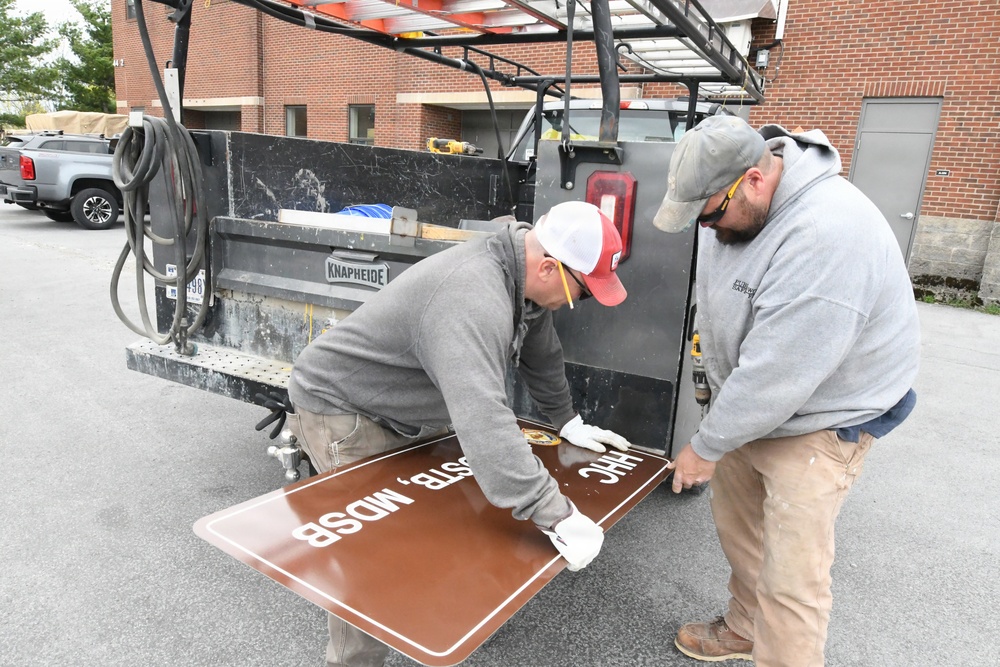
Photo By Michael Strasser | Todd Yurack, carpenter, and Jason Risley, mason, with Fort Drum Directorate of Public...... read more read more
FORT DRUM, N.Y. (July 17, 2026) -- As street, building, and lawn signs across post become worn and damaged, Fort Drum Directorate of Public Works employees work year-round to repair or replace them.
In recent months, DPW Operations and Maintenance Division employees have embarked on a larger remediation effort to both improve and standardize signage across the 10th Mountain Division’s footprint.
The extensive work is due, in part, to the number of unit redesignations within the 10th Mountain Division (LI) under the Army’s force structure modernization plan, and new tenant organizations. To date, this has included:
The redesignation of the 1st and 2nd Brigade Combat Team as mobile brigade combat teams (MBCT).
The 3rd Battalion, 6th Field Artillery Regiment moved from 1st Mobile Brigade Combat Team to 10th Mountain Division Artillery.
The 41st Brigade Engineer Battalion was redesignated as the 41st Engineer Battalion and transferred from 2nd Mobile Brigade Combat Team to 10th Mountain Division (LI) Headquarters.
Following the inactivation of the 91st Military Police Battalion, the 23rd MP Company was assigned to 10th Mountain Division Headquarters and Headquarters Battalion.
Elements of the 2nd Multi-Domain Task Force, including 3rd Battalion, 12th Field Artillery Regiment, are now stationed at Fort Drum.
Command Sgt. Maj. Daniel Burns, Fort Drum garrison senior enlisted adviser, said that signs reflect the time period when they were created, and outdated ones need to change with current Army standards.
“The whole concept of standardization in the military is to create a common operating picture,” he said. “And it creates ease of repair. We can be more efficient when the signs are standardized.”
Holly Moore, illustrator in the DPW Buildings and Grounds Branch, said that all sign replacements will comply with the Army’s Unified Facilities Criteria (UFC). This specifies a rectangular format with square corners, Helvetica lettering, and standardized colors. Division signs are brown and white, while garrison and tenant organizations are green and white.
Before there were standardized guidelines for military facilities, units would ask to customize the signage on their buildings. In addition to the extra costs and labor involved, it lacked uniformity across the installation that Moore said they hope to achieve now.
“The UFC is very clear on how everything should look,” she said. “It directs us on the lettering, colors and styles according to their design program.”
Moore operates the sign shop herself, creating most of the signs displayed throughout the post. During the summer months, she touches up and repaints as many signs as possible to restore them to near-new conditions. She said wooden signs generally can last several years – and metal signs last twice as long – before requiring repair or replacement.
“If you maintain them and get them refurbished before the wood is compromised then they are good for at least another seven years,” she said. “We’ll peel all the vinyl off, sand it down, prime and repaint the whole piece. It’s kind of simple when you know the process.”
Signs that can’t be refurbished are used for other DPW construction projects.
“Some of them need to be thrown away, but for the most part we try to repurpose everything,” Moore said.
Winter weather complicates sign maintenance, especially when snowbanks block their access to lawn signs or impede equipment operation. That’s why the DPW team began their remediation efforts in early spring and have maintained a steady pace ever since.
“There are signs that have been up for a long time, and they need new faces,” said Todd Yurack, DPW carpenter. “It’s a lot of work, but making these changes now is a good thing.”
Yurack and Jason Risley, DPW Buildings and Grounds Branch Carpentry Section, worked together to refurbish the large welcome sign on Iraqi Freedom Drive, one of the first signs people see upon entering Cerjan Gate.
“We took care of cleaning up all of the stones that have been there for a long time,” Yurack said. “We removed old dilapidated wooden insignias, pre-drilled the stone, and stud mounted new aluminum insignias. We’ll go back later this summer to replace the main part of the sign.”
Robert Ashley and Bill Hoffman, with DPW Municipal Services Branch, Roads and Grounds’ Signs and Fences Section, said it is a year-round effort to repair and install signs across post. In one instance, they removed a damaged sign in front of the barracks and were able to replace it by the very next day.
“Holly paints them, fills any holes, cuts all the trim by hand and aligns everything up so it looks brand new,” Ashley said. “You can’t even tell where she had to repaint part of it.”
“Those guys are the real stars,” Moore said. “I’ve kept them very, very busy.”
Moore said it would be difficult to estimate how many signs will be installed by year’s end, as it is only a portion of her workload. In addition to producing regulatory signs for safety and operational security, roadside signs, labelling, interior signs and other projects, she anticipates completing two or three division signs per week, and changing company-level signs to the new design when she receives the unit information.
Going forward, company-level signs will bear the company insignia instead of division insignia that has been standard on most unit signs. Moore said this was approved by command to demonstrate unit pride and esprit de corps.
“That’s kind of a big deal because the Soldiers have been asking for that forever,” she said. “They care, and they are very proud of their crest.”
Burns said that it not only instills unit pride, but a sense of ownership.
“You can wear the division patch and have pride, but so do 16,000 other people,” he said. “But by displaying the individual unit crest, it’s like saying, ‘This is my property and these are the things we have ownership over. And I’ve got to take care of it now.’”
Burns is reminded of the original Mountain Soldiers of World War II who spent years training for combat without their own unit patch.
“It’s a very cultural thing in the Army to have a unit patch – it’s about pride and identity,” he said. “They all felt left out without one. So, they created their own unauthorized one, the Pando Commando, until they received the powder keg patch and ‘Mountain’ tab.”
Burns visited one battalion area two weeks after new signs were installed.
“They were really excited about it because, again, it delivers that unit pride,” Burns said. “A Soldier never sees his unit patch unless they’re in dress uniform. Now they are seeing it every day, walking into the building. It makes a difference.”
| Date Taken: | 07.17.2026 |
| Date Posted: | 07.17.2026 11:05 |
| Story ID: | 570172 |
| Location: | FORT DRUM, NEW YORK, US |
| Web Views: | 724 |
| Downloads: | 0 |

This work, Sign replacements at Fort Drum improve standardization, reflect changes in 10th Mountain Division, by Michael Strasser, identified by DVIDS, must comply with the restrictions shown on https://www.dvidshub.net/about/copyright.


No keywords found.





