
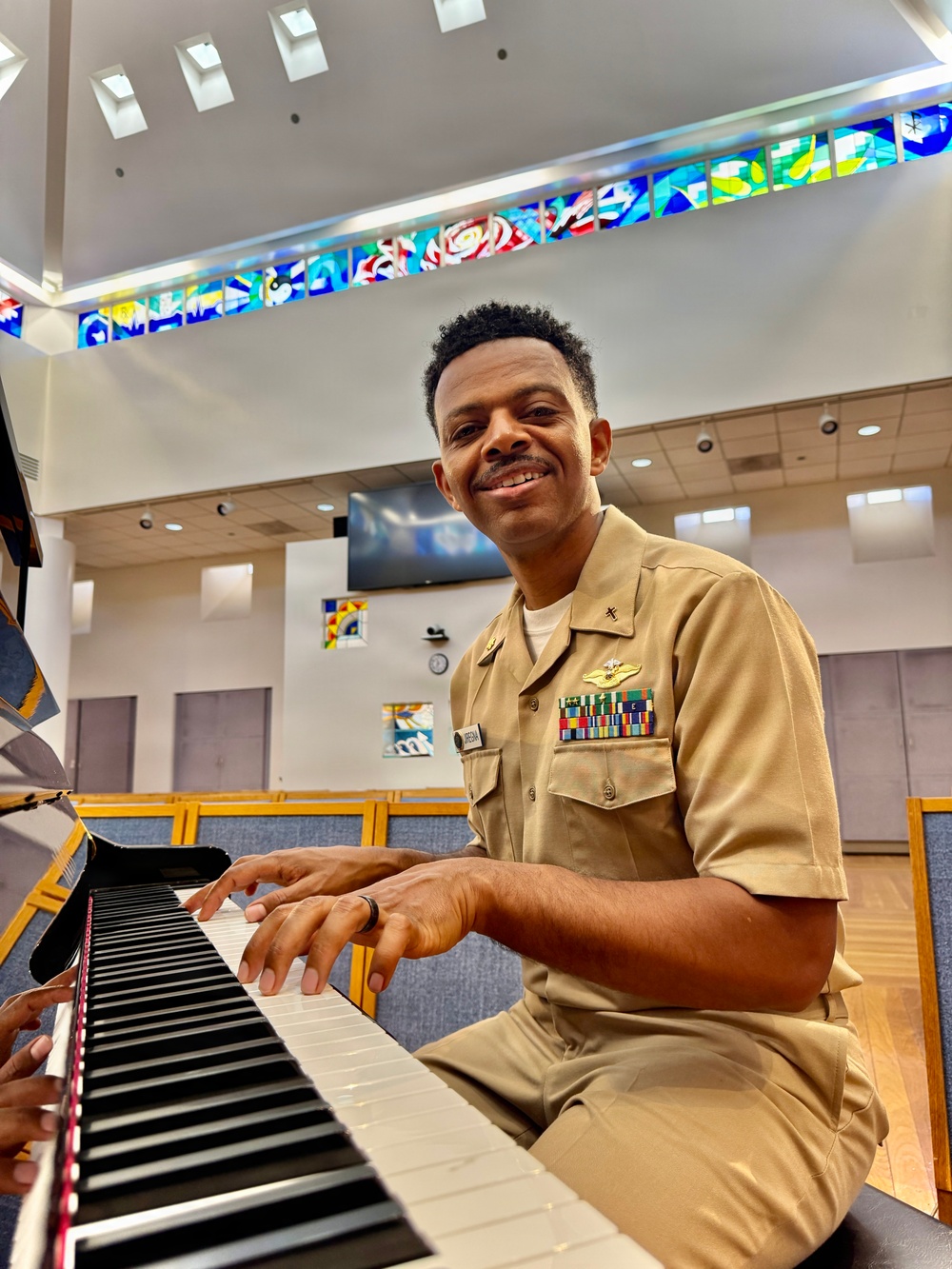
Photo By Arsenio R. Cortez Jr. | Lt. Cmdr. Abraham Jiregna plays the piano at Navy Medicine Readiness and Training...... read more read more
Military service comes with high stress. Warfighters often carry invisible burdens such as chronic stress, operational fatigue, grief and moral injury. These experiences can be difficult to talk about. To support warfighter readiness and recovery, Naval Medical Forces Pacific is highlighting an innovative approach to mental health care: music-informed spiritual care with AI-assisted music.
At Navy Medicine Readiness and Training Command San Diego and Naval Medical Center San Diego, Lt. Cmdr. Abraham Jiregna, a clinical pastoral education resident chaplain, is blending traditional pastoral care with artificial intelligence to support mental health and spiritual readiness.
Jiregna draws from a lifelong passion for the arts and his experience from more than 5,000 counseling sessions. He uses AI-assisted music to create tailored therapeutic experiences for service members.
"Music often reaches places that ordinary conversation cannot," Jiregna said. "What makes music-informed spiritual care unique is that the music is not merely entertainment or background ambiance; it becomes a therapeutic and spiritual bridge. Through carefully produced AI-assisted music experiences, service members and veterans are able to reflect on themes such as loss, hope, moral injury, purpose, belonging, forgiveness, and recovery.
This work directly supports Naval Medical Forces Pacific's (NMFP) mission to ensure medical forces are fully trained, properly manned, and capably equipped to be forward deployable and ready to execute operational medicine responsibilities in support of warfighter requirements. Capt. David Alexander, NMFP chaplain, recognizes the impact of this approach for overall readiness.
“The value of this approach is not primarily the technology itself, but its potential to help some service members throughout the enterprise approach difficult experiences in a way that feels less exposing than conversation alone,” Alexander said. “Music can sometimes create the conditions for reflection, honesty, connection and new meaning-making around experiences that contribute to grief, shame and isolation. Tools like these may help support chaplains and caregivers foster such conditions while preserving what remains central to spiritual care: the fundamental human work of relational accompaniment grounded in compassionate, discerning presence.”
Rather than replacing human connection, the AI-assisted music serves as a catalyst for it. Jiregna uses the music in group settings like Chaplains Corner or Play and Pray. He writes songs about common struggles so individuals can maintain their privacy but still relate to the message. Tracks like "Dopamine Motel" look at unhealthy coping mechanisms, while "Broken Compass Blues" reflects the emotional disorientation people feel after trauma or moral injury.
During a typical session, the group spends 15 minutes talking and building connection. Then, they listen to a song while reading printed lyrics, followed by guided discussion and reflection on ways to cope.
"The goal is not simply to make songs, but to create emotionally resonant experiences that help service members feel seen, understood, and less alone in their struggles," Jiregna said. “Music-informed spiritual care is designed not merely to reduce symptoms, but to strengthen resilience, restore meaning, improve emotional regulation, encourage healthy coping strategies, and foster a greater sense of connection and belonging.”
He noted that music lowers emotional defenses and gives people language for their experiences when ordinary conversation falls short.
“For some warfighters, music becomes a safer entry point into discussing difficult subjects such as trauma, grief, anger, shame, guilt, fear or hopelessness, topics that may otherwise remain suppressed,” Jiregna explained. “What makes the approach adaptive is the ability to tailor the musical experience to the needs of the audience or individual. Some sessions may focus on resilience and motivation, while others emphasize grief processing, recovery, emotional awareness, hope, forgiveness or identity restoration. The music is intentionally paired with guided reflection, mindfulness practices, spiritual care conversations and practical coping strategies to create a more holistic therapeutic experience rather than passive listening alone.”
The feedback from participants shows the approach helps build trust and self-awareness. The music helps individuals process trauma and build psychological safety. One participant said, "This is what I needed today. This put how I’ve been feeling into context and helped me better understand how to move forward." Others regularly ask Jiregna to post the songs online so they can listen outside of group meetings. While Jiregna uses AI tools to help compose music, he said that technology does not replace human care. AI helps with creativity, but healing takes real human connection.
"AI is simply a tool that helps facilitate reflection, creativity, and therapeutic engagement," Jiregna said. "The heart of spiritual care is still relational presence. It is sitting with someone in grief, helping them process trauma, praying with them, and listening without judgment."
Jiregna has made more than 300 original songs.
“The musical styles span a wide range of genres, including hip hop, country, R&B, bluegrass, jazz, rock ‘n’ roll, funk, soul and more, which helps increase accessibility and engagement among different generations, cultures and personalities within the military community,” he explained.
Looking ahead, he hopes to share this work across Navy Medicine to support Warrior Toughness and Total Force Fitness programs. As he prepares for his next assignment at Naval Station Great Lakes to support recruits during their formative military stages, his mission remains clear: using innovative tools responsibly to foster resilience, reduce the stigma surrounding mental health, and ensure no warfighter walks their healing journey alone.
NMFP provides oversight for 10 Navy Medicine Readiness and Training Commands (NMRTC) on the West Coast and Pacific Rim that train, man and equip medical forces, primarily in military treatment facilities. Globally, NMFP oversees eight research laboratories that deliver research expertise in support of warfighter health and readiness. Additionally, NMFP manages the Naval Expeditionary Medicine Warfighter Development Center (NEMWDC), which plays a critical role in preparing medical teams for expeditionary and operational environments.
| Date Taken: | 07.16.2026 |
| Date Posted: | 07.16.2026 18:25 |
| Story ID: | 570127 |
| Location: | SAN DIEGO, CALIFORNIA, US |
| Web Views: | 510 |
| Downloads: | 0 |

This work, Navy chaplain uses AI-assisted music to support warfighter mental health care, by Arsenio R. Cortez Jr., identified by DVIDS, must comply with the restrictions shown on https://www.dvidshub.net/about/copyright.


No keywords found.





