
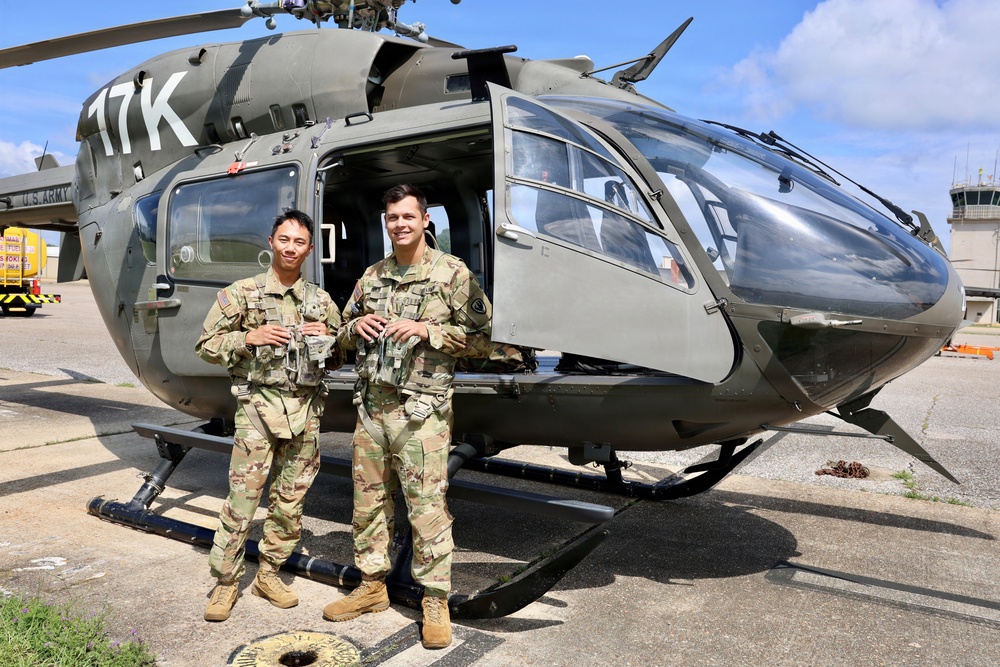
Photo By Leslie Herlick | U.S. Army 2nd Lts. Kyler Suerth, left, and Blaine Dolin, student pilots assigned to...... read more read more
 Subscribe
FORT RUCKER, Ala.- Army aviation students are taking a major step in their training as the first class begins solo cross-country flights during the Basic Warfighting Skills phase of flight school. This return to early career autonomy will help build confidence, sharpen decision making, and better prepare new aviators for operational service.
The new training model, introduced by the 1st Battalion, 223rd Aviation Regiment, adds two weeks of deliberate cross-country instruction before students complete a check ride. Once they pass their check ride, they fly 50 to 100 nautical miles beyond Shell Army Heliport without an instructor on board. It is the first time in decades that Army aviation students will navigate the national airspace system independently.
Lt. Col. Andrew Bartlett, the battalion commander overseeing the rollout, said the change shifts flight school from isolated, task-based drills to a more realistic mission environment.
“Flight school is excellent at teaching individual tasks,” Bartlett said. “This gives students a chance to scrimmage, to put all those skills together in a real, end to end mission.”
Bartlett said the goal is to achieve rigor, confidence and readiness.
“This is about aeronautical decision making and putting all the knowledge together,” he said.
Instructor pilots say the shift is already paying off. Travis Ogburn, a retired Army aviator now with Amentum, has flown OH-58D Kiowas, UH-60 Black Hawks, and spent the last seven years instructing in the LUH-72 Lakota. He said the return to visual flight rules (VFR) flying before tactics is a critical improvement.
“Students used to focus more inside the cockpit when trying to fly tactics,” Ogburn said. “Now they are back to being VFR pilots, flying outside.”
Ogburn said instructors look for strong flying fundamentals, clear radio communication and independent decision making before clearing a student for solo cross-country flights. He said that civilian radio procedures are one of the biggest challenges student pilots face.
“Leaving Cairns and talking to Jacksonville Center or Atlanta Center, that is new for them,” he said. “They have not had that opportunity until now.”
His advice before a student steps into the aircraft alone is simple. Confidence.
“If we can build their confidence, it will segue into their competence, and that is what makes Army aviators.”
Second Lts. Kyler Suerth and Blaine Dolin, both recent West Point graduates, are among the first students to train under the new model. After a week of flying to Tallahassee, Montgomery and Andalusia, both said the experience is pushing them in ways that feel challenging and motivating.
“This time, we are going somewhere,” Suerth said. “We are actually operating in civilian airspace the way aviators do. I am nervous, but every day I get a little less nerve wracked and a little more excited.”
Dolin said instructors are preparing them by stepping back and letting students handle the workload.
“They are giving us the opportunity to do it on our own and only stepping in when needed,” Dolin said. “It is definitely going to be a confidence builder, not having someone to fall back on.”
Both students said radio calls remain the biggest challenge as they shift between military and civilian terminology.
“You have to know who you are talking to, what you need to say and how to say it,” Suerth said.
The new cross-country phase leads directly into tactical terrain flight training without GPS, reinforcing the ability to operate in degraded or denied environments. Students will complete at least two fully solo flights and up to five total cross-country missions, depending on weather.
Ogburn said the autonomy mirrors what aviators face in operational units.
“This builds a foundation to get them where they need to be,” he said. “We have not done this in 25 years. It is a learning curve for everyone, but it is bringing back memories and I am enjoying getting back into the national airspace.”
After a few days of substandard weather, Dolin and Suerth completed their first cross country solo flight to Selma and back on July 16. After the flight, both said the experience felt surprisingly natural.
“It feels like we have been doing it for a while,” Suerth said. “We went in more confident, making radio calls and being comfortable operating with civilians in the air.”
Dolin said the flight demanded teamwork and trust. “The biggest lesson was having confidence in our skills and what we have learned so far.”
Both students said the solo reinforced the importance of staying ahead of the aircraft and anticipating what comes next.
“Operating in civilian airspace makes you proactive,” Suerth said. “You have to stay ahead of your flight plan. It makes you anticipatory rather than reactive, and that is a huge help as we move into BWS (Basic Warfighting Skills) and start flying lower.”
Their confidence, they said, grew noticeably from takeoff to shutdown.
“I did not have to second guess myself nearly as much as I used to,” Suerth said. “There is a huge difference from P1 and even from when I first got here at Shell.”
The flight also gave them a chance to work through real issues without an instructor in the cockpit. Before departing, they handled a fuel gauge problem and navigation system concerns on their own.
“Being able to solve that by ourselves without asking an instructor who to talk to was valuable,” Dolin said. Both agreed the experience broadened their understanding of what it means to fly as Army aviators.
“It definitely increased our scope,” Suerth said. “Getting this experience early is good for us.”
As the Army reintroduces solo cross country flying to its training pipeline, students like Suerth and Dolin say the value is already clear. The confidence gained, the decisions made in real time, and the exposure to civilian airspace all point to the same conclusion.
“We are asking them to think, to decide and to fly like real aviators,” Bartlett said.
If the first cross country solo flights are any indication, the next generation of Army pilots is ready to take that responsibility and take off on their own.
| Date Taken: | 07.16.2026 |
| Date Posted: | 07.16.2026 15:24 |
| Story ID: | 570106 |
| Location: | ALABAMA, US |
| Web Views: | 235 |
| Downloads: | 0 |

This work, Army flight school launches first solo cross-country training in decades, by Leslie Herlick, identified by DVIDS, must comply with the restrictions shown on https://www.dvidshub.net/about/copyright.


No keywords found.




