
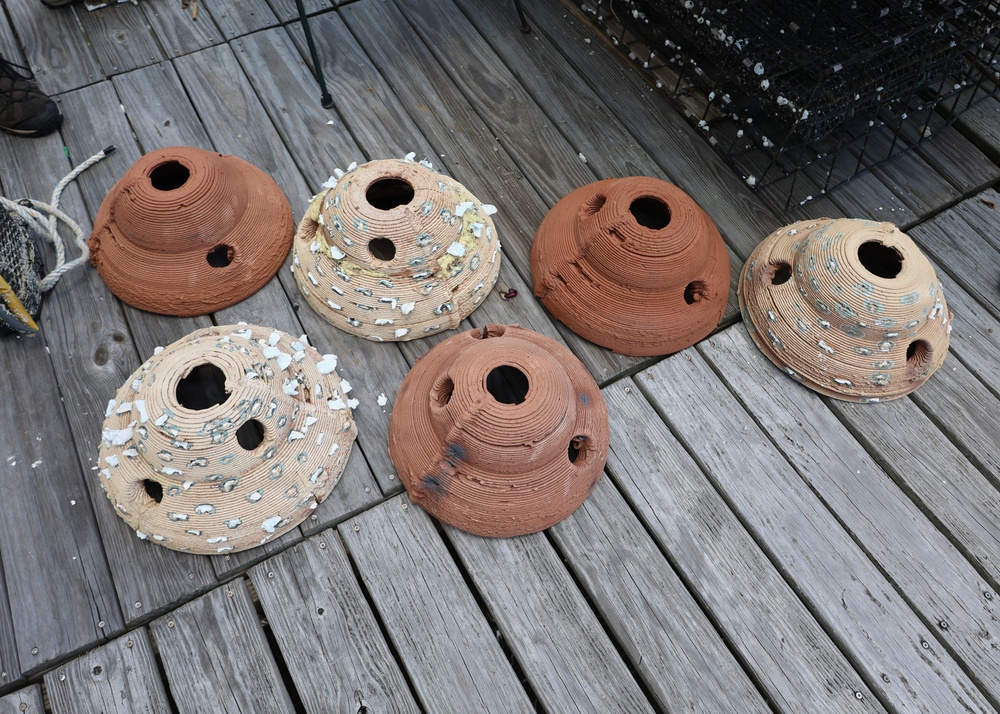
Photo By Keesha Robinson | Six 3-D printed oyster reefs sit waiting to be deployed into Mobile Bay in Coden,...... read more read more
MOBILE, Ala. — Maintaining the nation's waterways requires removing millions of cubic yards of sediment annually to keep navigation channels safe and reliable. Traditionally, this dredge material has been viewed as a byproduct to be managed.
Today, researchers and engineers with the U.S. Army Corps of Engineers (USACE) are advancing a radically different approach: treating dredged sediment as a valuable engineering resource to strengthen coastal systems.
"The real opportunity is to keep sediment working within the coastal system and use it as a resource," said Elizabeth Godsey, a USACE Regional Sediment Management and Engineering with Nature Practice Lead. "By combining dredged material with innovative design and printing methods, we can develop solutions that support navigation, restore habitat, and increase coastal resilience."
This innovative question is currently being explored in Alabama's Mobile Bay. Here, storms, shoreline changes, shifting sediment processes, and other environmental stressors have contributed to habitat loss and a decline in local oyster populations.
To combat this, the USACE Engineer Research and Development Center (ERDC), the Mobile District, and regional partners are evaluating how dredged sediment can be transformed into 3D-printed structures that provide critical oyster habitat, improve shoreline resilience, and expand beneficial use opportunities.
Oysters have long played a vital role in coastal Alabama. As a keystone species, they are a primary driver of both economic development and ecology in the region. Oysters are pivotal to the function of Alabama's estuaries—they enhance water quality, offer habitat for other ecologically and economically important species, and naturally influence nearshore waves and sediment processes to mitigate coastal erosion.
The innovation gained momentum when Mobile District engineers were introduced to ERDC's 3D printing technology. The innovation offers immense design freedom, enabling rapid production of prototypes that mimic nature's architecture.
"The idea came from observing how oysters naturally build reefs," Godsey explained. "As oyster reefs grow, they filter and stabilize sediment while creating complex habitat. We asked whether we could use the same system's sediment, already in the navigation channel, as a building material to create structures that encourage new reef development."
Researchers from ERDC's Environmental Laboratory (EL) collected sediment from the Blakeley Island Confined Disposal Facility (CDF) to fabricate the 3D-printed structures. The team developed a specialized, printable sediment-based mixture to produce domes featuring varied surfaces, openings, and internal geometries intended to provide a stable substrate and habitat complexity.
"We are using fine-grained dredged sediment from Mobile Harbor as building material," said Dr. Al Kennedy, a research biologist with ERDC-EL. "The sediment that we collected from the Blakeley Island CDF can restore CDF capacity after being scaled up. The layers and complex geometry of the printed domes provide microhabitats and surface structures that are ideal for larval colonization."
Early deployments of the oyster domes are showing highly promising results. The nature-inspired structures are successfully attracting barnacles and oysters, adding immediate ecological value to the coastline.
"The 3D oyster reefs are holding up and are resilient to tides," Kennedy noted. "Barnacles and oysters are shown to like colonizing on the printed dredged sediment structures as much as the ideal reference material, terracotta. The models provide a hard substrate where they previously didn't exist, expanding the oyster population. The oyster reefs also provide wave breaks and energy reduction while retaining more coastal sediment and reducing erosion."
The implications of this research extend far beyond Mobile Bay. Recognizing the myriad benefits of oysters and the success of these resilient designs, USACE is in the final stages of publishing a nationalEngineering Practice Guide for Oyster Reefs. This upcoming publication underscores that nature-based coastal engineering is of critical national interest.
Looking ahead, future phases of the project will include deeper analysis of oyster engagement with the sediment and the advancement of immediate, on-site 3D printing capabilities.
"We plan to compare structural durability and oyster colonization rates of all-dredged-sediment domes against domes that contain 10 percent oyster shell and 90 percent sediment," said Kennedy. "We will also use a hopper to continuously print sediment into structures, habitat structures, and building materials. Additionally, we strive to print on-site and on-demand to reduce transportation costs and discover bio-inspired binders for the sediment."
For USACE, the ultimate goal is a sustainable cycle where navigation maintenance directly fuels environmental restoration.
"Every year, we move millions of cubic yards of sediment to maintain our nation's waterways," Godsey said. "The opportunity before us is to keep more sediment working within a coastal system, where it can continue providing ecological and engineering benefits. Projects like this help redefine what beneficial use can look like in the future."
| Date Taken: | 07.16.2026 |
| Date Posted: | 07.16.2026 15:05 |
| Story ID: | 570104 |
| Location: | MOBILE, ALABAMA, US |
| Web Views: | 197 |
| Downloads: | 0 |

This work, USACE Transforms Dredged Sediment into 3D-Printed Oyster Reefs to Bolster Coastal Resilience, by Charles Walker, identified by DVIDS, must comply with the restrictions shown on https://www.dvidshub.net/about/copyright.

No keywords found.





