
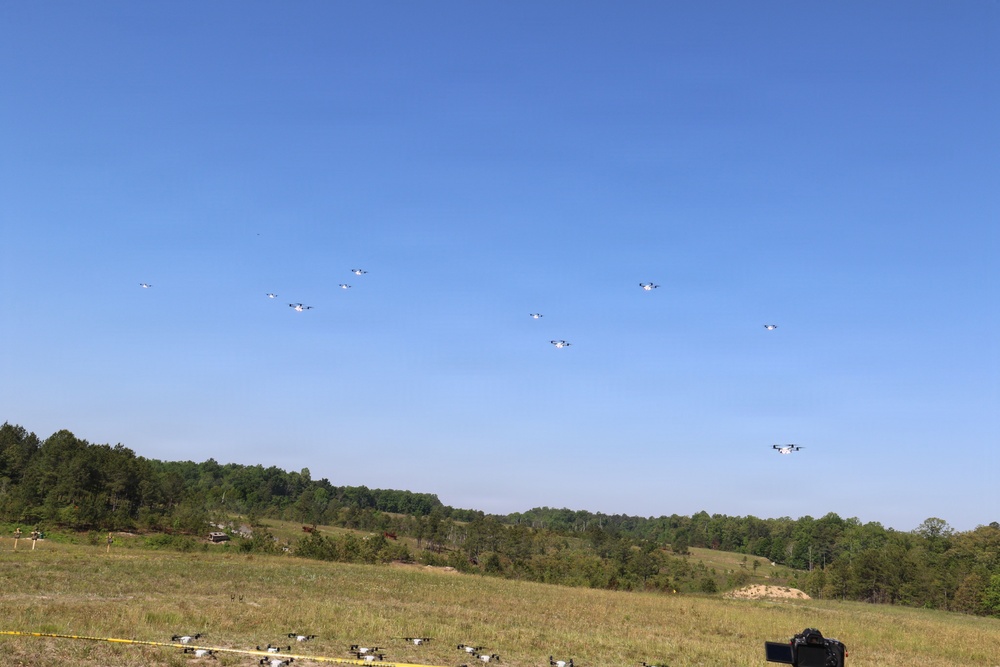
Photo By Brian Feeney | A simulated UAS swarm attack at C5ISR's Warden C-sUAS event at Fort AP Hill. (Photo...... read more read more
As the war in Ukraine and ongoing global conflicts demonstrate, the rapid proliferation of agile, armed unmanned aircraft systems (UASs) has fundamentally transformed modern warfare. Seen up close, the ability of UASs to seemingly swoop in out of nowhere and drop a bomb on your head is astounding. In direct alignment with the Secretary of War’s guiding principles of urgency, speed, efficiency, competition and lethality, the U.S. Army Command, Control, Communications, Computers, Cyber, Intelligence, Surveillance, and Reconnaissance (C5ISR) Center is taking a leading role in ensuring our forces maintain absolute battlefield overmatch.By driving collaboration with defense technology developers, the Center is rapidly delivering next-generation capabilities that will protect warfighters against these evolving lethal threats. May 18-29, the Center executed its first-ever counter-small unmanned aircraft systems (C-sUAS) event, known as Warden, a collaborative government and industry assessment held at Fort A.P. Hill, Virginia. It served as a venue for data collection, demonstration and evaluation of non-kinetic drone defeat technologies. Over the course of a week and half, a team of C5ISR Center counter-UAS experts collected data and performed field assessments of Technology Level Readiness (TRL) 5+ systems against various UASs flying mock attack runs. For the 17 industry partners in attendance, Warden presented a unique opportunity to test their C-UAS systems against multiple types of aerial threats in real-world scenarios. They pitted their lasers, radio frequency (RF) jammers, and an intercept UAS against more than a dozen types of UASs using a variety of realistic attack patterns, including a swarm of drones. During these challenges industry was constantly collecting performance data to refine and improve the systems and underlying algorithms. Once the data was collected, each industry participant submitted their findings to the Center for comparison to the actual UAS flight paths for ground truthing. By comparing this data against a verified baseline, C5ISR Center experts can assess each system’s performance against newly established performance criteria recently established by the Department of War and the Committee on Homeland and National Security of the National Science and Technology Council. Called ‘The Standard Guidelines for Test and Evaluation of Counter-Unmanned Aircraft Systems Technologies,’ it establishes an apples-to-apples comparison for the industry participants to further refine their systems. Improvements made as a result of Warden include detecting and identifying incoming UAS threats from longer standoff distances for better force protection; updated sensor algorithms to create more resilient C-UAS solutions; and enhancements to make it easier to share data between the sensors, warfighters in the field and command and control. Other improvements aim to make sensor and laser effector systems easier for dismounted squads to use. These enhancements will deliver low size, weight and power systems that can be rifle-mounted or paired with wearable sensors to keep Soldiers’ hands free while jamming. Some advances in technology demonstrated at Warden are truly next generation, including systems that search for UASs’ electronic signatures by finding the uplinks to the controllers and the downlinks to the video feeds. In some cases, the sensor system operator could see where a UAS is looking and even view the video feed itself at the same time as the UAS operator. Another system in development fuses inputs from multiple counter-UAS sensors with 3-D terrain and signal propagation analysis to turn multiple raw sensor inputs into a clearer, higher-confidence operational picture for the Soldier. The C5ISR Center organizers fully appreciated the value of collaboration, which combined with a sense of friendly competition to find the best-of-breed solutions for protecting America’s warfighters. And it was not only Industry that reaped benefits of the Warden event. The event’s project manager, Clint Farrell said, “As an honest broker assessing these technologies, the C5ISR Center is able to learn, transparently, which systems are mature and where there are still gaps that industry needs to apply future investments.” C5ISR Center Director Beth Ferry agreed. “Working together with industry, we are finding the best C-UAS technology for our Soldiers: high performance, low weight, easy data sharing. There are no failures for our industry partners, just opportunities to improve and ensure they meet Soldiers’ needs.”
━━━━━━━━━━━━━━━ The U.S. Army Command, Control, Communications, Computers, Cyber, Intelligence, Surveillance and Reconnaissance Center is the Army’s applied research and advanced technology development center for C5ISR capabilities. As the Army’s primary integrator of C5ISR technologies and systems, DEVCOM C5ISR Center supports our networked Warfighters by identifying, developing, maturing, and rapidly integrating innovative technologies to drive continuous transformation. DEVCOM C5ISR Center is an asset of the U.S. Army Combat Capabilities Development Command. DEVCOM is the Futures and Concepts Command’s leader and integrator within a global ecosystem of scientific exploration and technological innovation. DEVCOM expertise spans seven major competency areas to provide integrated research, development, analysis and engineering support to the Army and Department of War. From rockets to robots, drones to dozers, and aviation to artillery, DEVCOM innovation is at the core of the combat capabilities American Warfighters need to win on the battlefield of the future. For more information, visit c5isrcenter.devcom.army.mil.
| Date Taken: | 07.15.2026 |
| Date Posted: | 07.15.2026 09:18 |
| Story ID: | 569973 |
| Location: | US |
| Web Views: | 263 |
| Downloads: | 0 |

This work, Army-Industry Collaboration Advances Counter-UAS Technology, by Brian Feeney, identified by DVIDS, must comply with the restrictions shown on https://www.dvidshub.net/about/copyright.


No keywords found.





