
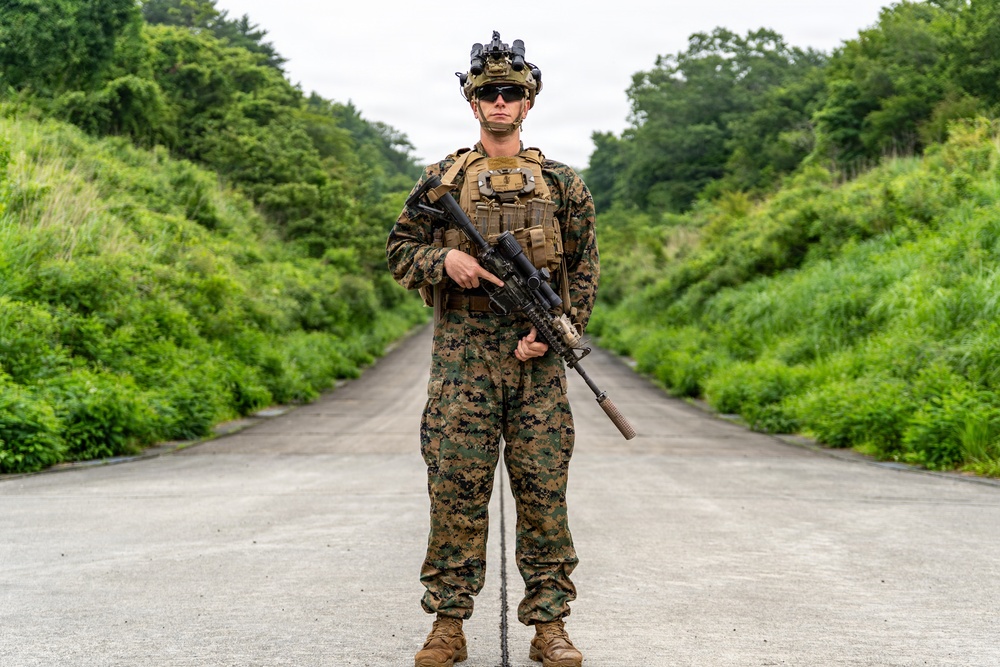
Photo By Lance Cpl. Oscar Ocampo | U.S. Marine Corps Cpl. Dalton Parnell, a squad leader with 2nd Battalion, 8th Marine...... read more read more
 Subscribe
CAMP SCHWAB, Japan —As Marines line up at the top of a rappel tower, Cpl. Dalton Parnell watches as they descend, sliding quickly down the rope. For many of them, it’s their first time rappelling since boot camp. For Parnell, it’s another chance to learn how to tackle the unique challenges of Okinawan training environments. As squad leader with 2nd Battalion, 8th Marine Regiment, Parnell is responsible for ensuring that he and his Marines are prepared and adaptable for any mission, in any environment.
“My main job is making sure my squad is doing the right thing and can accomplish whatever task we’re given,” Parnell said. “That means taking care of my guys and making sure they’re ready to go every day.”
Parnell, a native of North Carolina, is currently forward deployed with 4th Marine Regiment as part of the Marine Corps’ Unit Deployment Program, where units rotate through the Indo-Pacific to train in diverse and demanding conditions. For Parnell and his squad, the shift from Camp Lejeune’s wooded training areas to Okinawa’s dense jungle terrain has required both physical and mental adaptation.
“The environment is the biggest difference,” Parnell said. “Back home, it’s mostly woods. Out here, it’s thick jungle, steep hills, and cliffs. You can’t just go around obstacles, you’ve got to go through or over them.”
The terrain pushes Marines to hone skills like rappelling and traversing through the jungle. These training opportunities are less common in places like Camp Lejeune, North Carolina. Learning and gaining the knowledge to be proficient in a variety of environments builds the Marines’ confidence in their ability to perform no matter where they are.
For Parnell, some of the most rewarding moments in Okinawa don’t come from the training itself, but from watching his squad grow throughout the training. Seeing Marines overcome their fears, especially during fast-roping exercises has been a highlight. He’s watched his Marines adapt and overcome obstacles in a world-class training environment.
“A lot of these guys hadn’t done it since boot camp,” said Parnell. “Watching them get out there, push through it, and succeed together; it builds confidence and morale across the whole squad.”
As his unit continues training in Okinawa, Parnell says the biggest lesson he’ll take back to Camp Lejeune is the importance of being adaptable enough to succeed in any environment.
“You’ve got to be ready for any environment,” said Parnell. “Hot, humid, cold, it doesn’t matter. You have to be able to adjust and still get the job done.”
For Parnell and his Marines, that mindset is what ensures they remain ready to complete the mission in any clime and place that they’re called to next.
| Date Taken: | 04.20.2026 |
| Date Posted: | 07.13.2026 20:19 |
| Story ID: | 569862 |
| Location: | CAMP SCHWAB, OKINAWA, JP |
| Web Views: | 133 |
| Downloads: | 1 |

This work, Marine Increases Adaptability Through Training in Okinawa, by LCpl Alexander Canal, identified by DVIDS, must comply with the restrictions shown on https://www.dvidshub.net/about/copyright.

No keywords found.




