
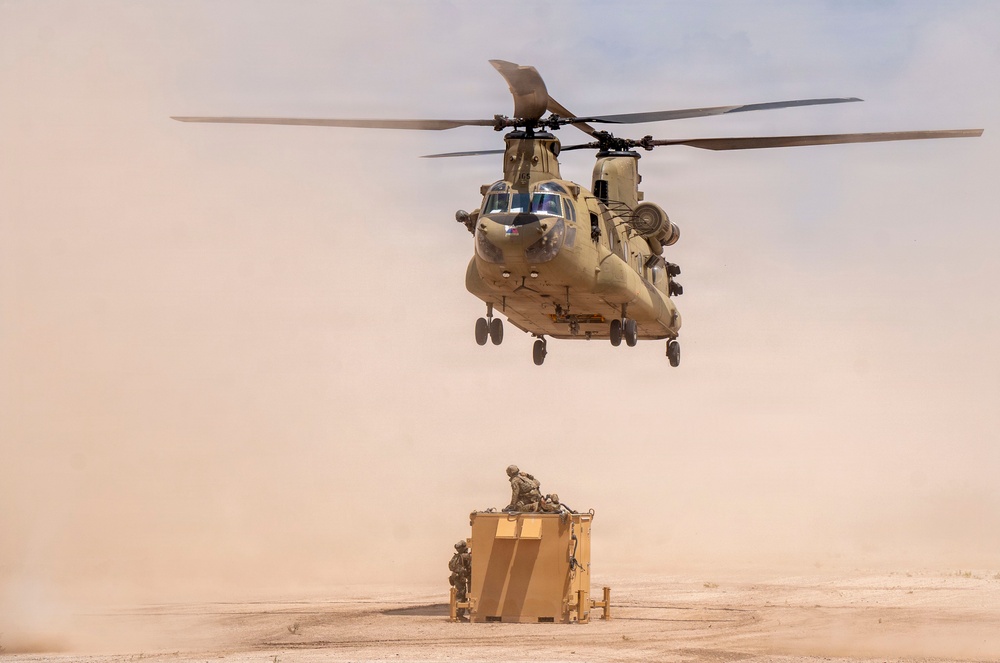
Photo By Sgt. 1st Class Kyle Larsen | A U.S. Army CH-47 Chinook helicopter with the Combat Aviation Brigade, 1st Armored...... read more read more
 Subscribe
BIG BEND, Texas – Soldiers assigned to Joint Task Force — Southern Border (JTF-SB) assisted U.S. Border Patrol by moving and replacing a damaged telecommunication networking system (TCNS) during Operation Muleskinner Trailblazer III, July 2, 2026. The team, composed of Soldiers from the 101st Airborne Division (Air Assault), 82nd Airborne Division, 10th Mountain Division and the 1st Armored Division, executed the sling load operation through austere conditions in the Big Bend Sector, getting key communication equipment through rough terrain.
The mission required extensive coordination and training to build cohesion within the task force. Before dropping the new TCNS up on the mountain, the team had to utilize their combined knowledge and skill to develop the most effective strategy to accomplish the task.
The Soldiers assisting with the operation trained for weeks before the execution, performing mission rehearsals on top of a container using a vehicle with a wrench to simulate a CH-47 Chinook Helicopter.
U.S. Army Sgt. Forest Stocking, the noncommissioned officer in charge of the operation and a pathfinder, a highly trained Soldier who establishes and operates drop zones and landing zones to guide aircraft and support airborne and air assault missions, assigned to 10th Mountain Division, ensured the Soldiers conducted the correct procedures in proper gear.
“It’s a big group of people but it comes down to the planning process and communication,” said Stocking. “We had to plan, advise and assist with brigade level command teams, pilots, all the way to the lowest level.”
Over the period of two weeks, the team focused on climatizing, by training in the heat, simulating the conditions expected during the execution. Soldiers rehearsed the process they would use on execution day by wearing combat gear, helmet, eye protection, and gloves to mock the conditions required.
“The train-up to the event was a rigorous week,” said 1st Lt. Nadim LissaHernadez, the officer in charge of the operation from the 82nd Airborne Division. LissaHernadez said both of his pathfinders took different teams on different loads, performing single and double hook ups on the cargo container.
Leading up to the operation, the team, consisting of CH-47 Chinook Helicopter pilots, officers, NCOs and Soldiers, conducted a combined arms rehearsal. During the rehearsal, 10th Mountain Division used a scaled terrain model to show leadership the step-by-step planned execution of the mission, highlighting key terrain features in the Big Bend Sector. During the rehearsal, the pilots explained the considerations needed to fly and deliver the new TCNS safely on top of the mountain.
After all the training and rehearsals, it was time to conduct the physical mission. At dusk, July 2, 2026, the team loaded the CH-47 Chinook to fly to the pickup zone where the new TCNS was staged. The team quickly found out while landing in Big Bend that the sand would be the most difficult obstacle to overcome.
“We come in pretty high, in order to not disturb the land and cause a dust storm,” said U.S. Army Warrant Officer 2 Leonard Seymore, CH-47 Chinook Helicopter pilot, “During the rehearsal, when we picked up from the dirt runway, we ran into a lot of dust." Seymore said the solution was to use a water truck to wet the dirt, significantly improving the dirt.
Even with the difficulty of lessened sight from the sand, the practice run went smoothly, leading to the successful execution of the sling load mission. The teamwork, focus and communication between the different units, led to successfully achieving a hook-up within 10 minutes, dropping the new TCNS on the mountain, and completing the mission within an hour.
The TCNS extends the communication capabilities of the U.S. Customs and Border Protection, Border Patrol and Joint Task Force—Southern Border personnel, enhancing the security of the Southern border along the frontier of freedom.
| Date Taken: | 12.31.1969 |
| Date Posted: | 07.20.2026 17:19 |
| Story ID: | 569754 |
| Location: | BIG BEND, TEXAS, US |
| Web Views: | 35 |
| Downloads: | 0 |

This work, JTF-SB successfully completes Operation Muleskinner Trailblazer III, extending communication through Big Bend Sector, by SSG Adelina Garcia, identified by DVIDS, must comply with the restrictions shown on https://www.dvidshub.net/about/copyright.


No keywords found.




