SRF-JRMC Boosts Fleet Readiness with a 360-Degree Tank Inspection System
Photo By Aya Stewart |
Master Labor Contract (MLC) employees from U.S. Naval Ship Repair Facility and Japan......read moreread more
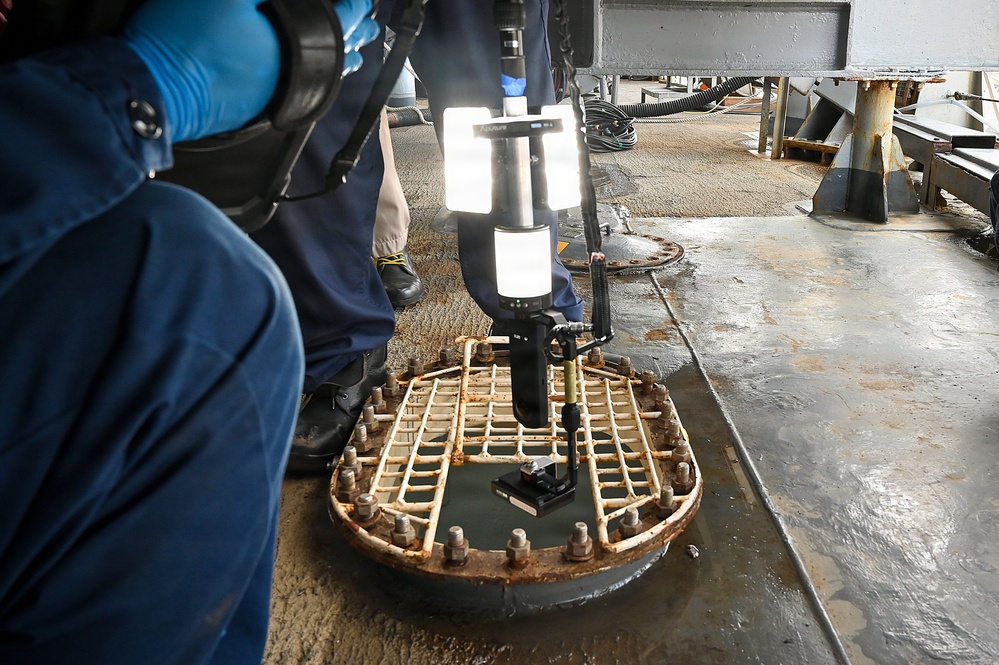
Photo By Aya Stewart | Master Labor Contract (MLC) employees from U.S. Naval Ship Repair Facility and Japan Regional Maintenance Center (SRF-JRMC) conduct a coating inspection of a void, on board a forward deployed ship at Commander Fleet Activities Yokosuka, using the Insertable Stalk Inspection System 360 (ISIS360) on Jun 21, 2026. In this picture a locally developed tank grating has been placed over the void entry which allows for insertion of the ISIS rig while preventing a fall hazard for personnel. For over 75 years, SRF-JRMC has been the linchpin of U.S. naval operations in the Pacific region by providing intermediate and depot-level repair for the ships of the U.S. 7th Fleet. (U.S. Navy Photo by Aya Stewart) see less
| View Image Page
SRF-JRMC Boosts Fleet Readiness with a 360-Degree Tank Inspection System
YOKOSUKA, Japan - The U.S. Naval Ship Repair Facility and Japan Regional Maintenance Center (SRF-JRMC) is revolutionizing how it maintains the U.S. 7th Fleet with the deployment of a shipboard tank and void inspection system that drastically reduces the time and risk of inspecting shipboard tanks. The U.S. Naval Research Laboratory (NRL) with CNRMC delivered the Insertable Stalk Inspection System 360 (ISIS360) to naval maintenance crews in Yokosuka and Sasebo, Japan, in May, transforming a weeks-long process into one that takes only a few hours.
Developed by the NRL, the ISIS360 is a portable system designed to assess the condition of the thousands of tanks and voids found on naval vessels without human entry. Traditionally, inspecting these confined spaces required sailors to drain fluids, clean and gas-free then physically enter potentially hazardous environments to erect scaffolding and bring in lighting. The new system removes the need for human entry, significantly improving personnel safety.
The technology consists of a compact, 360-degree camera mounted on an extendable pole (or stalk) and is inserted into a tank’s hatch. Maintenance teams on the ship's deck can remotely control the camera to view a live feed of the tank’s interior and conduct a thorough visual assessment.
At the heart of the system is software developed by the NRL that analyzes the high-resolution imagery. This Corrosion Detection Algorithm maps the tank’s internal structure and calculates the percentage of corrosion on its surfaces. By automating analysis, the software provides objective, repeatable data, removing human subjectivity that can vary between inspections and ensuring a consistent assessment standard across the entire fleet.
The adoption of ISIS360 has received positive feedback from maintenance leadership at SRF-JRMC. Kouji Koizumi, branch head for Yokosuka’s Corrosion Control Information Management Program, noted that the system has been "permanently adopted as a means of reducing costs and time for maintenance." While significant defects still require a follow-up human-entry assessment, Koizumi stated such incidents are "relatively rare," allowing the inspection process to be dramatically accelerated.
The integration of ISIS360 into SRF-JRMC’s maintenance workflow marks a significant step forward in the service's push for greater efficiency and readiness. By leveraging advanced camera systems and data analysis, SRF-JRMC can safely and rapidly identify and address the need for maintenance or repair in tanks in short windows of opportunity vice waiting to understand the tank and void conditions in the middle of a long maintenance window on a much more frequent basis.
For over 75 years, SRF-JRMC has been the linchpin of U.S. naval operations in the Pacific region by providing intermediate and depot-level repair for the ships of the U.S. 7th Fleet.