
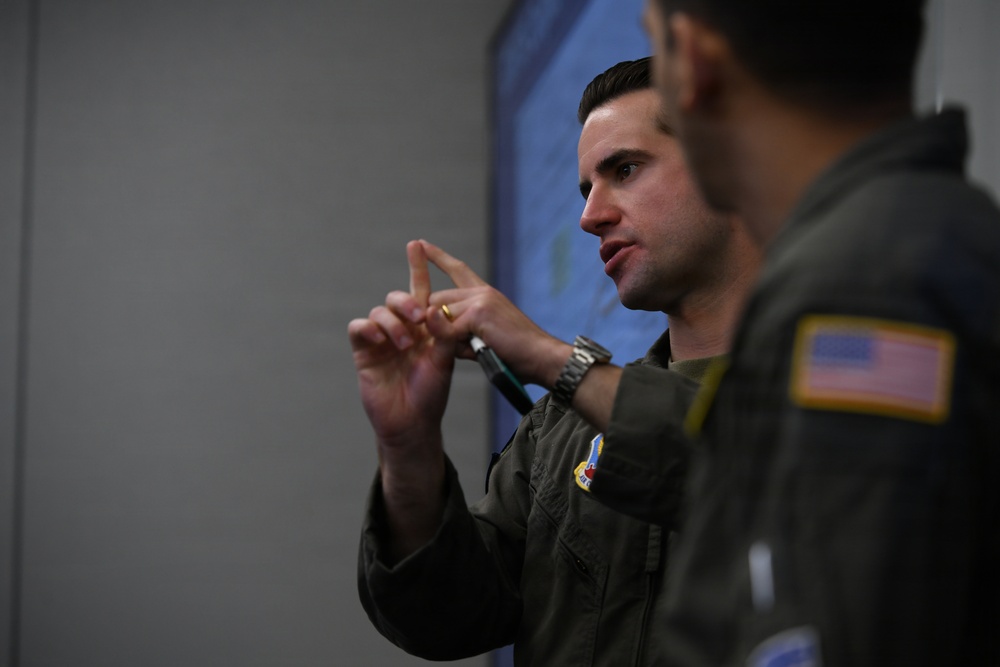
Photo By Senior Master Sgt. Julianne Sitterding | U.S. Air Force Capt. Michael Pufunt, 492nd Attack Squadron pilot instructor, teaches a...... read more read more
MARCH AIR RESERVE BASE, Calif. -- Students at the 163d Attack Wing Formal Training Unit learn to operate the MQ-9 Reaper aircraft in a challenging environment. Located in the complex Southern California civilian airspace, just getting to the training area requires daily integration to navigate and decipher intricate flight deconflictions and radio chatter.
Under guidance from FTU instructors, navigating these crowded skies becomes muscle memory for students.
"Southern California has some of the most congested and complex airspaces in the world," said Capt. Takashi Fujishin, 160th Attack Squadron pilot instructor. "Instead of learning to fly in a quiet military training area, our students are thrown right into the mix. They learn how to deconflict and communicate in a high-density environment from day one. If a student can confidently navigate an MQ-9 out of here, when they get to their combat units the airspace management feels easy by comparison."
Through Total Force Integration, the 160th Attack Squadron, comprised of California Air National Guardsmen, and the 492nd Attack Squadron, comprised of active-duty Airmen, work together to facilitate instruction at the FTU. Operating a remotely piloted aircraft in an area shared with commercial airliners and general aviation leaves no room for error. Despite these daily hazards and the challenges of teaching new students, the combined expertise of these instructors has resulted inyears of mishap-free operations, maintaining an exceptional flight safety record.
“Students have to really listen for our call sign in the busy chatter for instructions; all while flying, navigating and communicating with their sensor operator,” said Tech. Sgt. Christopher Tomasini, 160th ATKS sensor operator instructor.
After mastering the complexities of the local airspace, aircrews advance to integrating with ground forces.
The FTU has cultivated relationships with joint partners in the region to expand training beyond the standard syllabus. Through these connections, the unit routinely participates in joint interoperability events, including Service Level Training Exercises, Steel Knight, and the 11th Marines Fire Exercise, called FIREX.
"Last year, I completed the Weapons Training Officer certification course at Marine Corps Air Station Yuma. That experience prepared me to better train our students on how to integrate with the Marines,” said Tomasini. “During our last exercise, my student aircrews spotted artillery for the 11th Marine Regiment and dropped inert weapons with NATO-partner ground controllers. That kind of joint integration experience is invaluable for preparing our students."
This partnership creates a mutually beneficial training environment. While FTU students practice providing close air support, Marine units simultaneously train to use the MQ-9 to validate artillery hits and assess strike lethality.
“I am immensely proud of the caliber and adaptability of the students our team of instructors send out to frontline combat units,” said Lt. Col. Anthony Heiman, the 160th ATKS director of operations. “As our students transition from a training environment to combat units, it’s always a major test. We put them through rigorous preparation to ensure they are ready to lead and survive in highly contested domains.”
Operating in crowded airspace and integrating with joint partners requires instruction that goes beyond the standard syllabus. The 163d FTU cadre imparts an advanced level of Aeronautical Decision-Making essential for decentralized Mission Command, ensuring every graduate leaves as a combat-ready aviator prepared for the future fight.
| Date Taken: | 07.09.2026 |
| Date Posted: | 07.09.2026 17:11 |
| Story ID: | 569661 |
| Location: | MORENO VALLEY, CALIFORNIA, US |
| Web Views: | 345 |
| Downloads: | 0 |

This work, Formal Training Unit Produces Aircrews Skilled Beyond the Curriculum, by SMSgt Julianne Sitterding, identified by DVIDS, must comply with the restrictions shown on https://www.dvidshub.net/about/copyright.


No keywords found.





