
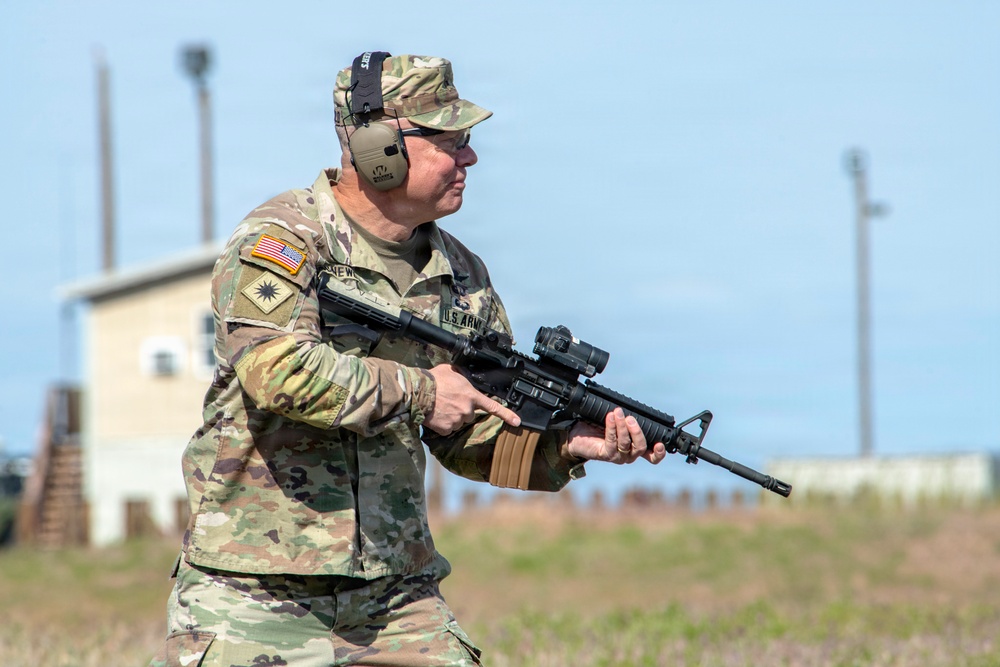
Photo By John Hughel | Brig. Gen. Alan R. Gronewold, Adjutant General, Oregon, takes part in the annual...... read more read more
 Subscribe
Our Lines of Effort: People, Culture, Readiness and Partnerships
By Brig. Gen. Alan R. Gronewold, Adjutant General, Oregon National Guard
Summer is here — and with it comes more daylight, more opportunity, and more responsibility. It is a signal to our entire organization that the time to prepare, to train, and to execute is now. The days ahead belong to those who are ready for them.
I recently had the privilege of meeting with our senior leaders at the Joint Senior Leader Workshop, and I want to share some of what we discussed, because the direction I provide to our senior leaders ultimately flows down to every Soldier, Airman, and civilian in this organization, and you deserve to understand the “why” behind the “what”. My commander’s intent is clear: we are building the Service of Choice — an organization of winning units of trained, ready, connected people who are proud to serve Oregon and our nation. Every decision you make, and every action you take as a leader, should be filtered through that lens. If it moves us toward that end state, do it. If it doesn’t, stop and reassess.
At the Joint Senior Leader Workshop, I introduced updates to our organizational design. These changes are not changes for the sake of change — they are deliberately aligned to support our operational mission and our strategic plan. Every adjustment in structure is intended to create clearer lines of responsibility, reduce friction, and ensure that our resources are focused where they produce the greatest readiness impact. Structure exists to serve the mission. If it doesn’t, we fix it.
Our Lines of Effort — People and Culture, Readiness, and Partnerships — remain the framework that guides how we invest our time, people, and resources. The task organization adjustments I’ve made are designed to operationalize those lines of effort more effectively across the force.
One of the most important leadership concepts we discussed at JSLW was disciplined initiative. I do not want an organization that waits for explicit direction at every turn. I want leaders who understand commander’s intent, understand the mission, and act decisively within their authority to move us forward — even when the situation is ambiguous.
Annual Training is the cornerstone of individual and collective readiness. It is our most concentrated window to sharpen our skills, train to standard, and build the unit cohesion that makes us capable in any environment. I challenge every leader at every level to treat AT preparation as a command priority — not an afterthought. Arrive ready to train, not ready to get ready to train. Know your task, know your standard, and hold your formation accountable to both.
Units with good culture and climate don’t have recruiting and retention problems. Units that train hard, train safely, and look out for one another — those are the units that Soldiers and Airmen choose to stay in. AT and other specialized exercises are opportunities to build that culture, and I expect our leaders to treat them that way.
As our operational tempo increases with the training season, I want to be direct: Safety is not a condition we sacrifice for speed or schedule. The risk of accidents and injuries rises when units are fatigued, rushed, or not paying attention. Our strategy relies on engaging training to build a sense of fulfillment. However, realistic and rigorous training must never come at the cost of the safety of our people.
People First is an operational imperative demanding rigorous risk management. Safety in training is a fundamental leadership responsibility at every echelon. As we increase the complexity of training to meet modern threats, we must equally elevate safety protocols. I expect every leader to conduct thorough risk assessments, enforce standards, and create an environment where Soldiers and Airmen feel empowered to speak up when conditions are unsafe. We do not cut corners. Incorporating risk assessments, enforcing standard operating procedures, and empowering every Soldier and Airman to call a halt when conditions become unsafe are nonnegotiable standards. We cannot serve Oregon or our nation from the sidelines — protect your people. When we protect our people, we build trust, directly meeting our goal.
Our nation commemorates its 250th anniversary on July 4th. We honor those original Minutemen and our lineage of service. Before the Declaration of Independence was signed, the militia stood ready to defend communities. The uniform you wear represents a quarter millennium of sacrifice, resilience, and commitment to freedom. The strategy we execute today and the safety standards we uphold honor those who served before us. We build a modern, ready force to ensure this legacy endures. Stay focused. Stay safe. Lead with purpose. Be Connected. Be Competent. Be Committed. These are not just words on a slide — they are the standard of leadership I expect from every person in this organization. Summer brings with it renewed energy and renewed purpose. Let’s use every day of it.
Always Ready, Always There!
------------------------------------------------------------------------------------------------
Honored to serve as the voice of the Enlisted Force to The Adjutant General
Command Chief Master Sergeant Brent W. Cavanis, Command Senior Enlisted Leader
As we move into Summer, there have been many senior enlisted moves in the Oregon National Guard. As our new Command Senior Enlisted Leader, I’ve been on the job for about a month now and am humbled and honored to serve as the voice of the enlisted force to TAG. Tough to follow Command Sgt. Maj. Smith, who was an incredible CSEL during his tenure. His regard for the welfare and development of our enlisted force was at the forefront of his words and actions. I’m no Lee Smith, but I’ll do my best to continue building on his work and that of the Command Senior Enlisted Leaders who came before him.
Some other updates on key enlisted leadership moves: Chief Master Sgt. Darron Forbes is coming up from the 142nd Wing Command Chief to serve as the next Oregon Air National Guard State Command Chief. Command Sgt. Maj. Robert Bertilson has moved up from the 82nd BDE CSM to serve as the Oregon Army National Guard State Sergeant Major. I am reluctant to tell you how many years of service our combined years add up to, but let’s just say there are some experienced SNCOs to represent our enlisted force and advise senior leaders! Both the 142nd and 173rd Wings are currently selecting new Command Chiefs, and both brigades have new CSMs.
All of those moves result in a domino effect of additional leadership moves, and so it goes in the organizational cycle of retirements and assignments. As we are in a period of significant movement in key enlisted leadership positions, I want to affirm to you that we are committed to working together to advocate for and improve health, morale, welfare, and quality-of-life programs for our enlisted force while maintaining a focus on individual and unit readiness.
Effective communication is a challenge in all organizations, so one way to reach a broader audience from my lane will be to restart the ORNG CSEL podcast that Chief Dan Conner produced during his tenure. While that is one-way communication, to be an effective voice of the enlisted force, I’ll need to address field-driven issues to reach my level.
The primary means of this is connection through enlisted leadership channels - First Sergeants, Sergeants Major, and Chiefs are the primary interface in facilitating communications from the unit to HQs. I also encourage you to use your enlisted councils and professional associations, such as EANGOR, to vector issues to my level. I look forward to battlefield circulation and unit visits to hear directly from our enlisted force. In today’s world, effective communication requires using multiple media and options. While the chain of command is primary, it must be appropriately supplemented with the other means of communication at our disposal.
In closing, I look forward to the opportunity to have candid conversations and hear from the Soldiers and Airmen of the Oregon National Guard. While we focus on mission and readiness, the combined voice of the senior enlisted of the Oregon National Guard has the potential to influence issues of mutual concern, backed by the decades of competence and commitment of the NCO Corps. When we are connected and unified in our efforts on behalf of your soldiers, airmen, and families, there’s no limit to what we can achieve.
| Date Taken: | 07.03.2026 |
| Date Posted: | 07.09.2026 13:28 |
| Story ID: | 569641 |
| Location: | SALEM, OREGON, US |
| Web Views: | 86 |
| Downloads: | 0 |

This work, Our Lines of Effort : People, Culture, Readiness and Partnerships, must comply with the restrictions shown on https://www.dvidshub.net/about/copyright.

No keywords found.




