
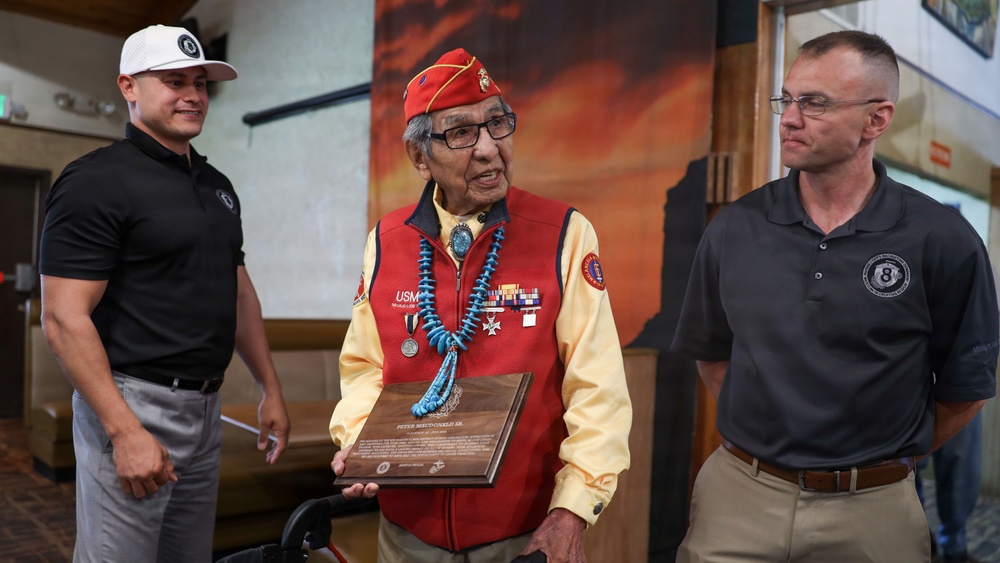
Photo By Staff Sgt. Jacqueline Melendez | Peter MacDonald Sr., a World War II Navajo Code Talker, speaks with Master Gunnery...... read more read more
TUBA CITY, Ariz. — U.S. Marines with the 8th Marine Corps District, Western Recruiting Region's Pipehitters received a presentation from World War II Navajo Code Talker Peter MacDonald Sr. at the Navajo Code Talkers Museum in Tuba City, Arizona, providing a firsthand perspective on one of the Marine Corps' most significant contributions to Allied victory during World War II.
The presentation gave Marines the opportunity to hear directly from one of the last surviving Navajo Code Talkers, whose service helped establish one of the most secure military communication systems in history. Throughout the discussion, MacDonald reflected on his experiences as a young Marine, the creation of the Navajo Code, and the importance of preserving the legacy of the Navajo Code Talkers for future generations.
In 1942, the Marine Corps recruited 29 Navajo Marines to develop a secure communications system using the Navajo language. The resulting code combined traditional Navajo words with specially created military terminology to represent letters, equipment, aircraft, ships, and battlefield operations. Because of the language's complexity and the need to memorize the code, it was never deciphered by Japanese forces during the war.
More than 400 Navajo Marines eventually served as Code Talkers throughout the Pacific Theater, transmitting thousands of tactical messages during major campaigns including Guadalcanal, Tarawa, Saipan, Peleliu, Iwo Jima, and Okinawa. Their ability to relay encrypted battlefield communications within seconds enabled commanders to coordinate troop movements and combat operations while denying the enemy critical intelligence.
MacDonald enlisted in the Marine Corps as a teenager and later completed communications training before becoming a Navajo Code Talker. He served in the Pacific Theater during World War II and has since dedicated his life to preserving the history of the Navajo Code Talkers through public speaking, education, and his leadership at the Navajo Code Talkers Museum.
Following the presentation, Marines toured museum exhibits highlighting the development of the Navajo Code, historical photographs of the original Code Talkers, wartime artifacts, and documents detailing the program's impact on the Pacific campaign. MacDonald also met individually with the Marines, signed copies of his book, and discussed the importance of leadership, service, and carrying forward the legacy of those who came before them.
The visit reinforced the Marine Corps' commitment to preserving its history and honoring the service of those whose courage, innovation, and dedication helped shape the outcome of World War II. By hearing directly from MacDonald, the Marines gained a deeper appreciation for the sacrifices of the Navajo Code Talkers and the enduring impact of their service on the Corps today.
| Date Taken: | 07.08.2026 |
| Date Posted: | 07.14.2026 10:46 |
| Story ID: | 569617 |
| Location: | TUBA CITY, ARIZONA, US |
| Web Views: | 168 |
| Downloads: | 0 |

This work, Navajo Code Talker Peter MacDonald Sr. shares Marine Corps legacy with 8th Marine Corps District Pipehitters, by SSgt Jacqueline Melendez, identified by DVIDS, must comply with the restrictions shown on https://www.dvidshub.net/about/copyright.

No keywords found.





