
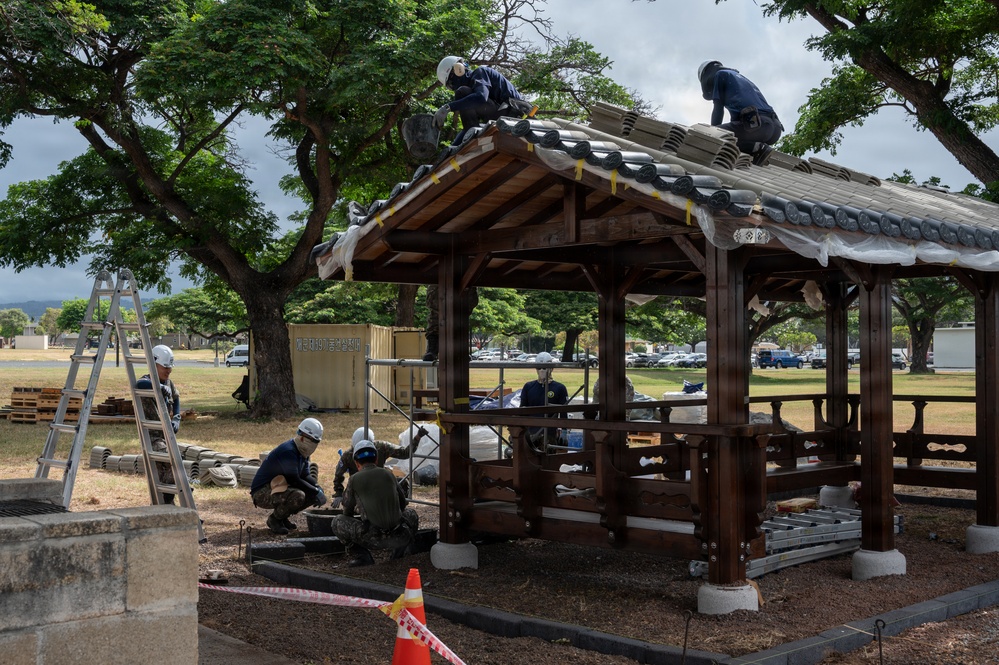
Photo By Jessica Vos | Republic of Korea Navy sailors build a pagoda at Joint Base Pearl Harbor-Hickam,...... read more read more
 Subscribe
Sailors assigned to Naval Construction Battalion 25 based out of Port Hueneme, Calif., worked alongside Republic of Korea (ROK) Service Members and U.S. Marines during Exercise Rim of the Pacific (RIMPAC) 2026 to complete a concrete demolition and site preparation project and construction of the Su-Hyang-Jeong gazebo.
The crew demolished a damaged concrete pad measuring approximately 75 by 40 feet before grading, compacting and preparing the site for a follow-on concrete pour during RIMPAC. The project restored critical infrastructure, served as a hands-on training opportunity that allowed service members from multiple nations to hone construction skills while learning to operate together, building interoperability and partnership.
"The importance of this project is that we have Marines, Republic of Korea service members and Seabees all working together," said Equipment Operator 1st Class Anderson, assigned to Naval Construction Battalion 25. "It's about building partnerships and relationships."
Senior Chief Petty Officer Matthew Mangum, senior enlisted leader for the project and assigned to Naval Construction Battalion 25, said the construction effort represents far more than completing a single engineering project.
"The reason for doing this is base enhancements, but also joint partnership and training. That's what RIMPAC is about," Mangum said.
Although language differences would typically be a barrier during a multinational project, Anderson said the team quickly established an effective workflow through demonstrations, and clear communication.
"Once we got over the language barrier, we showed them the scope of the project and what we wanted to accomplish," Anderson said. "Since then, it's been seamless." The construction mission requires several pieces of heavy equipment, including backhoes equipped with hydraulic breakers to fracture the concrete, an excavator to remove reinforced sections containing steel, and a skid steer for final grading operations.
Like many engineering missions, the project has not been without obstacles. Equipment breakdowns forced the team to adapt while maintaining progress toward mission completion.
"We've had breakdowns, but the Seabee motto is Can Do. We found creative ways to work around those issues and keep the project moving," said Anderson. Beyond just getting the project done, Anderson emphasized that the greatest value of the project lies in the training it provides to both junior and international service members.
"It makes our junior Sailors, Marines and Republic of Korea partners more efficient because it's a training evolution," Anderson said. "The next time they go on a concrete mission, they'll already understand what's required."
The experience also prepares participants for future deployments and missions where construction tasks may need to be completed under demanding conditions.
"When we're deployed, it may not be a training environment we may have to go," Anderson said. "The knowledge they're gaining here transfers directly to future missions and helps operations run more smoothly."
Working alongside international partners also provides opportunities to better understand different cultures, communication styles and problem-solving approaches.
"It's exciting learning how other countries do things," Anderson said. "You learn about their culture, you build rapport, and you realize that everyone is working towards the same goal."
Mangum said working alongside ROK forces reinforces the long-standing partnerships that make multinational exercises successful.
"A lot of times people don't understand the actual partnership we have with these other nations," Mangum said. "The fact that we come here during RIMPAC and work hand in hand with these other countries is huge."
For ROK Navy Petty Officer 3rd Class Park Jun, an engineer supporting the project, RIMPAC has provided a unique opportunity to work alongside military members from around the world.
"I have never experienced so many countries coming to the same place and working together," Park said. "It is a very special experience for me."
Park said training together before future operations is essential because allied nations often bring different languages, cultures and operating procedures.
"Working together during exercises like RIMPAC improves our ability to operate together," Park said. "That's why RIMPAC is important."
This project came to a close with a ribbon cutting ceremony on July 14, 2026. The ceremony did more than just signify completion, it celebrated the hard work, dedication, and partnership that was built during this mission. The construction of the Su-Hyang-Jeong gazebo and the concrete pad demolish show the importance of RIMPAC and its ability to foster interoperability, teamwork, and partnership.
| Date Taken: | 07.06.2026 |
| Date Posted: | 07.15.2026 19:49 |
| Story ID: | 569591 |
| Location: | FORD ISLAND, HAWAII, US |
| Web Views: | 20 |
| Downloads: | 0 |

This work, Navy Seabees, ROK Military and U.S. Marines strengthen partnerships through RIMPAC 2026 construction project, by SGT David FitzPatrick, identified by DVIDS, must comply with the restrictions shown on https://www.dvidshub.net/about/copyright.


No keywords found.




