
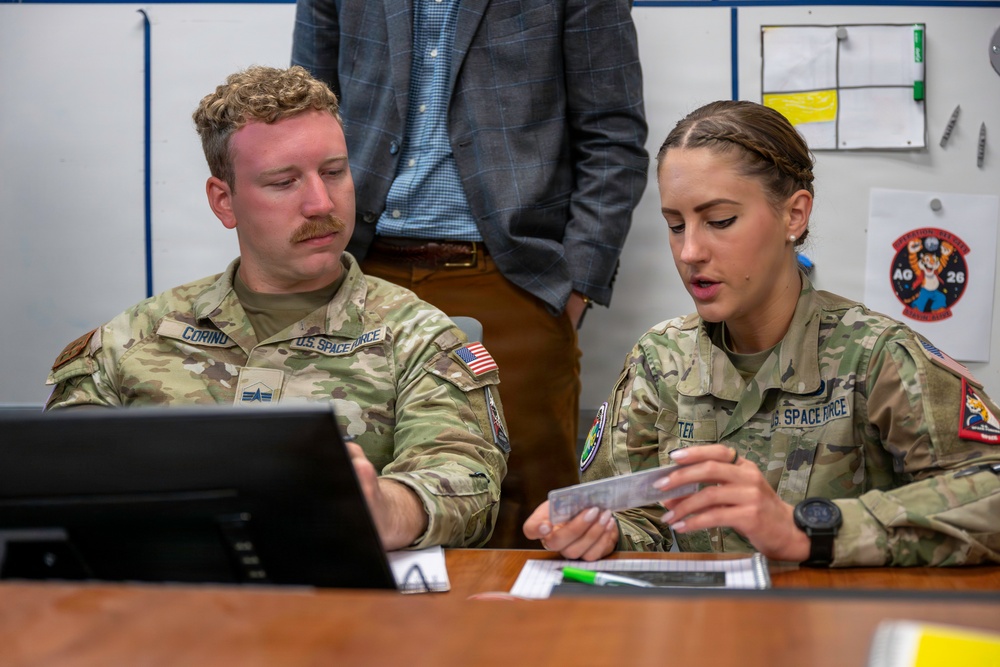
Photo By David Dozoretz | U.S. Space Force Spc. 4 Jake Corino, 74th Intelligence, Surveillance and...... read more read more
Securing the critical space-based capabilities the Joint Force relies on daily requires constant vigilance and tactical evolution. The Space Tactics Analysis Team Working Group 2026 (SpaceTAT’26), hosted by the U.S. Space Force’s Tactics and Adversary Studies Element, convened here at U.S. Space Forces-Space (S4S) headquarters June 24 to July 1, to focus on ensuring potential adversaries fail to exploit vulnerabilities in the domain.
The extensive planning and coordination required to execute the event was spearheaded by the U.S. Space Force’s Combat Forces Command (CFC)—the field command responsible for training and generating combat-ready forces—alongside staff from S4S, the service component field command to U.S. Space Command that employs those forces in day-to-day global mission execution.
The working group brought together U.S. and Five Eyes coalition space operators, system experts, and intelligence professionals to turn raw threat intelligence into an operational advantage.
“Space superiority begins with understanding the threat,” said U.S. Space Force Capt. Nathaniel Hlavin, Mission Delta 9 orbital warfare weapons officer. “SpaceTAT transforms intelligence into warfighting tactics that give Guardians and our allies the operational advantage they need to deter aggression and, if necessary, fight and win.”
Building that operational advantage requires breaking down traditional silos and fusing the expertise of different space disciplines.
“Whether addressing orbital warfare or satellite communications, we are bringing operators and analysts together to solve the challenges that require our deepest focus and investment,” said U.S. Space Force Master Sgt. Jesse Silveira, CFC lead intelligence coordinator for the event. “SpaceTAT executes a clear vision to deliver actionable solutions directly to the formation.”
To deliver those solutions, participants studied historical intelligence during the event to map adversary tactics, techniques, and procedures. Operators then translated those findings into practical defensive options, outlining the precise satellite maneuvers and system adjustments needed to counter specific orbital threats. The team then identified non-materiel and materiel solutions—ranging from updated training guidelines to immediate software modifications—providing “fight tonight” solutions while also informing future force design.
This work directly shapes the future of Space Force training and tactics. Moving forward, teams will share these critical findings with units across the enterprise, ensuring Guardians are prepared to effectively counter evolving adversary capabilities.
Since space is a contested global domain, defending it requires close coordination with international allies. Working alongside the United Kingdom, Canada, New Zealand, and Australia, participants built a shared playbook to ensure coalition forces can respond to threats seamlessly as an integrated global defense.
SpaceTAT’26 also sets the stage for the annual Weapons and Tactics Conference (WEPTAC) held each August. While WEPTAC helps senior leaders shape future capabilities, SpaceTAT provides the immediate tactical foundation—equipping today’s Guardians to counter today’s threats.
Following the week of analysis, teams presented their findings to senior leaders, including U.S. Space Force Lt. Gen. Gregory J. Gagnon, CFC commander, and Royal Canadian Air Force Maj. Gen. Kyle C. Paul, U.S. Space Command’s deputy Combined Joint Force Space Component commander.
| Date Taken: | 07.08.2026 |
| Date Posted: | 07.08.2026 16:37 |
| Story ID: | 569580 |
| Location: | VANDENBERG AIR FORCE BASE, CALIFORNIA, US |
| Web Views: | 34 |
| Downloads: | 0 |

This work, Turning Intelligence into Advantage: U.S., Coalition Forces Convene for SpaceTAT '26, by Stacie Shafran, identified by DVIDS, must comply with the restrictions shown on https://www.dvidshub.net/about/copyright.


No keywords found.





