
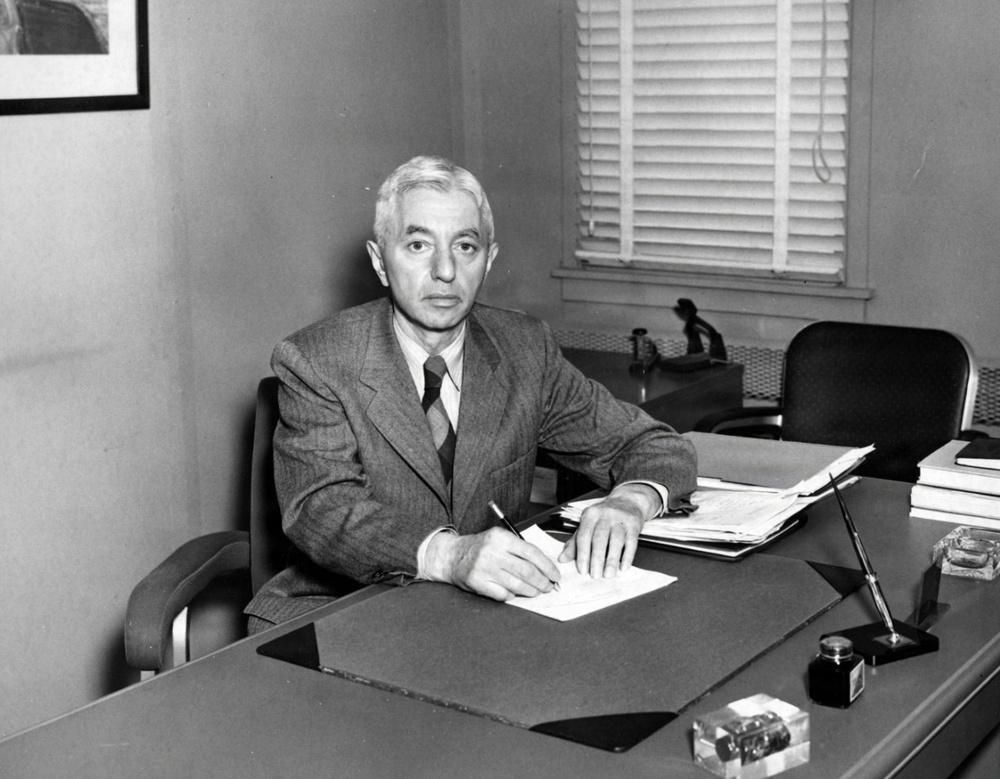
Photo By Rachel Rakoff | UA 463.02.01 Admiral Hyman Rickover Photo Collection A picture of Adm. Hyman...... read more read more
 Subscribe
Admiral Hyman G. Rickover, colloquially known as the “Father of Nuclear Navy,” is best known for spearheading the creation of the U.S. Navy's nuclear submarine force and overseeing the development of the world's first atomic-powered submarine, USS Nautilus (SSN-571). Nautilus, launched in January 1954, marked the beginning of the U.S. Navy's modern "silent service" and laid the foundation for the most survivable element of the nation’s nuclear strike force. Rickover’s cantankerous personality, demanding standards, and unmatched drive played a significant role in making the U.S. Navy the unrivaled leader in undersea warfare for nearly three quarters of a century.
The Early Years
Hyman George Rickover was born into a Jewish family in Maków Mazowiecki, a Russian-occupied Polish town on Jan. 27, 1900. In 1905, his family fled the Russian pogroms and initially settled in New York City, before relocating to Chicago, where his father worked as a tailor. Rickover started his first job when he was just nine years old, and by the time he was in high school he had a job delivering telegrams for Western Union. Rickover was determined to pursue higher education but knew that his parents could not afford college tuition. The solution arrived in 1918, when Rep. Adolph Sabath (D-Ill.) nominated Rickover for appointment to the United States Naval Academy in Annapolis.
Rickover passed the entrance exam and began his career in the U.S. Navy in June 1918. He commissioned as an ensign four years later when he graduated as part of the Naval Academy Class of 1922.
He spent the next 63 years on active duty in the U.S. Navy, serving on a destroyer, a battleship, several submarines, and even commanding a minesweeper before transitioning to focus on electrical systems and engineering. He was selected for “Engineering Duty Only” (EDO) in 1937, and a few years later he became the assistant chief of the Electrical Section of the Bureau of Ships.
In June 1945, Rickover was assigned to the Atomic Energy Facility in Oak Ridge, Tennessee. The Bureau of Ships chose Rickover and four other officers to join a select group tasked with developing an experimental power reactor proposed by Farrington Daniels, one of the leading chemists of the Manhattan Project.
In 1948, the Navy created the new Nuclear Power Branch with Rickover at the head of the Bureau’s Research Division. In February 1949, he was assigned to the Division of Reactor Development, U.S. Atomic Energy Commission and assumed the role of Director of the Naval Reactors Branch for the Bureau of Ships. This unique “dual-hatted” position allowed him to spearhead the development of the world's first nuclear powered submarine, USS-Nautilus (SSN-571).
Rickover attended the keel-laying ceremony for the USS Nautilus (SSN-571) in Groton, Conn. in 1952. Less than three years later, on January 17, 1955, the submarine sent the historic words that would define the new era of Navy submarines: “Underway on Nuclear Power.”
The Man in Charge
Rickover was known to disdain formalities and rules; during an interview with Diane Sawyer for 60 Minutes, he said, “We never had a book of Navy regulations in my office. I prohibited it. One time some guy brought it in, and I told him to get the hell out and bum it…for Chrissake, what the hell is there about standing up and saluting and dressing up in uniform? You can put dummies to do that job.”
Rickover was adamant that as long as a Sailor knew what their job was, they did not need a book of regulations. He nearly always wore civilian clothing and believed that technical competency was more important than formality. Above all, he demanded excellence and was a staunch believer in individual responsibility.
“Responsibility is a unique concept,” testified Rickover during the 1961 Hearings Before the Joint Committee on Atomic Energy. “If responsibility is rightfully yours, no evasion, or ignorance or passing the blame can shift the burden to someone else. Unless you can point your finger at the man who is responsible when something goes wrong, then you have never had anyone really responsible.”
Rickover criticized the absence of individual responsibility at all levels of society, not just among his students or military personnel. He was outspoken in his criticisms of government, even going so far as to coin an expression – “Say-do” – and explaining:
“All you have to do is say that you will do something and you get lots of applause. You hear that all the time from the executive branch. You do nothing, yet you get the credit. It is a very interesting phenomenon that nobody ever follows up to see if the action has been taken. I see this petty trick going on all the time. People say something. The newspapers laud them before they have done a single thing. Then they never do it and go on to some other "Say-Do" thing and get more credit. Pretty soon they become important public figures who are always saving taxpayers' money; yet they have never produced any product or effected any saving. I am like Diogenes. I have been looking vainly for those who actually do what they say.”
Firm in his conviction that “to be educated is to be made better,” Rickover often criticized and lamented the state of American educational institutions, arguing that extracurriculars and athletics were a distraction and detracted from the primary purpose of schooling. At the time of his graduation from Annapolis in 1922, the Naval Academy’s curriculum was largely professional and technically focused. It emphasized science, engineering, and ordnance, while requiring only one English, History and Government final humanities paper.
To ensure that potential candidates for the nuclear power training program met his exacting standards, Rickover personally interviewed every single one. All of the new Naval Academy or Officer Candidate School graduates, as well as any other naval officers who sought entry into the nuclear program had to obtain his approval. He was notorious for his unconventional interview methods, which included having prospective students complete their interview while sitting in a chair that had several inches sawed off the front legs to make them physically uncomfortable. Rickover subjected candidates to intense, abrasive questioning in an effort to force them to demonstrate calmness under pressure and a commitment to the exacting standards he demanded from those to whom he would entrust the maintenance of nuclear reactors.
After Rickover attained the rank of rear admiral in July 1953, Congress promoted him to the rank of vice admiral in October 1958. When Rickover finally retired with the rank of admiral in 1982, his career spanned the administrations of 13 presidents.
His Legacy
Given the importance Rickover attached to education, it is fitting that several educational facilities bear his name today including, Hyman G. Rickover Naval Academy and the U.S. Naval Academy’s “Engineering Studies Complex,” which was completed and named for Rickover in 1975.
The submarine, USS Hyman G. Rickover (SSN-709) was launched in August 1983 and sponsored by Rickover’s wife, Cmdr. Eleonore Bednowicz Rickover, USN (Ret.). A second nuclear submarine named for the admiral, USS Hyman G. Rickover (SSN-795) was commissioned in October 2023.
Rickover died in Arlington, Va., on July 8, 1986, at the age of 86.
| Date Taken: | 07.08.2026 |
| Date Posted: | 07.08.2026 14:17 |
| Story ID: | 569560 |
| Location: | US |
| Web Views: | 224 |
| Downloads: | 0 |

This work, More Than His Moniker: Admiral Hyman G. Rickover, by Rachel Rakoff, identified by DVIDS, must comply with the restrictions shown on https://www.dvidshub.net/about/copyright.

No keywords found.




