
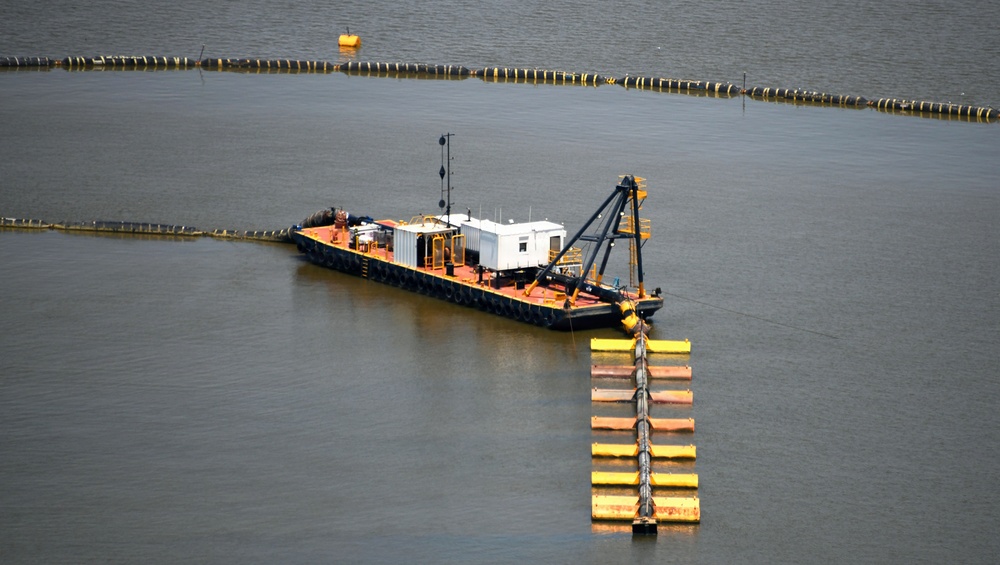
Photo By Charles Walker | A dredge performs maintenance work in the Mobile Harbor, Mobile, Alabama, June 3,...... read more read more
MOBILE, Ala. — The U.S. Army Corps of Engineers (USACE), Mobile District incorporates Regional Sediment Management (RSM) and Beneficial Use (BU), including Thin-Layer Placement (TLP), as part of its sediment management strategy for dredging operations, keeping vital sediment within the bay contributing to systems natural sediment processes.
Valerie Morrow, USACE Mobile District Dredge Material Program Manager, said that is exactly what the Mobile District is doing in Mobile Bay. "The material dredged from the federal navigation channel is natural sediment and a resource that should be managed intentionally. Thin-layer placement is an intentional placement practice that is a beneficial use of dredged material and is in alignment with the 'Expanding Beneficial Use of Dredged Material in USACE' memo dated August 28, 2023."
Today’s sediment management strategy builds on more than two decades of engineering innovation, RSM research, interagency collaboration and monitoring that transformed beneficial use from individual demonstration projects into a long-term management approach.
“Beneficial use is often most successful when it becomes part of a collaborative regional sediment management strategy,” said Elizabeth Godsey, a Regional Sediment Management technical lead with the USACE. “Rather than asking where dredge material can be placed, we ask where sediment is needed within a natural system. Collaboration, sound science and engineering analyses help identify placement strategies that support economically viable and environmentally sustainable solutions.”
The Historical Challenge: Losing Ground From 1986 to 2011, maintaining the Mobile Harbor Navigation Project meant annually removing over four million cubic yards (MCY) of maintenance material from Mobile Bay. Hopper dredges hauled this sediment out to the Ocean Dredged Material Disposal Site (ODMDS) in the Gulf; a practice that permanently removed sediment from the bay system.
History highlighted what would soon be realized by many as a large engineering challenge: Is hauling 4 million cubic yards of material offshore the right thing to do? Rather than continually removing sediment from the estuary, could navigation maintenance be accomplished while keeping sediment working with the natural system?
Forging a New Template: The Interagency Working Group
Beginning in the early 2000s, RSM initiatives had begun shifting the conversation from managing individual dredging projects to managing sediment as a regional resource. Engineering studies, sediment budgets, hydrodynamic and sediment transport modeling, long-term monitoring and lessons learned from coastal inlets demonstrated that sediment functions as part of an interconnected natural system and should be managed at a systemwide level.
Building off this, Mobile District along with stakeholders and partners established a collaborative framework for evaluating sediment management decisions on the scale of the Mobile Bay system. This system-based approach emphasized using science and engineering to identify where dredged sediment could provide the greatest long-term navigation and environmentally sound solutions.
In 2011, that collaborative framework was formalized through the Mobile Bay Interagency Working Group (IWG), bringing together entities responsible for navigation, natural resources, environmental stewardship and coastal resilience. Rather than evaluating projects independently, the IWG provided a forum for integrating engineering analyses, environmental considerations and operational needs into regional sediment management decisions.
Using science, engineering analyses and monitoring the group identified opportunities to transition beneficial use from isolated demonstration projects into routine operations. Early collaboration efforts included several Beneficial Use (BU) ideas authorized under WRDA 96, including:
These efforts demonstrated that beneficial use could become an integral component of routine navigation channel maintenance while supporting environmental sustainability.
“Beneficial use is about more than finding a place to put dredged material,” said Jason Kudulis, Director of the Mobile Bay National Estuary Program. “Through the Beneficial Use Interagency Working Group, agencies are working together to develop long-term, regional strategies that restore habitat, improve coastal resilience, and make the best possible use of this valuable resource.”
Innovative Solutions: The Thin-Layer Placement Demo
The most critical breakthrough came when the team pursued a one-time demonstration of Thin-Layer Placement (TLP) using a hydraulic cutterhead dredge. The demo involved pumping approximately 9 MCY of bay material in a thin lift—just 6 inches, not exceeding 12 inches—over the adjacent bay flats.
To answer the critical question, "Where did the material go after placement?" the Engineer Research and Development Center (ERDC) and Mobile District deployed 3D hydrodynamic and sediment transport modeling, Particle Imaging Camera System (PICS), Sedflume, and other advanced tools.
The results were highly encouraging:
A Win for the System
The modeling, monitoring and engineering analysis demonstrated that thin-layer placement could safely retain dredged sediment within the Mobile Bay’s natural sediment system while meeting navigation and environmental objectives. Based on these findings, the IGW unanimous supported in-bay placement as an environmentally acceptable alternative to offshore disposal. On June 30, 2014, water quality certification and coastal zone consistency were issued allowing the routine in-bay placement of operations and maintenance (O&M) material from the Mobile Ship Channel.
This decision marked a fundamental shift in sediment management philosophy. Rather than viewing dredged sediment as a simple byproduct requiring disposal, Mobile District began managing sediment as a valuable natural resource.
Operationally, the approach expanded the Corps’ ability to use cutterhead dredges, reducing the reliance on the limited hopper dredge fleet while improving placement efficiency and lowering the cost to the nation. Strategically placing sediment farther from the channel margins also reduces the likelihood or material transporting back into the navigation channel in a manner which promotes a much faster recovery of benthic communities.
Kudulis said MBNEP continues to work with the USACE Mobile District to find solutions for the use of dredged material.
"The Mobile Bay National Estuary Program works closely with the U.S. Army Corps of Engineers, Mobile District, and our partners through the Beneficial Use Interagency Working Group to identify long-term opportunities for dredged material," Kudulis said. "Together, we're identifying opportunities to restore marshes and other habitats by returning valuable sediment to places where it can provide the greatest benefits."
Strategy Comparison: Old vs. New Management
More than two decades of scientific research, engineering, monitoring and collaboration transformed how one of the systems’ most valuable resources, its sediment, is managed in Mobile Bay. What began as a question of whether maintenance dredging could be accomplished without removal of sediment from the estuary evolved into development of an RSM strategy.
Today, Mobile District continues to evaluate beneficial use opportunities throughout Mobile Bay, to help identify locations where sediment can provide the greatest environmental, engineering, and economic value, while meeting the operational needs of Mobile Harbor. Through continued collaboration the USACE Mobile District is building on this foundation to keep sediment working within the natural system while maintaining a safe and efficient channel.
“USACE Mobile District has been partnering and supporting Beneficial Use projects for decades,” Morrow said. “USACE Mobile District is actively engaged with practitioners looking for opportunities to provide sediment for beneficial use projects. USACE Mobile District is also actively involved in the Beneficial Use Interagency Working Group to support identification of future beneficial use sites within Mobile Bay.”
| Date Taken: | 07.08.2026 |
| Date Posted: | 07.08.2026 13:33 |
| Story ID: | 569557 |
| Location: | MOBILE, ALABAMA, US |
| Web Views: | 175 |
| Downloads: | 0 |

This work, Turning the Tide in Mobile Bay: Keeping Sediments Working within the Natural Mobile Bay System, by Charles Walker, identified by DVIDS, must comply with the restrictions shown on https://www.dvidshub.net/about/copyright.

No keywords found.





