
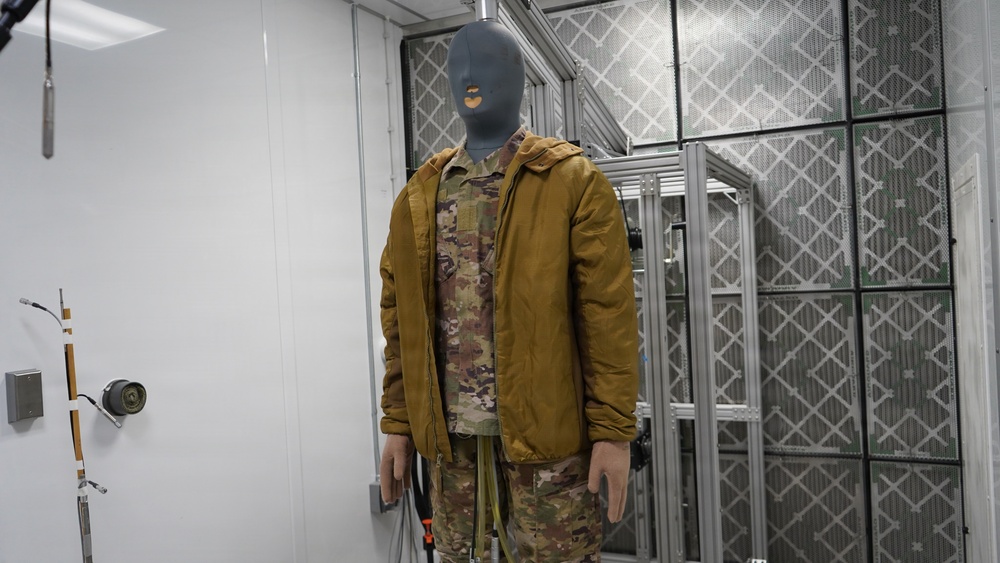
Photo By Danae Johnson | The U.S. Army Research Institute of Environmental Medicine's Advanced Newton Dynamic...... read more read more
NATICK SOLDIER SYSTEMS CENTER, Mass. – Where there is little rest, comfort, or compromise in the world's most austere cold-weather environments, a soldier's clothing is more than just a uniform – it is survival. For leaders, clothing decisions are tactical decisions, and the Medical Research and Development Command’s U.S. Army Research Institute of Environmental Medicine’s Cold Weather Ensemble Decision Aid – CoWEDA – is giving them the information to make the right ones.
Developed by biophysical mathematical modeler Dr. Xiaojiang Xu, CoWEDA is a research-backed decision aid designed to take the guesswork out of a leader's most critical pre-mission decisions. By accounting for environmental conditions, physical activity levels, and clothing ensembles, CoWEDA gives leaders the data they need to make informed and confident decisions about what their soldiers’ clothing needs are before stepping into the field. The Air Force recognized that need more than 10 years ago when approaching Xu and USARIEM looking for their expertise to a simple but critical question — what types of clothing do Airmen need when operating, maintaining, or jumping from aircrafts in extreme cold weather conditions?
"Ultimately, the question became, is this specific clothing suitable for minus 50 degrees Fahrenheit? We realized there was no reliable method to answer that question," said Dr. Xiaojiang Xu, a USARIEM biophysical mathematical modeler. "The only available method was to provide a single insulation number, such as if you go to minus 50 degrees, you need a clothing value of five, but for the average user, that number means very little in terms of actual injury prevention. It was at that point we began designing a new method. With CoWEDA, the standard compares gear performance directly against the risk of hypothermia and frostbite, making it the most practical and usable decision aid to assess whether clothing will prevent cold weather injuries, and if not, when they will occur."
At the heart of CoWEDA is Xu's Six Cylinder Thermoregulatory Model, or SCTM, a sophisticated framework that breaks the human body into six distinct areas: the head, torso, arms, hands, legs, and feet. By combining the physics and physiology of heat transfer across each of those areas, the model can predict not just whether a soldier is at risk, but when that risk may become critical. Rather than offering a blanket assessment, CoWEDA delivers time-based outputs by telling a leader, for example, that frostbite may occur within two hours or hypothermia within twenty, based on the specific clothing being worn, the environmental conditions, and the physical demands of the mission.
Built for the leader, rather than the individual soldier, CoWEDA allows decision makers to tailor those assessments by inputting expected weather conditions, such as temperature, humidity, and wind speed, alongside the planned physical activity level and the clothing ensemble available to the unit. Critically, the aid accounts for the reality that soldiers are not static. A soldier standing still at minus-20 degrees Fahrenheit in a standard Army glove presents a very different risk profile than one moving artillery shells in the same conditions, because physical exertion generates body heat and that changes the equation entirely. CoWEDA captures that nuance.
"CoWEDA is designed for any warfighter going out into a cold weather environment," said Dr. John Castellani, acting division chief of USARIEM's Thermal and Mountain Medicine Division. "It is really about prevention. If a leader has an idea of the operation, mission, or training their soldiers are going into, the predicted air temperature, the intended activity, and what clothing is available — CoWEDA will tell them what the risks are."
Xu's research has positioned CoWEDA as a resource that extends well beyond the Army with other military branches and federal agencies increasingly turning to the decision aid to inform their own cold weather decision making. One example is the Probability of Survival Decision Aid which USARIEM first developed for the U.S. Coast Guard in 2010. Today, the PSDA has been expanded to incorporate Xu’s thermoregulatory model. It is now mandated for USCG use and runs automatically whenever a rescue swimmer enters the water during a search and rescue operation. When the Coast Guard responded to search for workers who fell into Baltimore Harbor during the Francis Scott Key Bridge collapse in 2024, the model was immediately activated, informing leaders how long it was safe to sustain active search operations. Other agencies are adopting the decision aid as well to include: the United Kingdom Coast Guard and the Department of Homeland Security. The science behind CoWEDA is not theoretical, it is already saving lives.
Beyond developing CoWEDA, USARIEM is responsible for producing and maintaining the Army's cold weather injury prevention and treatment guidance — the doctrine that shapes how leaders think, plan for, and respond to cold weather threats across the force. USARIEM’s research data with CoWEDA affirms what many experienced leaders intuitively know: that no two soldiers respond to cold in the same way.
“The Army values uniformity, but in extreme cold, a one-size-fits-all approach to cold weather dressing can put soldiers at risk. What works for one soldier, may not work for another,” said Castellani. “By allowing a leader to input factors specific to their soldiers and operating environment, CoWEDA does not replace a leader's judgment, it gives them the ability and researched backed information to exercise it better."
For the Army and USARIEM, the next steps are about access and integration. Currently as a desktop application, CoWEDA is in the process of being developed into a web-based platform that would make it easier for leaders to access the decision aid without specialized software. The longer-term vision is more ambitious: embedding CoWEDA into the larger operational planning systems already used by military planners, so that cold weather medical risk becomes a standard input in mission planning alongside logistics, terrain, and threat assessments.
“Oftentimes, the medical side is that last part of planning," explained Castellani. “The hope is that CoWEDA will be embedded into the Army's broader planning systems such as the Android Tactical Assault Kit, so that the medical side is present from the outset. Then a leader might say, ’we are going to do this mission in these conditions with this clothing, what is our cold weather injury risk’ they will get an evidence-based response and be able to decide if they are willing to accept that risk.”
Ongoing research continues to sharpen the decision aid's precision. Current studies are examining the specific role of socks in frostbite prevention; a gap identified directly from field feedback. Mannequin and human subject testing are currently underway to generate the data needed to make footwear selection as accurate within CoWEDA.
For now, the decision aid is available, the science is sound, and the need has never been clearer. As more soldiers are called to operate in cold and austere environments, CoWEDA offers leaders something no experience alone can provide, data, certainty, and the confidence to make the right call before the cold does.
| Date Taken: | 07.07.2026 |
| Date Posted: | 07.07.2026 14:14 |
| Story ID: | 569492 |
| Location: | NATICK, MASSACHUSETTS, US |
| Web Views: | 245 |
| Downloads: | 0 |

This work, Dressed to Survive: How an Army Decision Aid Is Improving Cold-Weather Readiness, by Danae Johnson, identified by DVIDS, must comply with the restrictions shown on https://www.dvidshub.net/about/copyright.


No keywords found.





