
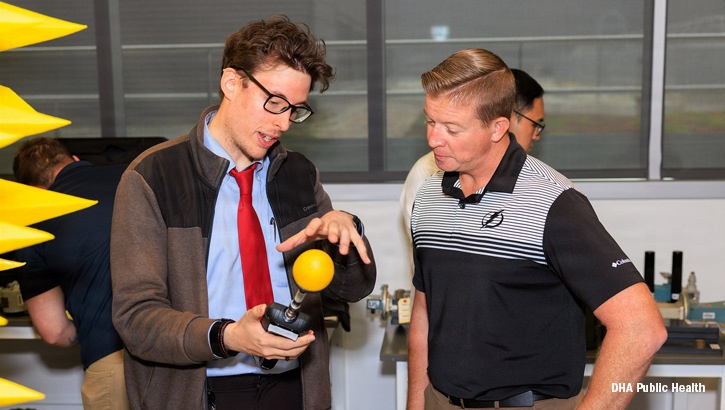
Courtesy Photo | From left, J.D. Tate, a physicist and instructor for Defense Health Agency-Public...... read more read more
 Subscribe
By Douglas Holl, Defense Health Agency-Public Health
On the modern battlefield, not all hazards can be seen, heard, or felt before damage is done. High-power radars, communication antennas, laser target designators, and emerging anti-drone technologies rely on nonionizing radiation, a form of energy that poses severe burn, thermal, and optical hazards to the force if not properly managed.
To mitigate these risks, the Defense Health Agency-Public Health Nonionizing Radiation Division at Aberdeen Proving Ground, Maryland, hosts a specialized training course designed to transform safety specialists and health physicists into front-line experts on radio frequency and laser hazards.
Recent iterations of the Nonionizing Radiation Safety Course have drawn safety professionals from across the globe, equipping them with the hands-on skills necessary to protect service members and civilians in clinical, tactical, and industrial environments.
One of the primary challenges instructors face is resetting how students perceive the threat of nonionizing radiation.
"Students tend to underestimate the hazards of laser and high-intensity optical sources, and [they] sometimes overestimate the RF (radio frequency) hazards," said Colleen Jenkins, course facilitator and division chief for the DHA-PH Nonionizing Radiation Division. "There is no RF or ionizing system that compares to a classroom laser pointer or cat toy. There are rifle-mounted lasers that are the same size as a laser rangefinder from a store-bought laser but have the ability to blind or seriously hurt a person."
Conversely, students often misunderstand how radio frequency affects the body. Romeo J. Gallamoza Jr., an electronics engineer at DHA-PH, noted that a common misconception is that "low levels may be harmful or accumulative, like ionizing radiation."
James D. Chye, who holds a doctorate in physics, is a public health scientist and physicist with DHA-PH. He emphasized that addressing these misconceptions is vital for unit readiness.
“The basic scenario I am looking to avoid is the injury of a Soldier, as dealing with the injury uses additional resources, has long-term potential impacts for the Soldier, and obviously degrades near- and long-term unit readiness,” said Chye. “Those injuries — in my mind — would be most often related to breakdowns in muzzle discipline (keeping the muzzle pointed in a safe direction at all times), misunderstanding of capabilities, and the often-invisible nature of the hazards.”
When accidental exposures do happen, the operational impact is immediate.
"An operator or maintenance worker is inadvertently exposed to radio frequency radiation while working on a system, like a radar or SATCOM (satellite communication) terminal, and is required to report to a clinic for treatment and/or an eye test," said Gallamoza. "An activity stand-down may be put in place until the incident can be investigated and procedures are reviewed."
To combat these threats, the curriculum utilizes the modernized facilities at the DHA-PH lab at APG to transition students from classroom lectures to hands-on applications.
"Overall, my impression of the course has been that there's a lot of information for a safety professional," said Shawn Kasica, division safety director for the Army Reserve Medical Command in Pinellas Park, Florida. "It's one thing to hear a whole bunch of information about ionizing and nonionizing radiation issues and sources, but to actually see what they do here, in the labs, and how it applies to the safety aspect is really important."
Corbet Rece, safety chief for the U.S. Army Electronic Proving Ground at Fort Huachuca, Arizona, echoed that sentiment.
"I'm a safety specialist. I'm not an engineer, so I'm learning basically from the ground up," said Rece. "Today's been a lab day. So now we see the theory put into practice, which is a real hands-on training. However, these instructors put it into plain language, and it is going to help me explain it to my command and my personnel."
The hands-on instruction relies heavily on the installation's specialized infrastructure, which allows instructors to demonstrate hazardous equipment safely.
"We looked at the different RF labs that showed the different types of testing equipment, anechoic chambers, those types of things, and I was very impressed by what they had available," said Stanley Wilson, health physicist and radiation, RF, and laser safety officer at Anniston Army Depot, Alabama.
Gallamoza explained exactly why the anechoic chambers are a critical piece of the training.
"The anechoic chambers are used to generate reference electromagnetic fields to ensure the accuracy of probes before going out to measure sources that operate at various frequency ranges, and to keep uncertainty to within one decibel," Gallamoza said. "Calibration test procedures ensure that measurement results are traceable to national standards."
Because military technology evolves rapidly, the instructional team reviews and updates the curriculum at least twice a year.
"In 2026, we have added content accounting for the use of armed drones, HEL (high-energy lasers), and other DEW (directed-energy weapons)," said Chye. "We are also both educating ourselves and taking part in the policy shifts that are trying to adapt procedures and standards to the developing technologies of the modern era."
Casey Nege, a health physicist with the U.S. Army Communications-Electronics Command Safety Office, attended the course to expand his operational knowledge of these emerging threats to support the U.S. Army National Guard.
"Yes, just ensuring that what we're doing already is meeting all the compliance, and then looking at the new anti-drone stuff that's coming out and ensuring that we're deploying that in a safe way," said Nege. "Making sure that from a safety perspective, we are putting forth guidance on how to be safer on that type of equipment."
Every student interviewed highlighted the same overarching benefit: leaving the course with direct access to DHA-PH subject matter experts. This networking is a deliberate goal of the instructional team.
"We try to instill in them both self-sufficiency and the instinct to ask others, including us, when action or knowledge is needed," said Chye. "We are both the source of much of the information they will need to interpret, and important contacts on many of the situations they will need to handle."
Rece said he’s keeping his instructors’ numbers on speed dial.
"When I have an issue, I need to be able to tap them for information,” said Rece. “You have to be able to have the resources of these guys, who do it every day, to pull from."
For safety professionals considering the training, recent graduates highly recommend the program.
"The experience of what I knew before attending the course and what I know now is night and day," said Sodiq Oduye, chief of environmental health for the Preventive Medicine Division in Bavaria, Germany. "It is worth it. We've had amazing tutorials and lectures. I like having access to these instructors to get their knowledge, and they've also made themselves available going forward if we have safety questions."
The Defense Health Agency is a Combat Support Agency, serving as a force multiplier for the joint services by optimizing lethality through warfighter medical readiness.
NOTE: The mention of any non-federal entity and/or its products is for informational purposes only, and is not to be construed or interpreted, in any manner, as federal endorsement of that non-federal entity or its products.
| Date Taken: | 07.07.2026 |
| Date Posted: | 07.08.2026 07:53 |
| Story ID: | 569457 |
| Location: | US |
| Web Views: | 149 |
| Downloads: | 0 |

This work, Protecting the force from unseen threats: inside Defense Health Agency-Public Health’s nonionizing radiation course, by Douglas Holl, identified by DVIDS, must comply with the restrictions shown on https://www.dvidshub.net/about/copyright.

No keywords found.




