
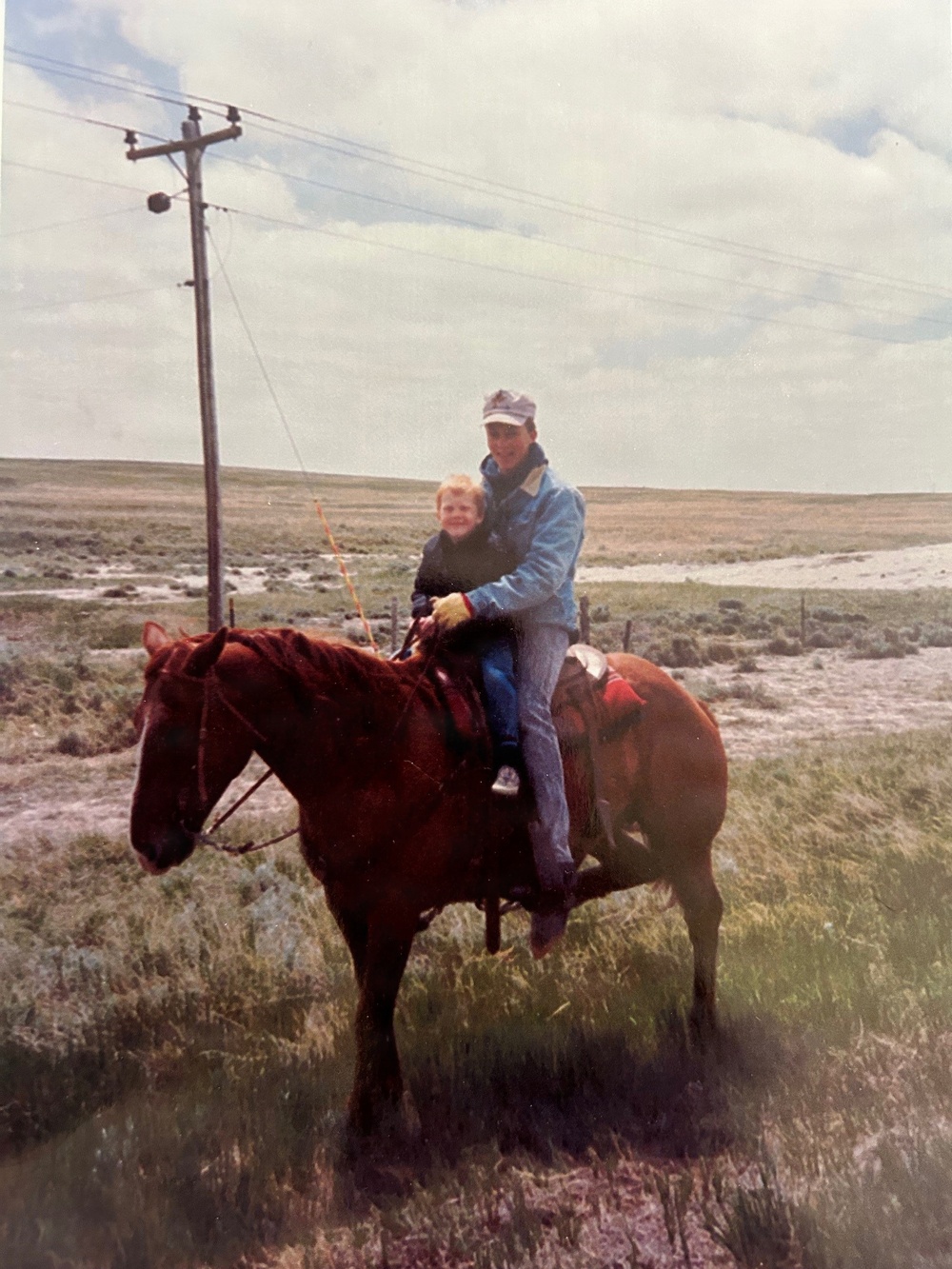
Courtesy Photo | Jason Brengle in high school with his 6-year-old brother on horseback. (Photo courtesy...... read more read more
 Subscribe
This year, as we celebrate the nation’s founding, the Forest Service looks back to its own creation and guiding principles. Since 1905, conservation, a paradigm to sustainably use resources and care for the land has been at the agency’s heart.
In 1630, forests blanketed 45%, or 1 billion acres, of what is now the United States.
Today that number stands at about 39%, due in large part to conservationists and land managers across the country. From federal agencies, like the Forest Service, to states and private landowners, thoughtful land management over the years has shaped what our forests and grasslands look like today.
Across time immemorial, people have shaped and been shaped by—the land.
Long before the ideal of conservation — before Forest Service founders Gifford Pinchot and President Teddy Roosevelt drew up plans for the first national forests, before the formation of the United States—native civilizations stretched from coast to coast.
Some of those first people lived high in the mountains during summer and down in the valleys during winter, others along the seacoast, and still others high up on desert steppes. Some roamed the great plains and hunted bison, others fished the great rivers.
Though tribal beliefs cannot be generalized across all tribes, there is one that could be considered a common thread—a belief in the balance between humans and nature.
In contrast, the new nation saw its forests as a limitless natural resource.
“Our country was built on wood. And up until the late 19th century, wood provided 90% of U.S. energy needs,” said Lincoln Bramwell, a Forest Service historian. “It was our main natural wealth and resource, and we were using it at a very fast clip.”
Bramwell has spent the last 17 years as chief historian for the agency, cataloguing and communicating its rich history.
Exploration, expansion, and development characterized those early years assisted by technological advances like the railroad, settlers set out in search of a better life on the frontier.
The people and their demands on the land for seemingly limitless resources like timber was becoming more noticeable. By the 1870s and 1880s it became apparent to many citizens, politicians and industry professionals that action needed to be taken to set aside land to conserve resources indefinitely.
“Back then, the entire concept of public lands was a really radical idea. It didn't occur anywhere else in the world when Congress created them,” he said.
Today those very same lands continue to deliver their bounty to the American public over and over again.
In the earliest days of the agency, a single Forest Service employee would oversee up to 1 million acres on their own.
“Around this time is when you see this image of the lone forest ranger out in the woods,” said Bramwell. “The early rangers had to manage for grazing, timber and wildfire.”
Land management practices were practically nonexistent at the time. This meant these first Forest Service rangers were critical to collecting the very first data.
“Forestry as a science was in its infancy. The agency started setting up scientific explorations and experiments and studies just to understand more about the forest ecosystem,” said Bramwell.
Those observations and that science continue to this day, often built on those very first studies. Across the nation there are still landscapes that serve as natural laboratories essential to studying wildfire, water, wildlife and ecosystems.
“They were tasked with thinking in terms of tree time,” said Bramwell. “The decisions they made 20, 50, 100 years ago made the forest landscape look the way it does today.”
The nation’s oldest national forest offers a clear view of how the Forest Service has spent more than a century balancing conservation with the needs of surrounding communities.
The Shoshone National Forest, formerly the Yellowstone Park Timber Land Reserve founded in 1891, is a 2.4-million-acre stretch of land in Northwest Wyoming near Yellowstone National Park.
Prior to becoming a national forest, this landscape exemplified the challenges and the stress being put on the land. But in this area, instead of timber, green pastures were the most highly coveted natural resource.
“In those days, ranchers were pushing livestock sheep and cattle from as far away as Utah. There were an amazing number of sheep in this country back in the day,” said Jason Brengle, a range management specialist for the Shoshone National Forest.
“They grazed the high mountains in summer. And they were essential to provide food and clothing to the local area.”
Professionally, Brengle is carrying on the tradition of those first Forest Service rangers. He has spent just over 25 years with the federal government working with local ranchers, land managers, and scientists to keep the land healthy for livestock year after year.
He also keeps with his own family traditions.
“I was helping my grandfather gather cattle and sheep by the time I was 8 years old,” said Brengle. “I grew up around agriculture in northwest South Dakota. My family has been there since the 1890s, farming and grazing.”
Each year on the Shoshone National Forest about 60 permittees graze around 16,000 head of livestock on 1.1 million acres of grazing allotments. This accounts for just a small part of 75 million acres of National Forest System lands permitted for grazing spread across 27 states. The agency administers nearly 5,500 permits each year for cattle, sheep, horses and goats.
Balancing rangeland, like his family’s and the national forest, is not unique to the area, said Brengle. Native Americans like the Eastern Shoshone, the Shoshone National Forest’s namesake, moved with the migrating bison. They too understood the balance.
In the early days of the United States, before public lands, it was a free-for-all.
“Rangeland is fairly resilient. It will recover if you do the right thing,” said Brengle.
With proper management, these grasslands have no problem rejuvenating because of the often meters deep root structure still intact below the surface. But that forward thinking wasn’t always the case.
“We came a long way since then,” Brengle said. “The Shoshone National Forest is still a lot like it was 100 years ago its vast wilderness brimming with life, but also still bringing the American public the resources, the food, clothing and enjoyment it always has. We absolutely achieved our conservation goal.”
| Date Taken: | 07.02.2026 |
| Date Posted: | 07.06.2026 08:02 |
| Story ID: | 569328 |
| Location: | US |
| Web Views: | 89 |
| Downloads: | 0 |

This work, Shaping America's public lands over 121 years, by Andrew Avitt, identified by DVIDS, must comply with the restrictions shown on https://www.dvidshub.net/about/copyright.


No keywords found.




