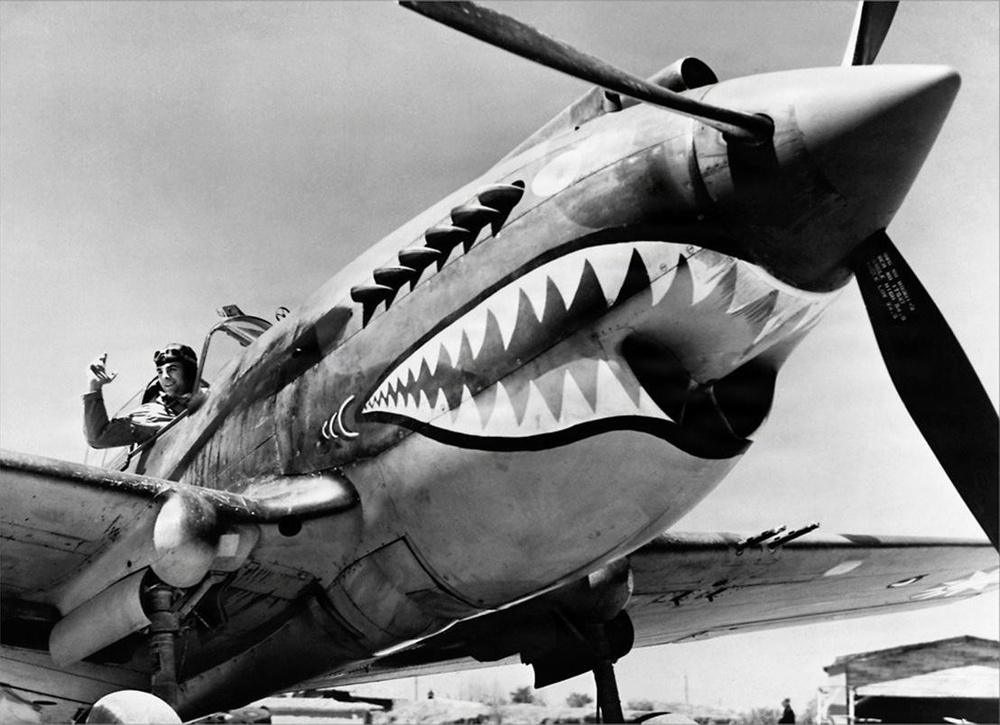
Photo By Senior Airman Savannah Carpenter | A U.S. pilot assigned to the American Volunteer Group sits in the cockpit of a Curtiss P-40 Warhawk adorned with the iconic shark teeth nose art during World War II. On July 4, 1942, the AVG, better known as the Flying Tigers, was officially disbanded, and its mission transitioned to the U.S. Army Air Forces' 23d Fighter Group, establishing a lineage that continues today through the 23d Wing. (Courtesy photo) see less
| View Image Page
250 years strong: The Flying Tigers legacy lives on
MOODY AIR FORCE BASE, Ga. — Across the flight line at Moody Air Force Base, rows of aircraft bear the unmistakable shark teeth that have become synonymous with the Flying Tigers. More than a striking paint scheme, the iconic design represents a legacy of courage, innovation and combat excellence that has endured for generations.
On July 4, 1942, as Americans celebrated Independence Day, one of the nation's most legendary fighting forces entered a new chapter. The American Volunteer Group (AVG), better known as the Flying Tigers, was officially disbanded, and its mission was assumed by the newly activated U.S. Army Air Forces 23d Fighter Group under Brig. Gen. Claire Lee Chennault.
The Flying Tigers were established in 1941 as a volunteer force to support China in its fight against Japanese aggression before the United States formally entered World War II. Operating in the China-Burma-India Theater, the AVG defended the Burma Road, protected key Chinese cities and earned an extraordinary combat record through innovative tactics, relentless determination and the now-iconic shark teeth painted across their aircraft.
Although the AVG existed for just seven months, its legacy endured. The 23d Fighter Group inherited the Flying Tigers' mission, tactics and many of its personnel, continuing combat operations against Japanese forces throughout World War II. More than the end of a volunteer organization, July 4 marked the beginning of a lineage that continues today through the 23d Wing.
“The men and women of the 23d Wing have done an excellent job of preserving and honoring the Flying Tiger heritage while making history and heritage of their own,” said William Godwin, 23d Wing historian. “The Flying Tigers’ legacy did not stop after World War II ended. They continued to produce warfighters who fought in the Korean War, Vietnam War, the invasion of Grenada, and Operations Desert Shield, Desert Storm, Enduring Freedom, Iraqi Freedom, Freedom Sentinel and Inherent Resolve.”
According to Godwin, the transition ensured the Flying Tigers' legacy would continue uninterrupted. The newly established 23d Fighter Group retained the iconic shark teeth, many of the AVG's experienced leaders and pilots, and continued the mission of protecting the Burma Road. Former Flying Tigers, including David "Tex" Hill, Frank Schiel Jr. and Edward "Ed" Rector, helped lead the group's newly formed fighter squadrons, carrying forward the experience and combat spirit that defined the AVG.
Chennault's influence extended well beyond the skies over China. His emphasis on teamwork, discipline and mutual support became a hallmark of the Flying Tigers and continues to resonate with Airmen today.
“Chennault’s warfighting tactics he taught to the AVG were carried over to the 23d Fighter Group,” Godwin said. “The ‘wingman concept’ we talk about today in our Air Force, that was Chennault’s idea. You need to always look out for your Airmen, whether you are on the ground or in the air.”
More than 80 years later, the legacy of the Flying Tigers remains woven into the identity of the 23d Wing. While today's Airmen operate in a vastly different battlespace, they continue to embody the same principles that defined the Flying Tigers: innovation, adaptability, teamwork and an unwavering commitment to mission success. The heritage they inherited is more than history; it is a standard of excellence that continues to shape how the wing generates combat-ready airpower.
As the nation commemorates America's 250th anniversary, the story of the Flying Tigers serves as a reminder that every generation of Airmen builds upon the sacrifices and achievements of those who came before them. The courage and determination displayed in the skies over China established a foundation that continues to strengthen today's force.
“Today, Airmen build the legacy established by generations before them, raising the standard and achieving even greater heights,” Godwin said.
For the Airmen of the 23d Wing, carrying the Flying Tigers heritage is an honor, a responsibility and a commitment. Every sortie flown, every aircraft launched, every rescue executed and every mission supported reflects a legacy forged more than 80 years ago. By embracing that legacy while continuing to innovate and adapt, today's Airmen ensure the United States remains ready to meet tomorrow's challenges and continue defending freedom for the next 250 years.
Godwin said the Flying Tigers' legacy is not preserved through history books alone, but through the Airmen who continue to wear the patch and uphold the standard established by those who came before them. He said former Flying Tigers often ask what today's Flying Tigers are accomplishing.

 Subscribe






