DSCU Concludes Inaugural ‘FMS for NATO Allies’ Course in Germany
Courtesy Photo |
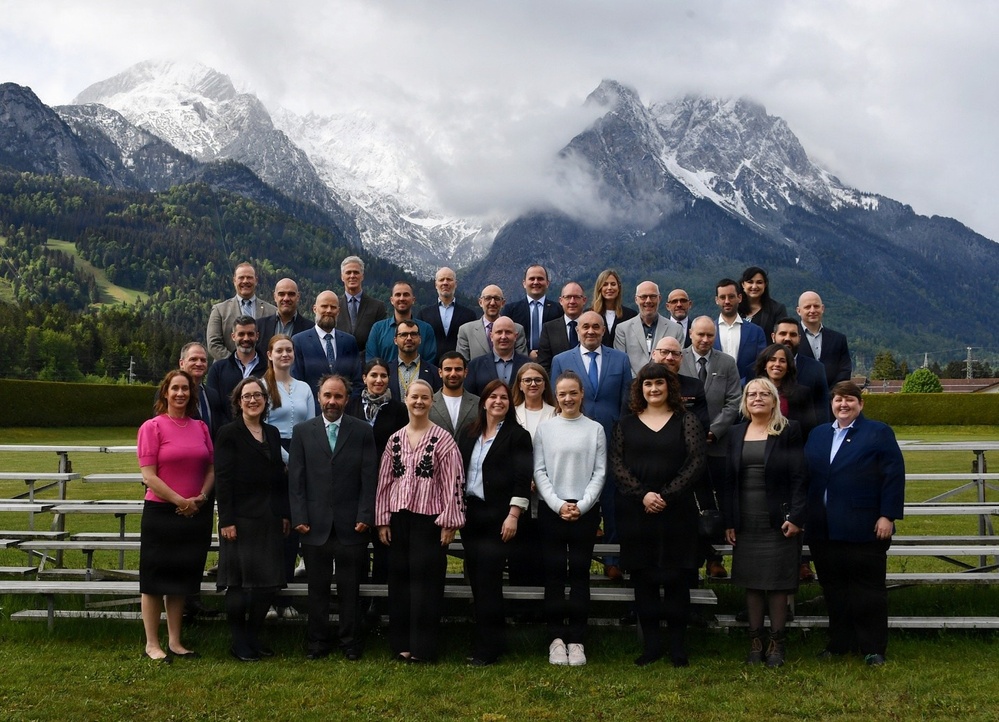
“FMS for NATO Allies” course participants pose for a group photo outside the......read moreread more
Courtesy Photo | “FMS for NATO Allies” course participants pose for a group photo outside the George C. Marshall European Center for Security Studies May 12, 2026, following a day of instruction in Garmisch-Partenkirchen, Germany. see less
| View Image Page
DSCU Concludes Inaugural ‘FMS for NATO Allies’ Course in Germany
GARMISCH-PARTENKIRCHEN, Germany – The Defense Security Cooperation University (DSCU), an office within the Defense Security Cooperation Agency (DSCA), concluded the inaugural session of its newest Foreign Military Sales (FMS) course, “FMS for NATO Allies,” on May 22, after two weeks of intensive, skills-based training at the George C. Marshall European Center for Security Studies.
The course brought together 33 students, including 29 allied practitioners from 16 NATO member states and four U.S. Military Group Personnel. Designed to provide allies with practical training in the modernized U.S. FMS system, the course reflects a continued collaboration across the security cooperation enterprise to deliver training aligned with current national security priorities.
The training initiative stems from Executive Order 14628, “Reforming Foreign Defense Sales to Improve Speed and Accountability,” and the America First Arms Transfer Strategy (AFATS) established on February 6, 2026. These policies call for faster, more transparent, and efficient processes to support partners in acquiring U.S. defense articles, services, and training, strengthening their security capabilities while enabling increased burden-sharing.
Reflecting on the need for a modernized FMS system, U.S. Secretary of War Pete Hegseth stated, "We must restructure U.S. [foreign military sales] to accelerate weapon deliveries. Our focus has to be on delivering high-demand weaponry to our allies faster by prioritizing speed and efficiency, which in turn boosts our own domestic industrial base and strengthens collective security."
Part of a broader DSCU effort to empower allies and partners with the procedural knowledge to effectively engage the FMS system for greater burden sharing – a central pillar of the 2026 National Defense Strategy − the curriculum explored aspects of FMS particularly relevant to NATO Allies, covering the FMS life cycle from pre-Letter of Request planning through case execution and closure.
The course was offered as a resident program at the Marshall Center with active engagement from DSCA. Its location at the Marshall Center, a U.S. Department of War and German Federal Ministry of Defense partnership, highlighted both the collaborative nature of the training and the institution’s ability to support evolving stakeholder needs.
“Foreign Military Sales are a practical way allies and partners build capability together, and this course provided participants with knowledge and skills that support the effective implementation of security cooperation efforts,” said Barre Seguin, Marshall Center director. “At the Marshall Center, we are happy to have served as hosts and look forward to future iterations.”
Scott Moreland, Senior Principal for DSCU International Training, Education, and Advising directorate, noted that the course “aligns arms transfers with domestic industrial revitalization, allied burden-sharing, and U.S. national and NATO security imperatives.”
A key focus of the curriculum was the “Total Package Approach,” ensuring that acquisition planning includes not just hardware, but also the critical training, maintenance, and logistics support required for long-term operational readiness. This approach is designed to align allies’ and partners’ capabilities targets with their acquisition planning.
The in-residence aspect of the course was crucial for its success. The face-to-face environment sparked critical dialogue, with one student calling it an “absolute delight to have FMS practitioners in the room,” and noting that “the energy from the DSCU team was contagious.”
That energy carried through to the capstone exercise, which helped practitioners connect the FMS process to matching real world threats with future capabilities. As one student concluded, the course made it clear how deeply FMS cases are tied to long-term strategic interoperability, adding, “FMS builds relationships and trust, creating long-term partnerships and alliances.”
NEWS INFO
Date Taken:
06.30.2026
Date Posted:
07.01.2026 15:58
Story ID:
569145
Location:
US
Web Views:
137
Downloads:
0
PUBLIC DOMAIN
This work, DSCU Concludes Inaugural ‘FMS for NATO Allies’ Course in Germany, must comply with the restrictions shown on https://www.dvidshub.net/about/copyright.