
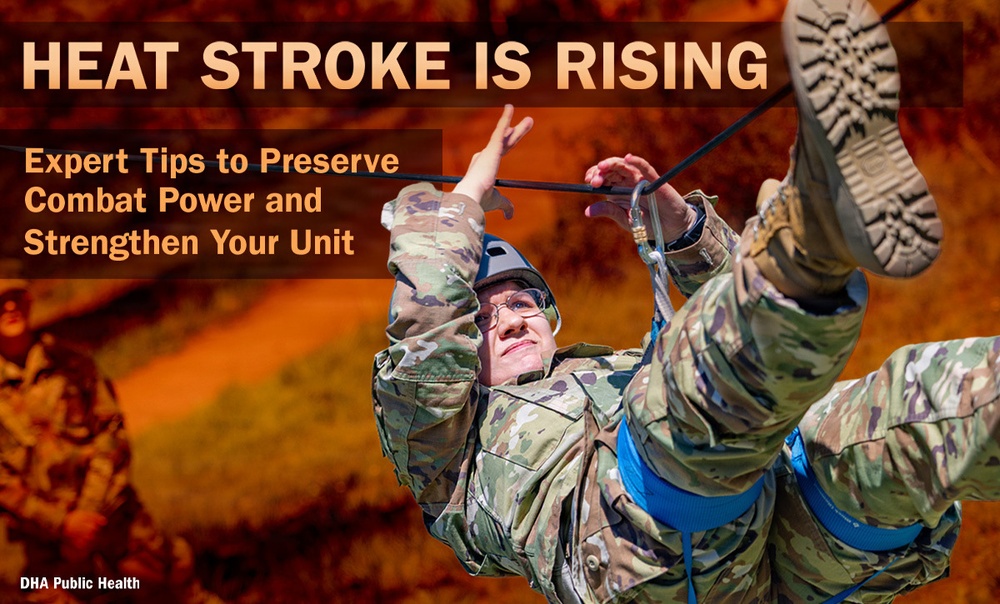
Photo By Douglas Holl | While overall heat illness rates for service members saw a slight decrease in 2025,...... read more read more
 Subscribe
By Douglas Holl, Defense Health Agency-Public Health
As the military braces for another summer, new data reveals a concerning trend in the ongoing battle against heat illness, demanding renewed focus from leaders and service members across all branches.
“Heat illness rates for recruit trainees will always be higher compared to other enlisted service members or officers,” said Alexis Maule, an epidemiologist with the Defense Health Agency-Public Health Disease Epidemiology branch in Aberdeen, Maryland.
“The focus should be on reducing the heat illness rate among recruit trainees. In the active component U.S. armed forces, the rate of heat illness decreased in 2025 compared to 2024,” Maule said. “However, the rate of heat stroke increased for the second year in a row."
The May 2026 issue of the Medical Surveillance Monthly Report includes an update on heat illness rates for active duty service members. The data from the June 2025 report finds service members under 20 and recruit trainees are at exceptionally high risk. Recruits are nearly 15 times more likely to suffer from heat exhaustion than other enlisted members.
The data underscores a critical challenge. As the force gets better at identifying and treating milder forms of heat illness, the risk of life-threatening heat stroke persists and is growing.
Preventing heat illness requires thinking like a risk manager, understanding that no single defense is perfect. According to Maule, a strategy called the "Swiss Cheese Model” layers multiple lines of defense to stop a hazard. Maule highlighted key approaches, including:
Maule believes this comprehensive model provides a framework for leaders at all levels to take care of their people.
Between 2019 and 2025, 86% of all instances of exertional heat stroke occurred during foot marches and running, according to Army Lt. Col. David DeGroot, director of the Army Heat Center at Fort Benning, Georgia. For service members, understanding personal limits is key, especially those newly arrived at a "hotspot" like Fort Benning or Camp Lejeune in North Carolina.
"You can’t 'out-work' the heat," said DeGroot. "The physiology is clear and performance is reduced with elevated ambient temperature and humidity. Any effort to ‘out-work’ the heat will only result in heat illness." This means gradually adapting to heat is non-negotiable. It can take more than 10 days to fully adapt to a new, hot environment, he said.
"Restricting max effort and timed effects during the first 7–10 days at a new, hot duty station while continuing to train at a moderate workload for 60–90 minutes per day is sufficient to heat acclimatize," DeGroot advised. For families, the risk extends beyond the training field.
"Stay well hydrated and plan strenuous outdoor activities in the mornings and evenings, when possible," said Dr. Charles McCannon, a preventive medicine physician with DHA-PH. "Pregnant women, infants, and young children may have a lower threshold for heat illnesses and rely on others to keep them cool and hydrated."
For squad and team leaders, the front line of prevention is observation. Identifying a struggling service member before they collapse is a critical leadership skill. The key sign to watch for is ataxia, a broad term for any loss of coordination.
"Ataxia is an important early warning sign for anyone to be aware of,” DeGroot said, as this is an indicator of central nervous system dysfunction typically preceding physical collapse. He advises leaders to engage a service member who looks unsteady.
"If I see a soldier with ataxia, I simply fall into step alongside them, have a quick conversation, and work in those mental status questions," he said.
Asking simple questions with fixed answers, like "What is your mother's name?" can reveal a service member's mental state, said DeGroot. He recommends not asking questions with changing answers, like “What did you have for dinner yesterday?”
"It’s irrelevant for the questioner to get the right answer,” he said. “The key is to assess how quickly and confidently the individual responds."
If there is any concern, DeGroot recommends taking immediate action to stop the individual, get them into shade, and call for medical help.
Ultimately, preventing heat illness is a command responsibility that requires enforcing standards and shaping unit culture.
"A good heat mitigation plan identifies all, or as many as possible, risk factors and implements mitigation practices to the extent possible," said DeGroot.
DeGroot cautions against a one-size-fits-all approach, noting that risk acceptance varies by mission. Commanders can inform their risk management worksheets by using foundational doctrine like “Heat Stress Control and Heat Casualty Management,” found in TB MED 507, the U.S. Army’s medical technical bulletin, updated in 2022. DeGroot says one of the biggest obstacles is "cultural resistance." Leaders and Soldiers must confront the facts — physics dictate performance in the heat.
"Unit leaders need to understand that physical performance during heat stress will be impaired, compared to cooler conditions,” said DeGroot. “Equal effort does not mean equal results."
DeGroot says leaders need to build a climate where it’s acceptable to slow down. Moreover, prevention measures such as arm immersion cooling, or emerging wearable technologies with lightweight, ruggedized designs, should be seen as tools for preserving combat power.
"As we train and operate in hot and humid environments, heat illness is inevitable," said McCannon. "The risk of heat illness can be reduced with early recognition of high-risk environments and effective early interventions." Maule agrees that although heat illness is inevitable, a layered approach tailored to the specific environmental, organizational, and occupational risk factors is the best strategy to reduce risk.
Maule concluded “Know your environment, know your personnel, and know your mission.”
For more information on preventing and managing heat illness, service members and leaders can consult the following official resources:
The Defense Health Agency is a Combat Support Agency, serving as a force multiplier for the joint services by optimizing lethality through warfighter medical readiness.
NOTE: The mention of any non-federal entity and/or its products is for informational purposes only, and is not to be construed or interpreted, in any manner, as federal endorsement of that non-federal entity or its products.
| Date Taken: | 06.30.2026 |
| Date Posted: | 07.01.2026 08:11 |
| Story ID: | 569032 |
| Location: | US |
| Web Views: | 10 |
| Downloads: | 0 |

This work, Battling the invisible enemy: The rise in severe heat illness, by Douglas Holl, identified by DVIDS, must comply with the restrictions shown on https://www.dvidshub.net/about/copyright.

No keywords found.




