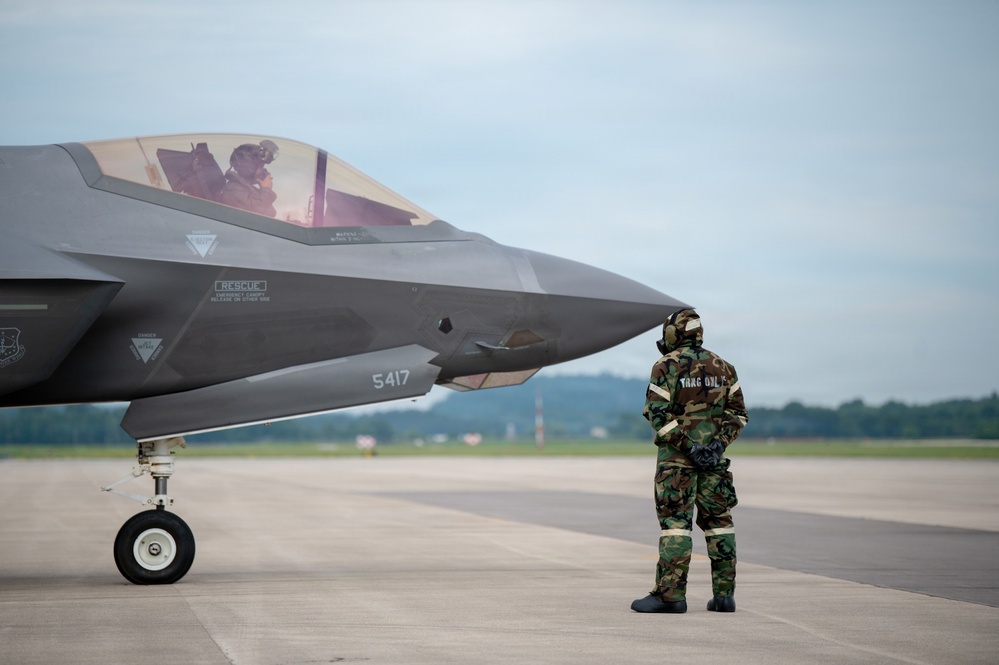
Photo By Airman Alec Martin | A U.S. Airman assigned to the 115th Fighter Wing, Wisconsin Air National Guard, conducts flight line operations in mission-oriented protective posture gear during a combat readiness exercise, Operation Iron Orchid, at Volk Field Air National Guard Base, Camp Douglas, Wisconsin, June 26, 2026. Operation Iron Orchid is designed to assess and reinforce the wing’s ability to generate combat capability, sustain operations, protect personnel and resources, respond to evolving conditions, and execute mission-essential tasks in a realistic and challenging environment. (U.S. Air National Guard photo by Airman Alec Martin) see less
| View Image Page
Wisconsin Air National Guardsmen assigned to the 115th Fighter Wing participated in Operation Iron Orchid, a combat readiness exercise, June 22 – 26 at Volk Field Air National Guard Base in Camp Douglas.
Operation Iron Orchid was the fighter wing’s largest exercise in 23 years designed to test and reinforce the unit’s ability to operate in a combat environment under a new deployment model.
“In the type of environment we have to be ready to fight against a near-peer adversary, you can’t just show up and learn who your team is when you get to the game,” said U.S. Air Force Lt. Col. Jason Crabb, the 115th Fighter Wing’s director of inspections. “You have to be able to train that way together.”
The exercise brought together over 500 Airmen who were able to practice critical deployment tasks in a contested, degraded and operationally limited environment while under threat of simulated drone, missile and chemical attacks.
“We’re trying to integrate a lot of the things that we saw from recent real-world operations into this exercise because we know that is what our brothers and sisters down range are experiencing,” said Crabb. “We want to make sure our Airmen are as trained and ready as they can be.”
Training is crucial in the Air Force’s new deployment model, Air Expeditionary Wing 2.0, which ensures Airmen are constantly ready to deploy, specifically with peers they have already trained alongside.
The new model is also an important piece of the Air Force’s Agile Combat Employment concept, which shifts operations from centralized physical infrastructures to a network of smaller, dispersed locations.
“To increase survivability, we can move our aircraft out to different locations if we think we’re going to be attacked,” said U.S. Air Force Col. Aaron Lunderville, the deputy commander of the 115th Fighter Wing. “For three days of the exercise we tested how aircraft would depart, fly an operational mission and then land and operate out of a different location.”
Those locations included the 123rd Airlift Wing in Louisville, Kentucky, the 127th Wing at Selfridge Air National Guard Base, Michigan and the 115th Fighter Wing in Madison.
Despite the dispersed nature of the ACE concept, the Airmen of the 115th Fighter Wing and supporting units always remained prepared and adaptive.
“We’re extremely pleased with the outcome of the exercise as the teams really integrated and came together in a way we don’t always see,” said Lunderville. “The innovation and positive attitude of our Airmen was exceptional as they further developed themselves and demonstrated they are ready to lead tomorrow’s fight.”

 Subscribe






