
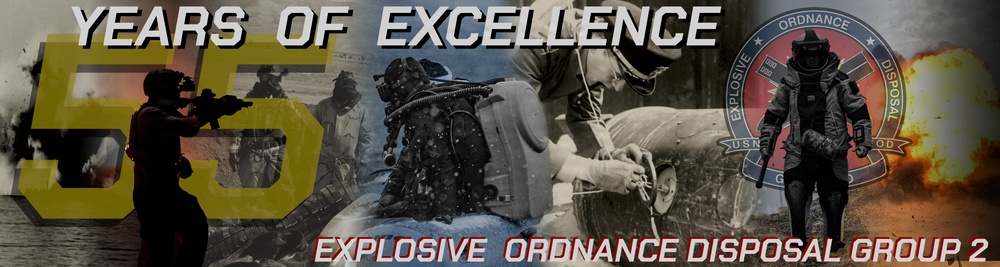
Photo By Petty Officer 2nd Class Jackson Adkins | VIRGINIA BEACH, Va. - Poster graphic commemorating Explosive Ordnance Disposal Group...... read more read more
 Subscribe
VIRGINIA BEACH, Va.- Explosive Ordnance Disposal Group (EODGRU) 2 celebrated 55 years of dedicated service to the U.S. Navy and the nation on July 1, 2026. From its early days tackling World War II-era mines to its modern-day global responsibilities, the command boasts a rich history of courage, adaptation, and innovation.
The journey to EODGRU-2 began amid the technological challenges of World War II. The emergence of sophisticated enemy weapons, particularly the German magnetic mine, necessitated the creation of specialized units capable of rendering explosive ordnance safe. In the post-war era, the U.S. Navy formalized these efforts, establishing Mine Disposal Unit 2 in Charleston, South Carolina, on Dec. 7, 1951. Originally, enlisted team members operated out of a simple Quonset hut at the U.S. Navy Minecraft Base, with the staff located nearby in an old rice mill.
The command underwent several transformations as its mission evolved alongside the growth of nuclear weapons and advancements in mine warfare. It was renamed EOD Unit TWO in June 1952. By the late 1960s, mine and bomb disposal units were consolidated, and the Atlantic Fleet assets relocated to Fort Story, Virginia, operating out of two concrete bunkers and seven Quonset huts that had previously provided harbor defense during World War II.
The Official Redesignation A significant milestone occurred on July 1, 1971, when the command was officially redesignated as Explosive Ordnance Disposal Group 2.
According to a 1971 command history report, EODGRU-2 was established to serve as the headquarters for all EOD support within the Atlantic Fleet's area of responsibility. Its duties included providing trained technicians for the "detection, identification, field evaluation, rendering safe, recovery, evaluation and disposal of explosive ordnance," a core mission that continues to this day. Following a reorganization in 1980, the group also took on the immense responsibility of technical escort for naval chemical, biological, toxicological, and nuclear agents.
"Celebrating our 55-year anniversary is really about honoring a legacy of problem-solving in the world's most unforgiving environments," said Capt. Steve Cobos, Commodore, EODGRU-2. "From rendering safe World War II-era influence mines to preparing for tomorrow's high-end maritime fight, this command has consistently evolved to meet the needs of the Navy and the nation. I am incredibly proud of the men and women who continue to adapt, innovate, and carry that mission forward today."
EODGRU-2 Today Today, EODGRU-2 has traded WWII Quonset huts for state-of-the-art facilities, growing into a major command that oversees a massive portion of the Navy's EOD power. The group commands EOD Mobile Units 2, 6, 8, 10, and 12, along with EOD Training and Evaluation Unit 2 and various shore detachments across the Atlantic area.
To keep pace with modern maritime threats, the command recently underwent a major force redesign. Instead of operating on parallel tracks, Mobile Diving and Salvage Units are now integrated directly under each EOD Mobile Unit. This shift brings the Navy's premier deep-sea divers and salvage experts under the exact same tactical roof as the EOD operators. This provides commanding officers with a streamlined, powerhouse team that can flawlessly transition from clearing underwater explosive threats to conducting complex deep-water salvage and recovery operations anywhere in the world.
As EODGRU-2 marks its 55th year of service, it celebrates a history defined by an unwavering commitment to protecting personnel and ensuring operational freedom for the fleet.
For more information, visit https://www.necc.usff.navy.mil/eod/
| Date Taken: | 07.01.2026 |
| Date Posted: | 07.01.2026 10:51 |
| Story ID: | 568918 |
| Location: | VIRGINIA, US |
| Web Views: | 176 |
| Downloads: | 0 |

This work, 55 Years of Explosive History and Fleet Support from EODGRU-2, by LT Martin Carey, identified by DVIDS, must comply with the restrictions shown on https://www.dvidshub.net/about/copyright.


No keywords found.




