
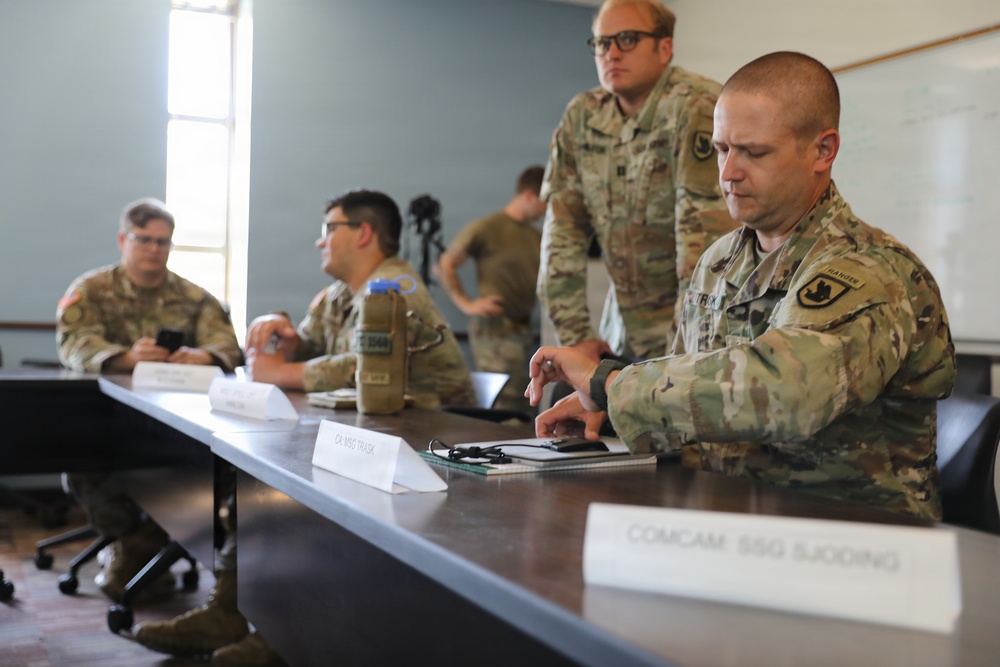
Photo By Staff Sgt. Meredith Vincent | U.S. Army Master Sgt. Chris Trask,156th Information Operations Battalion, 56th Theater...... read more read more
 Subscribe
In a cramped room on the bottom floor of the Information Operations Readiness Center at Joint Base Lewis-McChord, Washington., nine members of the Washington National Guard sit at their laptops. They anticipate a barrage of questions, and their responses will begin to build a world within a world. For the next seven days, these Soldiers will get used to their close quarters as they perform a role that is regularly mentioned, but seldom fully understood. They are the White Cell and they are the beating heart of most military training exercises.
The White Cell - so named for its neutral role during military exercises - is an unbiased control group that manages simulated scenarios to evaluate and train troops. Every member has their area of expertise and they work throughout the exercise to challenge teams and enhance training experiences. They are the “Man Behind the Curtain,” so to speak, and their role is integral to any military exercise.
“Prior to the exercise, we will build back-end products to support the scenario. We develop the plan, and what the teams are going to be responding to or executing,” said Master Sgt. Chris Trask, operations non-commissioned officer for the 156th Information Operation Battalion, 56th Theatre Information Operations Group, and a veteran of the White Cell group. “While the event is occurring, we are acting in a support role, whether that's role-playing working groups or having face-to-face conversations with the teams to answer questions. Then, at the end of the day, rolling all that up into essentially an evaluation to demonstrate to the battalion how the teams are operating and what level they're functioning at.”
Information Operations is a singular and unique field in the Army, one that can be difficult for newcomers to wrap their minds around. Multi-day exercises challenge new and veteran IO Soldiers alike to practice and perfect their skills. These exercises revolve around a fictional scenario, built by the White Cell team months in advance, and are kept afloat by the team through daily meetings, called working groups, and back-and-forth questions and discourse. Trask said none of this would be possible without the combined experience of the White Cell members.
“You can't do any of the planning in a vacuum, right? Because we're always drawing on someone's expertise in particular fields,” said Trask. “If you try to plan this stuff in a vacuum, it's difficult, because ultimately, the whole team has to know what the intent is, what’s already occurred, and where we're trying to drive this to.” Maj. James Deakins, public affairs officer, 156th IO BN, agrees and said the knowledge and expertise brought to the exercise by the White Cell members benefits all exercise participants.
“I think the White Cell is sometimes referred to as the ‘Greybeards,’ because there's a lot of experience in that room, and a lot of very smart people who have done the job,” said Deakins. “They're able to speak from experience and say, ‘This is what I've seen in this situation.’ You can draw from that [experience] to pivot with what the teams are presenting through their [questions] or through their working groups. So I think the level of experience is really something that is leaned on very heavily. We can't have new people in there doing that.”
The skills and talents required of the White Cell are varied, but one that stands out is the ability to be adaptable and creative with not just one, but multiple changing scenarios. Staff Sgt. Daniel Anderson, intelligence NCO for the 161st Infantry Regiment, 81st Mobile Brigade Combat Team, brought his team of junior soldiers to help build the products and documents to bring the scenario to life. He said the experience gave them opportunities to be creative, something they do not see often. “We’re taking the scenario [the White Cell] created, and we're building a world around it. They set the stage and now we put all the props in place,” Anderson said. “It needs to sync up well and make sense in a believable, real-world environment for training. It lets us have a lot of freedom, especially when you're working with multiple countries, multiple adversaries, and multiple domains, like the information environment and the physical environment.”
In addition to building the scenario, White Cell members must then role-play particular subject-matter experts throughout the exercise. In the IO world, these experts are called information related capabilities, or IRCs, and they span public affairs, cyberspace, electronic warfare and civil affairs. White Cell members must inhabit these roles for the training to be as authentic as possible, and they must do it with confidence. To be prepared for all manner of questions from the teams, White Cell members beef up their knowledge on their particular roles and continue learning about them during the exercise.
“I have to do my research before I go on those working groups,” said Trask, “so I can give them the best, most realistic answer possible. A lot of it comes down to, does that sound reasonable? But we do as much research as we can so that what we give them is fundamentally correct.”
The amount of questions, scenario plans, and ideas makes keeping track of the information very difficult. Having been a White Cell member for several exercises, Trask has a strategy for keeping it all balanced.
“I keep a little notebook, and all I put in there is the key points they talked about as a refresher for when I go back into a meeting with them,” Trask said. “Because we did four hours of meetings today, back-to-back-to-back-to-back, and if you don't keep track of what you've talked about, by the time you get to the last one, you can't remember where they're going with their plans. So you’ve got to keep good notes.”
The responsibility that rests on the shoulders of the White Cell to design, conduct and ultimately pull off a successful training event is immense. While there is pressure on the teams being evaluated, there is also pressure on the nine members sitting around that small room, and Trask said the work is vast.
“I never realized, until I became part of the White Cell, how much work went into creating (the event),” he said. “That was the biggest surprise to me, is just the amount of effort put into it.”
“You have to be able to adapt though,” Trask said. “Because, again, it is a very cerebral environment. In the first couple days, you don't know what these teams are going to come up with. So you have to be flexible, adaptable, and open-minded to helping them get the effects they want.”
As with all things in life, the White Cell is an ever-changing tapestry of personalities and experience. The door will continue to revolve as new members take the place of those leaving. Trask is among those on his way out, but he is optimistic for the future of this integral and complex group of professionals.
“Currently, we are scratching the surface of where the White Cell could be,” he concluded. “I think as we go forward, especially with some of the tools we have available now, there's potential for it to be a really cool thing. I think we're just getting started.”
| Date Taken: | 06.26.2026 |
| Date Posted: | 06.28.2026 16:40 |
| Story ID: | 568864 |
| Location: | JOINT BASE LEWIS-MCCHORD, WASHINGTON, US |
| Web Views: | 335 |
| Downloads: | 0 |

This work, Behind the Curtain: White Cell team integral to exercise success, by SSG Meredith Vincent, identified by DVIDS, must comply with the restrictions shown on https://www.dvidshub.net/about/copyright.


No keywords found.




