
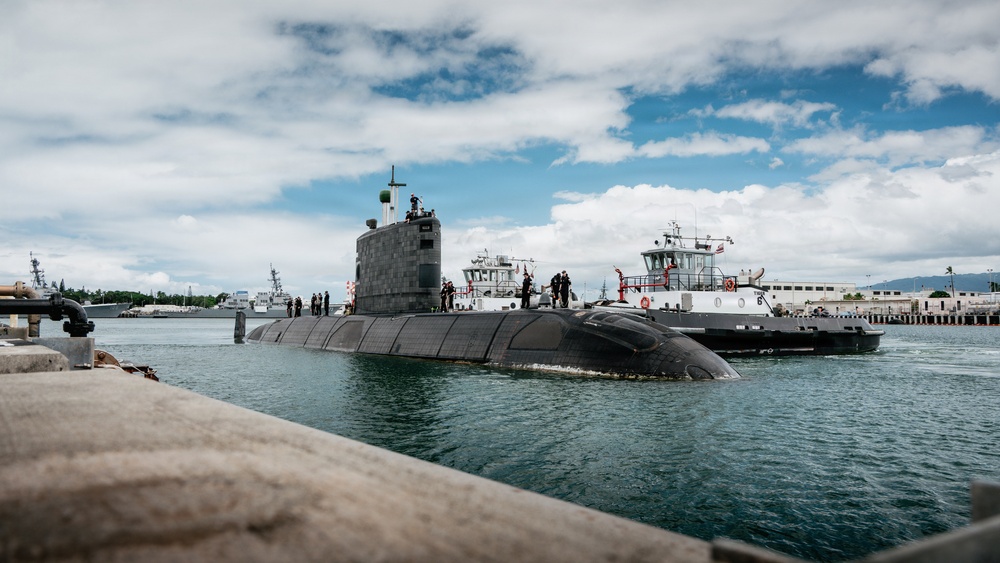
Photo By Petty Officer 2nd Class Nicholas Russell | Royal Canadian Navy submarine HMCS Corner Brook (SSK 878) arrives at Joint Base Pearl...... read more read more
 Subscribe
PEARL HARBOR, Hawaii - As thousands of service members from 30 nations participate in Exercise Rim of the Pacific (RIMPAC) 2026, the world's largest international maritime exercise, civilian professionals assigned to Naval Supply Systems Command (NAVSUP) Fleet Logistics Center (FLC) Pearl Harbor are working behind the scenes to ensure participating forces remain supplied, supported and ready to operate.
While military personnel rotate assignments every few years, many NAVSUP FLC Pearl Harbor civilians have spent decades developing the technical expertise and institutional knowledge necessary to sustain fleet operations throughout the Pacific. Their experience plays a critical role during RIMPAC, where logistics coordination is essential to supporting multinational training and strengthening maritime partnerships.
From contracting specialists and transportation coordinators to supply analysts, logisticians and ocean terminals personnel, civilian employees provide the continuity that enables mission success long before the first ship gets underway and long after exercise operations conclude.
"If the public could see one thing, I would want them to understand that the civilian workforce at NAVSUP FLC Pearl Harbor is the quiet engine powering this massive, multinational event," said Larry Larkin, executive director, NAVSUP FLC Pearl Harbor.
"For the past 24 months, our dedicated ohana has prepared to deliver the world-class logistics required for RIMPAC. This exercise is our opportunity to demonstrate our expertise while welcoming thousands of visiting Sailors, many of whom are experiencing Hawaii for the first time. We want our partners and the public to see a highly capable civilian workforce that stands ready to support the fleet while sharing the true meaning of aloha."
Supporting an exercise the scale of RIMPAC requires extensive planning and coordination across multiple logistics disciplines. Civilian employees work alongside military personnel to manage cargo movements, coordinate transportation requirements, execute contracts and maintain supply chain operations supporting participating forces from around the world.
For many employees, supporting the fleet is more than a job. It is a career built on years of experience and a commitment to operational readiness.
That experience is reflected in the work of Manny Galera, deputy director of ocean terminals, who recently marked 15 years as a federal employee supporting fleet logistics. Galera's team coordinates vessel support requests and cargo movements that keep RIMPAC operations on schedule, ensuring participating forces receive the logistics support they need when they need it.
"We have years of experience reviewing support requests and scheduling each vessel's requirements to ensure every ship receives the support it needs at the right time," Galera said. "Communication is critical, and the ability to deconflict competing requirements at a moment's notice can be the deciding factor in a successful evolution."
As RIMPAC has grown in size and complexity, so to have the logistics requirements necessary to support participating forces. The institutional knowledge maintained by experienced civilian employees enables NAVSUP FLC Pearl Harbor to adapt to changing mission demands while preserving the continuity required to execute large-scale operations.
Although much of the civilian workforce's contribution occurs outside the public eye, it directly enables the readiness of U.S. and partner nation forces participating in RIMPAC. Their expertise in logistics systems, contracting, transportation and fleet support allows NAVSUP FLC Pearl Harbor to respond to complex operational requirements while sustaining the exercise from start to finish.
RIMPAC demonstrates not only the strength of international maritime partnerships but also the value of the civilian professionals whose expertise sustains them. Working alongside their military counterparts, NAVSUP FLC Pearl Harbor's civilian workforce provides the continuity, technical knowledge and experience that transform years of planning into operational success.
As participating forces train together to strengthen interoperability, enhance regional security and promote a free and open Pacific region, NAVSUP FLC Pearl Harbor's civilian professionals remain an indispensable part of delivering the logistics that make the exercise possible. Naval Supply Systems Command provides supply, acquisition and logistics support to the Navy and joint force worldwide. As one of its 11 subordinate commands, NAVSUP Fleet Logistics Center Pearl Harbor enables forward operations and sustains fleet readiness throughout the Pacific. Headquartered in Mechanicsburg, Pennsylvania, NAVSUP employs more than 22,500 military and civilian personnel. In coordination with the Navy Supply Corps, NAVSUP delivers the logistics capabilities required to sustain naval forces and support operational readiness.
Thirty nations, over 30 surface ships, five submarines, 15 national land forces, more than 206 aircraft and 30,000 personnel are participating in RIMPAC in and around the Hawaiian Islands, June 24 to July 31. The world's largest international maritime exercise, RIMPAC provides a unique training opportunity while fostering and sustaining cooperative relationships among participants critical to ensuring the safety of sea lanes and security on the world's oceans. RIMPAC 2026 is the 30th exercise in the series that began in 1971.
For more information and updates on RIMPAC 2026, visit http://www.cpf.navy.mil/rimpac and http://www.dvidshub.net/feature/RIMPAC2026.
Media inquiries should be directed to mailto:rimpac.media@us.navy.mil.
| Date Taken: | 06.26.2026 |
| Date Posted: | 06.26.2026 20:48 |
| Story ID: | 568838 |
| Location: | JOINT BASE PEARL HARBOR-HICKAM, HAWAII, US |
| Web Views: | 251 |
| Downloads: | 0 |

This work, The Civilian Workforce Behind RIMPAC 2026: Experience That Delivers Readiness, by Wesley Burgos, identified by DVIDS, must comply with the restrictions shown on https://www.dvidshub.net/about/copyright.

No keywords found.




