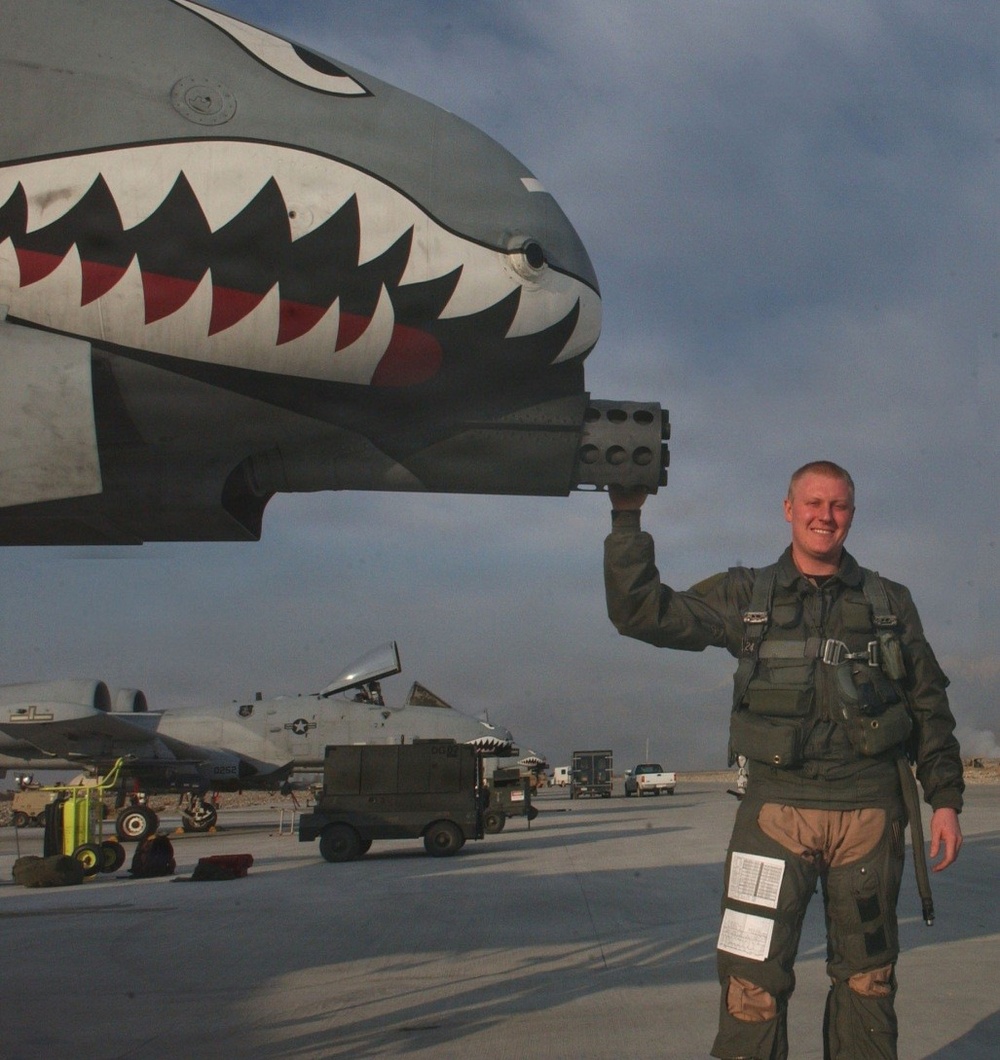
Photo By Senior Airman Savannah Carpenter | U.S. Air Force Col. John Blocher, A-10 Thunderbolt II pilot, poses with his aircraft prior to a combat sortie at Bagram Air Base, Afghanistan, winter 2005. The sortie supported combat operations in support of coalition forces during deployed operations in the region. (Curtesy Photo) see less
| View Image Page
MOODY AIR FORCE BASE, GA. – "If this is all I got left, what do I want to be doing with those last seconds?"
The question came to Col. John "Coke" Blocher on April 6, 2003, as enemy artillery rounds landed around his armored personnel carrier during the opening weeks of Operation Iraqi Freedom.
As an embedded joint terminal attack controller with the third infantry division's lead battalion, Blocher was responsible for integrating airpower for the coalition force driving toward Baghdad. Two artillery rounds had already landed dangerously close. He knew a third was likely coming.
He also knew aircraft overhead were relying on his guidance to strike targets ahead of friendly forces. Fear crept in as he weighed the reality of the situation, but the answer to his question came quickly.
"I want more than anything else to be doing my job, and to be doing it well," Blocher recalled.
Knowing the next artillery round could arrive at any moment, he climbed back up, keyed his radio and continued directing aircraft onto targets. The third round never came.
More than two decades later, the lesson from that day remains.
As America commemorates 250 years of service and sacrifice, Blocher's career reflects the enduring values that have connected generations of military members since the nation's founding. From combat operations during Operation Iraqi Freedom to mentoring the next generation of Airmen, his experiences demonstrate how today's service members carry forward a legacy built by those who answered the call before them while preparing those who will answer it next.
Blocher served as commander of the 93d Air Ground Operations Wing at Moody Air Force Base, leading Airmen across the nation's only Air Force wing dedicated to organizing, training and equipping battlefield Airmen. He is a senior pilot for the A/OA-10 Thunderbolt II and the AT-38 Talon with more than 1,500 flying hours and more than 150 combat hours supporting Operations Enduring Freedom and Iraqi Freedom, his career includes command at multiple levels, service in the Pentagon and recognition for valor under fire, including the Bronze Star and Air Force Commendation Medal with Valor.
Yet when reflecting on his career, Blocher is quick to dismiss the notion that his path was extraordinary.
"I am an incredibly ordinary Air Force academy graduate,” Blocher said. “I am not special. I have never testified in front of congress. I have never accepted some amazing award from a four star and my life is not going to be made into a movie. I have received no special training. I am the perfect example of every man"
There were moments in his career that sharpened his sense of who he wanted to be and how he wanted to serve his country. One of those came during his time as an Olmsted Scholar in Budapest, Hungary. Removed from the day-to-day demands of military service and immersed in a different culture, Blocher found himself viewing America from a new perspective, an experience that reinforced his sense of purpose.
For Blocher, the question was never why he joined the Air Force.
The more important question was why he stayed.
"It took me living in Europe, speaking another language and going to university as a more mature adult, then
looking back at the United States, for me to appreciate and realize what we stand for,” Blocher said. “There's the U.S., liberty, freedom, the pursuit of happiness, all the things in the Declaration of Independence and the Constitution. I believe those things. The thing that really stuck out to me, though, was that the United States military fought wars, and we did what we did, not because it was easy, but because it was right."
One of the defining moments of his career came during combat operations over Baghdad, when a close air support engagement under his control resulted in an A-10 Thunderbolt II being shot down by enemy fire. The pilot, Col. Kim "KC" Campbell, survived the engagement, recovered the aircraft, and flew it back to base, turning what could have been a catastrophic loss into a successful recovery under extreme conditions. For Blocher, however, the outcome carried a different weight.
“My greatest failure was somebody else’s greatest success,” he said.
In the days that followed, he kept returning to the same question, what, if anything, he could have done differently. The moment stayed with him as a reminder that in combat, responsibility rarely ends when the engagement does, but it also reinforced the duty to absorb that weight, learn from it and continue executing the mission.
That perspective took on new meaning years later. In 2019, after a series of unexplained symptoms, Blocher was diagnosed with superior semicircular canal dehiscence syndrome, a rare condition affecting balance and hearing that ultimately required complex brain surgery. The procedure forced him to relearn how to walk, followed by months of rehabilitation before he returned to flying and military service.
During that recovery, he leaned on the same framework that had carried him through combat and adversity. Rather than viewing the experience as an obstacle, he saw it as another opportunity to rely on the same principles that had guided him throughout his career. He invested in spiritual groundedness, physical fitness, mental toughness and social connectedness.
More recently, those principles continued to shape his leadership while serving in the Pentagon during two defining events: the withdrawal from Afghanistan and the opening months of Russia's invasion of Ukraine.
Working alongside senior civilian and military leaders, Blocher witnessed firsthand the complexity of national security decisions and the human impact they carry.
Blocher explained that the experience reinforced the importance of investing in people, emphasizing that even the most capable professionals are strengthened by leadership, coordination and clear communication. He noted that much of his time in the Pentagon was spent understanding individuals’ strengths, how they contributed to the mission and how to better align teams through constant communication.
Blocher explained that his approach to service is rooted in the example set by generations of Americans who came before him. Looking to the nation's founders, veterans of the Civil War and World War II, and even his own grandfather, he said many did not seek recognition or glory, but stepped forward when called and committed themselves to serving with excellence. He continued to say that he sees his own career as part of that continuing legacy. In every role he has held, his goal has remained the same: to do the job exceptionally well and leave those who follow better than he found them.
“I didn't want to do it halfway, I wanted to live a life of no regrets, where I was going to do it as good as I possibly can and put my all into it,” Blocher continued. “Well, so did they, and I feel like in doing that, I am continuing that legacy. I know that the legacy I leave more than anything else is the people that I've influenced. It's the people that I've touched. It's the people that I have lifted up. It's the people that I've inspired and it's the people that I've invested in. That's my legacy. My legacy is not a policy or an upper word or a thing that I've accomplished or an award that hangs on the wall. My legacy lives on in the hearts, the minds and the efforts of the people that I've influenced. It's a great legacy.”
That philosophy continues to shape how he leads Airmen today.
“As the wing commander, I speak to the youngest Airman: you have value, what you're doing matters, what you're doing is decisive and we can't succeed without you,” Blocher said. “We either succeed or do not succeed based upon you playing that critical role and understand that they are a vital part of the bigger picture. What you do today matters and we do not win without it.”
The success depends on every member understanding their role in the bigger picture.
“We've got amazing technology, but the Air Force does not put its trust in its technology, it puts its trust in its people,” Blocher said. “The Air Force believes in you. It believes the grit that got you here will get you there. It believes that you will make the investments so that you will be ready. It believes that it can trust in you. It trusted in me, an ordinary Air Force Academy grad”
For him, that belief extends beyond platforms and operations. It defines legacy.
“I wrote my own story, and so will you,” he explains. “Your life, like mine, will be filled with highs and lows, it will be filled with challenges, it will be filled with things that you do awesome, and probably some failures too. I have to be better from those failures. I have to have the courage to get up.”
As the nation commemorates 250 years of service and sacrifice, Blocher sees a common thread connecting the founders of the nation, the generations who defended it and the Airmen serving today: ordinary people answering the call to serve, striving to do their jobs exceptionally well and investing in those who will follow.
Together, those voices reflect a legacy still being written, one Airman, one legacy and one generation passing its lessons to the next.

 Subscribe






