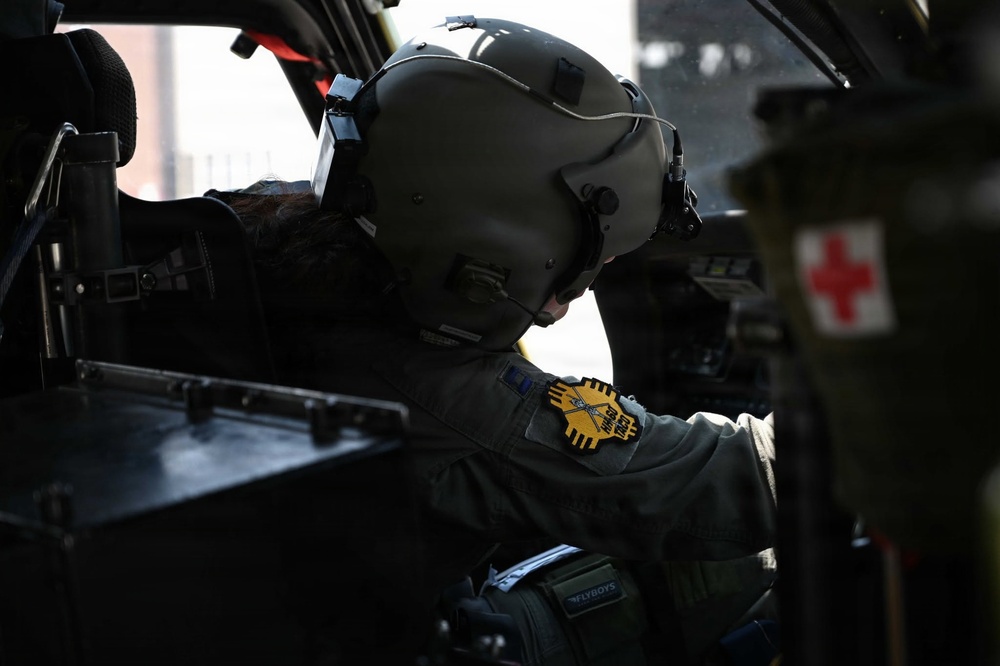
Photo By Staff Sgt. Tyler Catanach | Lt. Col. Danielle Youngberg, HH-60G Pilot, 150th Special Operations Wing, prepares for the final New Mexico Air National Guard flight on the HH-60G Pave Hawk, Aug. 15, 2024. The HH-60G, and now the HH-60W Jolly Green II, serve as vital pillars in the Air Force Rescue enterprise. (New Mexico Air National Guard photo taken by Staff Sgt. Tyler Catanach) see less
| View Image Page
KIRTLAND AIR FORCE BASE, N.M. – When the call came in April 2026 that an F-15E Strike Eagle (callsign "Dude 44") was down in the hostile Zagros Mountains of Iran, the U.S. Air Force executed one of the most complex Combat Search and Rescue missions in history. More than 150 aircraft and scores of special operators were mobilized to bring the crew home.
While the mission was a masterclass in tactical execution, its success began years earlier in the briefing rooms and flightlines of New Mexico’s Total Force Association.This TFA is a joint endeavor comprised of the 150th Special Operations Wing’s 188th Rescue Squadron and 512th Rescue Squadron at Kirtland Air Force Base, N.M.
Through its Total Force Integration mission, the New Mexico Air National Guard’s 150 SOW is the heart of the Air Force rescue enterprise, responsible for training the next generation of CSAR professionals. With over 30 students in the pipeline on any given day and over 140 students annually, the 150th Operations Group oversees the critical flying phase of training for the HC-130J Combat King II and provides an additive role for the HH-60W Jolly Green II platform.
"Our mission is to train and empower the world’s finest mission-ready Combat Search and Rescue aircrew," said Lt. Col. Lonnie Mazuranich, 150th Operations Group Commander. "When a crisis like Dude 44 occurs, our graduates rely on the countless hours of muscle memory built right here. The training flights a student completes alongside the mentorship they receive from our combined TEAM set the foundation for their success as an Air Force Officer first and as Professional Rescue Aircrew. Further, none of this happens without the Maintenance Group, and their ceaseless efforts expanding to the thousands of hours it takes to achieve and deliver the aircraft needed to sustain training throughput.”
The physical rescue, however, is only part of the equation. Before a single aircraft takes off, the mission's success depends on flawless intelligence. This is where the 150th Operations Support Squadron and its Personnel Recovery Intelligence Flight Training Unit are indispensable. Having trained over 540 graduates to date, the PRIFTU is the sole source for this specialized intelligence training. Analysts learn to map chaotic battlespaces, identify threats, and create safe corridors for recovery forces; skills that were critical for navigating the heavy air defenses during the Dude 44 rescue.
From the instructor pilots enduring 12-hour duty days to the SERE specialists and aircrew flight equipment technicians in the 150 OSS, a massive team effort ensures every graduate is prepared. The promise of “These Things We Do, That Others May Live” is kept by the operators in the field, but it is forged by the dedicated Airmen of the 150 SOW.
The Dude 44 rescue is a testament to American resolve. For the men and women in the 150th Special Operations Wing, it is a reminder of their daily, vital mission: Rescue starts here.