
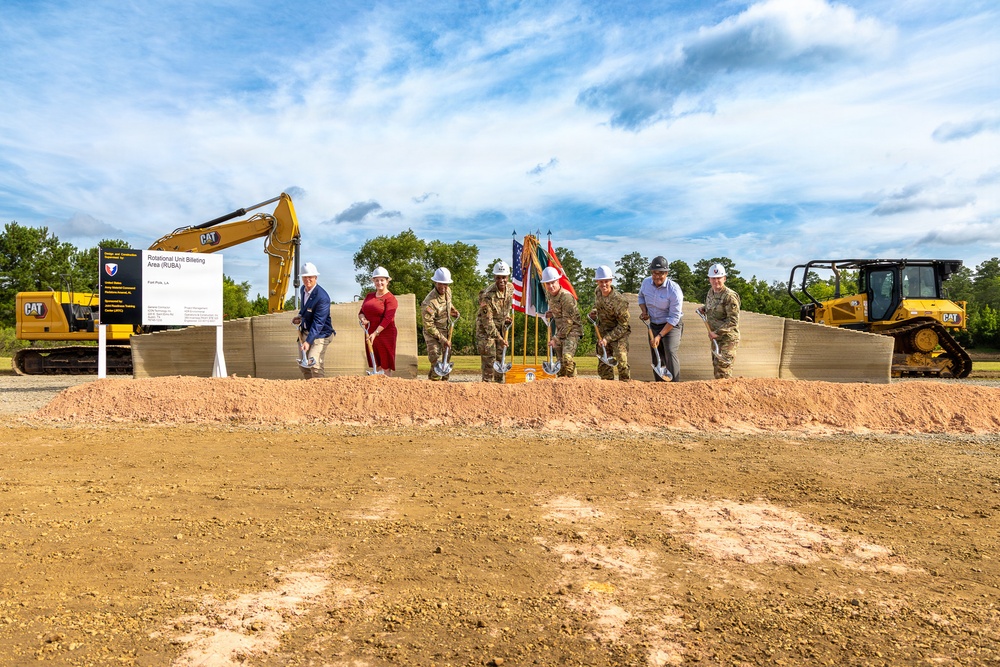
Photo By Porsha Auzenne | From left, Woody Daigle, representative of U.S. Sen. John Kennedy’s office; Whitney...... read more read more
FORT POLK, La. — The Joint Readiness Training Center and Fort Polk broke ground on the new Rotational Unit Billeting Area in North Fort on June 26, marking the start of a major infrastructure project that will enhance lodging and support for rotational training units.
By using advanced 3D printing technology and modern construction methods, the project demonstrates how the Army is modernizing the way it delivers critical infrastructure. By partnering with industry and leveraging advanced construction techniques, the Army is delivering capability faster while providing Soldiers with the facilities they need to build combat power and prepare for large-scale combat operations.
Among those attending the ceremony were Lt. Gen. Gavin A. Lawrence, deputy commanding general of Army Materiel Command; Will Herd, president of ICON Technology Inc.; retired Brig. Gen. Paul Owens of HDR Design Firm, JRTC leadership and community partners from across the region.
Lawrence said the groundbreaking represents more than the start of construction — it marks a transformational investment in the future of training readiness at the Joint Readiness Training Center.
Once completed, the RUBA will feature modern billeting and motor pool facilities capable of supporting up to eight battalions and their equipment. Lawrence said the project will improve support for rotational units, allowing Soldiers and leaders to focus on preparing for the demands of today's complex operational environment.
"The Joint Readiness Training Center remains one of the Army's premier combat training centers," Lawrence said. "The infrastructure we are breaking ground on today will directly contribute to that mission by providing the facilities necessary to sustain high-quality training and readiness for decades to come."
Lawrence also described the project as a key example of the Army's evolving approach to military construction. He said the initiative aligns with the Army's transformation efforts by modernizing how infrastructure is designed and delivered to meet future operational requirements.
"Across the Army, we are embracing commercial construction best practices to deliver better facilities faster, more efficiently and at lower cost to the American taxpayer,” Lawrence said.
Maj. Gen. Jason A. Curl, commanding general of JRTC and Fort Polk, thanked the agencies, industry partners, elected officials and installation personnel whose collaboration helped bring the project to fruition.
"This project continues to be our No. 1 priority," Curl said. "Your support, engagement and commitment to improving Army readiness have been instrumental in making today possible."
Curl said the existing rotational unit billeting area has supported generations of Soldiers but no longer meets the demands of modern training. Units are often dispersed across multiple locations, requiring leaders and Soldiers to spend valuable time navigating aging facilities rather than preparing for combat.
He said the new facility was shaped by extensive Soldier feedback collected through command channels, Interactive Customer Evaluation comments, after-action reviews and social media.
"Our Soldiers want facilities that allow them to focus on building combat power and preparing for training," Curl said. "This project is a direct response to those concerns and a commitment to providing the infrastructure our Soldiers deserve."
Rather than emphasizing appearance, Curl said the new RUBA is designed to improve safety, organization and readiness. The facility will provide space for units to establish communications, configure equipment, troubleshoot vehicles, validate command posts and complete final preparations before entering "The Box," JRTC's tactical training area.
"Units will enter The Box ready to maximize every minute of their rotation," Curl said. "They will enter and fight better prepared, learn more and leave JRTC more lethal and capable than ever before.”
Joshua Corley, chief of the Directorate of Public Works’ Master Planning Division, said the project will have a tremendous impact on rotational units arriving at Fort Polk.
“This new RUBA facility will replace deteriorating billeting trailers with energy-efficient, permanent structures designed to withstand hurricane-force winds, improving safety and readiness for our Soldiers,” Corley said. “With features like fire alarms and sprinkler systems, these upgrades will provide a safer environment so personnel can focus on preparing for combat readiness.
Using innovative technology like 3D concrete printing makes this project even more exciting. Our goal is to deliver a high-quality, lasting product to the warfighter faster and at a lower cost — cheaper, better, and faster.”
Construction is scheduled to begin in 2027, bringing a new era of infrastructure designed to enhance Soldier readiness and support future training missions at JRTC.
| Date Taken: | 06.26.2026 |
| Date Posted: | 06.26.2026 15:33 |
| Story ID: | 568711 |
| Location: | US |
| Web Views: | 140 |
| Downloads: | 0 |

This work, Army breaks ground on JRTC billeting complex, by Porsha Auzenne, identified by DVIDS, must comply with the restrictions shown on https://www.dvidshub.net/about/copyright.


No keywords found.





