
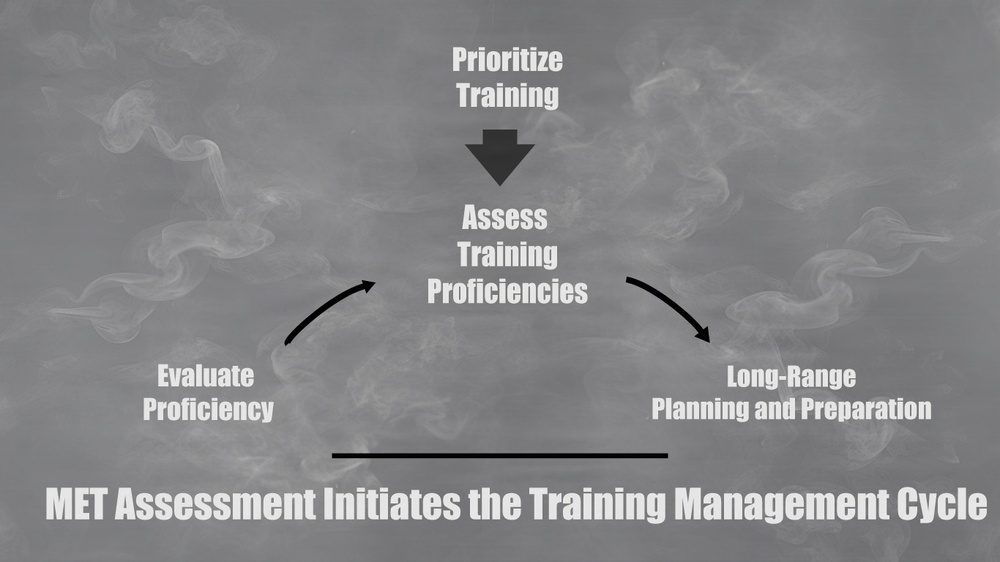
Photo By Jonathan Wagner | MET Assessment Initiates the Training Management Cycle... read more read more
Due to time and resource limitations, units are rarely able to achieve and sustain fully trained proficiency in all mission-essential tasks (METs), collective tasks below company level, and individual tasks simultaneously. Commanders therefore prioritize training based on their unit’s mission and MET assessments. Once training events are completed, commanders consider the evaluation of trained tasks, repetition, observations, input, dialogue, and other factors in their assessment of task proficiency. Although assessment is listed last in the training management cycle, each MET assessment initiates a new round of planning and preparation, execution, evaluation and further assessment, meaning MET assessment is both the start and endpoint of Army training.
Prioritizing training acknowledges the limitations of time and training resources. Commanders use a prioritized training approach to optimize the available time allocated to training on the calendar and training resources, such as land, ranges, and ammunition, to achieve proficiencies based on their unit’s mission and previous assessments. To further focus this effort, the commander engages in dialogue with the next higher echelon commander. Every unit is unique, but the fundamentals of shoot, move, communicate, and survive apply to all types of formations and serve as the basis for prioritization.
At home station, commanders (and staffs at higher echelons) design unit training plans focused on achieving their desired (or directed) proficiency level in their prioritized MET. Their prioritized MET is nested with and promotes accomplishment of the higher commander’s prioritized MET. After selecting the unit’s prioritized tasks, commanders identify events to train the designated tasks in logical progression. Combined Arms Training Strategies (CATS) are tools that the commander can access for assistance in identifying a logical progression of tasks to train with recommended resources. The commander also provides written training objectives for each training event, identifying the tasks and expected proficiency levels. This allows the unit to develop task proficiency by following a progressive training methodology, such as the crawl-walk-run method, starting with supporting individual tasks and advancing through the unit’s prioritized METs.
Unit leaders use the crawl-walk-run method to sequence progressive training events that increase in complexity and build upon one another. Adding more complex tasks and training conditions makes the training more challenging. Leaders and Soldiers enhance their understanding of where and how they, and their unit echelon, fit into the larger operation through multi-echelon and combined-arms training.
All training must be evaluated to measure performance against established standards. Standards can be found in the training and evaluation outlines (T&EOs) for individual tasks, drills, other collective tasks, and collective live-fire tasks. T&EOs provide the known, predictable standard toward which Soldiers prepare and train during training event execution. Execution of tasks during training events is also the culmination of a cycle of short-range planning and preparation (though not the culmination of training management for those events). Knowing what is expected and having evaluators make observations against standards feeds into the after action reviews and eventually the commander’s assessment of task proficiency.
The unit uses internal or external evaluators to evaluate individual and collective tasks performed during execution. Commanders are responsible for training and certifying evaluators. Internal evaluators are part of the organization and may participate in the training whereas external evaluators do not. Commanders ensure a supporting evaluation plan exists for training events. This plan provides trained and certified evaluators with a process to observe and record task proficiency. Evaluators record the results of their observations and provide them to the commander at the conclusion of training as part of feedback. The T&EO will identify the steps and sub-steps of the task, in addition to when evaluation occurs. The evaluators’ observations contribute to the holistic approach of the commander’s assessment. These observations, along with feedback from the training event participants, facilitators, and other observers, are captured and discussed in the after action review (AAR). During the AAR, Soldiers and leaders discuss how well they performed training and what needs to improve.
Only commanders assess training. To do so they must take a holistic view of feedback to “ensure that the final assessment is not based on one or a few sources of feedback but is a balanced consideration of all available information,” according to FM 7-0, Training. Based on observed task performance and other feedback, the commander renders a proficiency assessment (Trained, Practiced, Untrained). Completed T&EOs, personal observations, and commander dialogues are examples of factors commanders consider when assessing a unit’s capabilities. Other factors such as personnel turnover after training may require the commander to assess the unit at a lower proficiency. The commander uses all the information available to assess training proficiency and determine whether the unit achieved the training proficiency level anticipated. Ultimately, the commander’s assessment also informs planning for future training events on the areas that require improvement or sustainment.
The assessment brings the unit back to the beginning of the training management cycle. The commander identifies the prioritized task and directs the unit towards a specified proficiency. Throughout the training management cycle, the unit knows the commander’s expected outcome, providing subordinates predictability on what to train, how often, and to what proficiency. Effective training management relies on the commander’s ability to focus training of individuals, squads, and platoons toward a single goal – MET proficiency. The path toward achieving that goal starts with MET assessment, which resets the training management cycle, leading to another round of planning and preparing.
To learn more about MET assessment, the training management cycle, or prioritized tasks, visit the Training Management Directorate (TMD). TMD, under Combined Arms Command, maintains training management podcasts, tutorials, and tools to help commanders and small unit leaders build sound training plans, conduct more efficient and informative training meetings and briefings, and successfully plan, prepare, execute, evaluate, and assess training exercises. Visit us today at https://atn.army.mil/.
| Date Taken: | 06.25.2026 |
| Date Posted: | 06.26.2026 11:17 |
| Story ID: | 568666 |
| Location: | FORT LEAVENWORTH, KANSAS, US |
| Web Views: | 138 |
| Downloads: | 0 |

This work, MET Assessment Initiates the Training Management Cycle, must comply with the restrictions shown on https://www.dvidshub.net/about/copyright.


No keywords found.





