
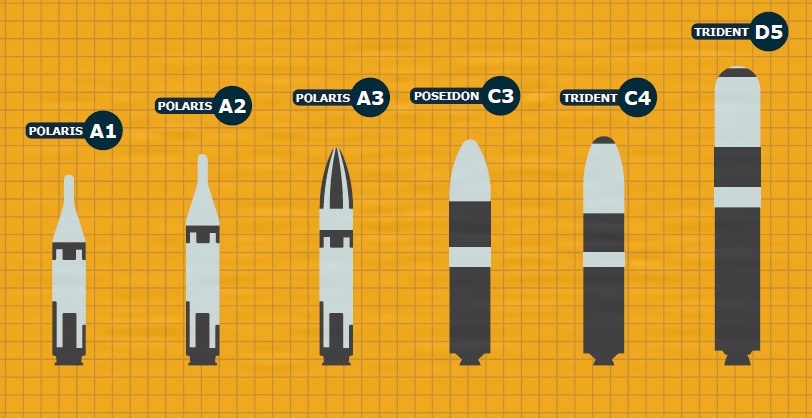
Photo By Jermaine Eubanks | A graphic of the evolution of the U.S. Navy's strategic weapon systems, sustained and...... read more read more
 Subscribe
I. The Imperative: Why Modernization is Essential The U.S. Navy’s Portfolio Acquisition Executive (PAE) Strategic Systems Programs (SSP) is spearheading a massive modernization of its sea-based nuclear weapon system to meet the nation's future defense needs. Modernization of nuclear triad capabilities is focused on the Trident II D5 Life Extension 2 (D5LE2) weapon system and the W93/Mk7 warhead development program. The D5LE2 will replace the currently deployed Trident II D5 weapon system, first deployed on Ohio-class submarines more than 35 years ago. Although a successful life extension program has extended the currently deployed D5LE, further mitigation of aging and obsolescence is not practical without a more extensive modernization effort. The D5LE will be in service through the 2040s for the remaining life of the Ohio-class SSBNs and as the initial loadout on the Columbia-class SSBNs. This is well past the original intended service life of 25 years, and more than double the historical service life of any previous generation of submarine launched ballistic missile. II. The Solution: The Trident II D5 Life Extension 2
The Navy’s solution is the Trident II D5 Life Extension 2 (D5LE2), a next-generation system designed to ensure a credible sea-based deterrent for decades to come. The D5LE2 will be a hybrid of proven, cost-effective, and updated components, maintaining reliability while adapting to new security challenges. This modernization also involves the development of a new nuclear warhead, the W93/Mk7. This marks the first time in nearly forty years that the U.S. has undertaken a new warhead development program, a joint effort with the National Nuclear Security Administration (NNSA).
III. The Enabler: PAE SSP’s Advantage as a DRPM
Since 1955, PAE SSP has been trusted by the Navy to oversee the complete cradle-to-grave lifecycle of each generation of the weapon system, from the Polaris A1 in the 1950s to today’s Trident II D5LE. Operating with complete authority and ownership has empowered PAE SSP to become the technical expert on every aspect of the weapon system, and to build efficiency into every area of the program’s acquisition framework through long-standing openness and trust with industry partners. On 16 March, the Department of the Navy announced PAE SSP’s transition to a Portfolio Acquisition Executive (PAE), reinforcing the success that PAE SSP has had in managing acquisition authority and accountability to rapidly deliver effective capabilities to the warfighter. This transition aligns to DoW’s Warfighting Acquisition System and empowers rapid decision making and execution of PAE SSP’s programs of record across the regional deterrence and homeland deterrence programs. PAE SSP has set the standard for cradle-to-grave lifecycle management since its inception in 1955 - the phrase “Direct Reporting Program Manager” originated with PAE SSP when it was established. Given PAE SSP’s past and present successes within the DRPM architecture, the command's transition to PAE SSP reinforces a well-established ownership culture.
“That mentality is already part of our system,” said Mr. James “Jim” Kern, PAE SSP’s chief engineer. “I’m big into complete ownership of the lifecycle. I believe my team’s willingness to accept complete responsibility and accountability for their areas of ownership is a hallmark of our success. I have zero fear of expectation.”
IV. The Proof: Delivering Tangible Progress
The D5LE2 program is already hitting key targets, with an initial fleet introduction planned for FY39. D5LE2 achieved a Milestone B decision in mid-year 2025 and is currently in the engineering and manufacturing development phase of the acquisition process.
“Reaching the Milestone B decision for D5LE2 marked a key phase in the development of sea-based strategic deterrence,” said Mrs. Kelly Lee, the executive director for PAE SSP. “We keep pushing forward, working collaboratively with our industry partners to accelerate D5LE2 development at an aggressive pace, embracing a wartime mindset.”
Crucial to this effort is the modernization of testing and support infrastructure. In November 2025, PAE SSP brought online Strategic Weapons Systems Ashore (SWS Ashore), a state-of-the-art test facility designed for testing modernizations and alterations of the Trident II D5 weapon systems and Strategic Weapon Support System (SWSS) equipment in a systems integrated facility prior to fleet deployment. The facility expands the ground-based testing capabilities for the sea-based strategic weapons systems to ensure PAE SSP is ready to support the Columbia-class as they come online.
PAE SSP has also begun modernizing the infrastructure that will support D5LE2. In February, Naval Ordnance Test Unit (NOTU), PAE SSP’s field activity responsible for testing and evaluation capabilities and solutions for the Trident weapon system, broke ground on its new Engineering Test Facility, one of nearly 30 projects planned through 2032 to boost testing and evaluation capabilities.
“This Engineering Test Facility represents a critical investment in the infrastructure that underpins our most vital mission,” said Vice Adm. Johnny R. Wolfe Jr., former director of PAE SSP. “This building will be a hub of innovation, a place where our talented engineers and scientists can develop and test cutting-edge technologies, ensuring our Sailors have the most accurate, reliable system at their disposal, modernizing the most survivable and effective leg of our nuclear triad for decades to come.”
Similar upgrades are happening across the nation. In Kings Bay, Georgia, Strategic Weapons Facility Atlantic (SWFLANT) is expanding missile production capacity for the future Columbia-class submarines. Meanwhile, Strategic Weapons Facility Pacific (SWFPAC) in Bangor, Washington, is planning a massive recapitalization program roughly equal to the output of the nation’s largest construction firm, offering significant partnership opportunities for local businesses.
V. The Vision: Securing the Future Deterrent
PAE SSP is leveraging new tools from the Department of War’s (DoW) acquisition transformation, accelerating technology advancements. PAE SSP is also cutting through bureaucracy by coordinating a comprehensive program plan for D5LE2 that includes all requirements, acquisition, infrastructure, lifecycle maintenance, delivery to the submarine warfighter, and disposal.
As part of D5LE2 modernization, PAE SSP is spearheading W93/Mk7, the first new U.S. nuclear warhead since the late 1980s. Nuclear surety is a shared responsibility between the Department of War and NNSA. PAE SSP’s oversight of “end-to-end" program execution, including human resources, cost estimation, and contracting, make it a reliable partner for both industry and U.S. government counterparts, particularly when engaging in programs such as W93/Mk7 where there are overlaps in responsibility and considerable coordination is required.
PAE SSP has been actively planning, budgeting for, and executing construction for critical training infrastructure. These efforts are occurring, have occurred, and will continue to occur more than two decades prior to the early 2040s deployment of D5LE2.
Supporting the future Columbia-class extends beyond construction and budgeting. PAE SSP’s cradle-to-grave responsibility for the current and future sea-based weapons system has allowed the command to start knowledge building opportunities with the Columbia-class Pre-commissioning Unit (PCU). Whether by walking the PCU through the testing facilities at SWS Ashore, or by hosting a week-long orientation for the PCU and supporting industry and laboratory partners at one of PAE SSP’s PMOs to build their understanding of the current and future weapons systems that will be deployed on the Columbia-class, PAE SSP is delivering knowledge and experience to the warfighter ahead of need, supporting the Navy’s priority mission of sea-based strategic deterrence. “I’m really interested in getting that direct interface...,” said Senior Chief Adrian Rowe, the SWS master chief for PCU District of Columbia during a recent PAE SSP engagement that brought the PCU and industry partners together. “Being able to talk directly to the people who are developing the systems and proofing the technology – I think it puts the pieces in order and helps us to have a fuller understanding of what we are doing.”
While modernizing the nuclear triad remains the core mission, PAE SSP is also expanding its portfolio providing solutions designed for emerging threats. The organization is developing regional deterrence options, including the nuclear-armed sea-launched cruise missile (SLCM-N) and the non-nuclear hypersonic Conventional Prompt Strike (CPS) system, providing a wider, more flexible spectrum of deterrence. PAE SSP’s role in providing these capabilities reinforces the command’s expertise in sea-based strategic solutions. As stated by former STRATCOM commander Adm. Chas Richard at a recent Sea Air Space panel, "...all nuclear weapons are strategic, but not all strategic weapons are nuclear."
| Date Taken: | 06.25.2026 |
| Date Posted: | 06.25.2026 14:21 |
| Story ID: | 568586 |
| Location: | WASHINGTON NAVY YARD, DISTRICT OF COLUMBIA, US |
| Web Views: | 357 |
| Downloads: | 1 |

This work, Answering the Call: How PAE SSP is Forging the Future of Sea-Based Deterrence, by Shelby Thompson, identified by DVIDS, must comply with the restrictions shown on https://www.dvidshub.net/about/copyright.

No keywords found.




