By MAJ Eric Johnson 2nd Battalion, 130th Field Artillery Regiment, Kansas Army National Guard and Josh Courage, DEVCOM Aviation & Missile Center
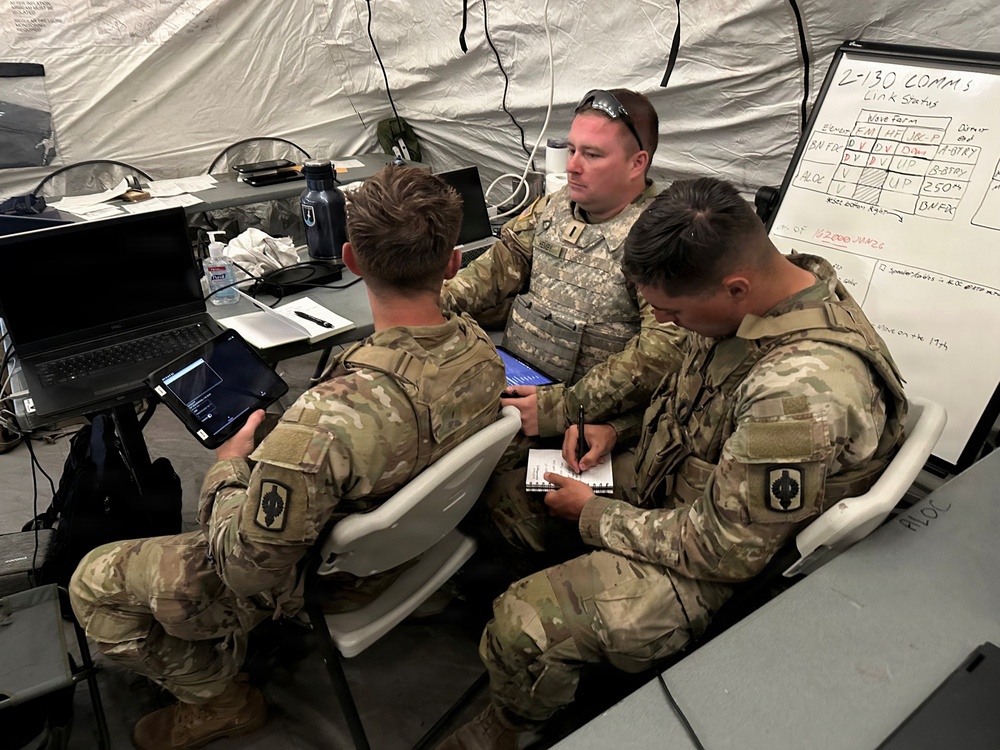
FORT RILEY, Kansas — What began as a concept became a fully executed multi-partner exercise in just six weeks. Soldiers from the 2nd Battalion, 130th Field Artillery Regiment (2-130FA), Kansas Army National Guard, partnered with DEVCOM Aviation & Missile Center (AvMC) and a coalition of defense industry and joint partners to demonstrate next-generation Command and Control (C2) on the move for HIMARS during Remote Archer 26, held June 13–21, 2026 at Fort Riley, Kansas.
The exercise validated critical capabilities for distributed fires in contested environments, with a particular emphasis on Cross-Domain Fires (XDF), our approach that enables Fires as a function rather than siloing capability to Field Artillery or Air Defense Artillery alone. By demonstrating XDF through a mobile Fire Direction Center (FDC), the team showed that fires coordination can transcend traditional domain boundaries, setting conditions for a more integrated and survivable fires enterprise.
"Going from concept to a major joint exercise in just six weeks shows the agility of our Soldiers and partners. It proves the National Guard can rapidly integrate and field next-generation technology to ensure our forces maintain a decisive edge," said Lt. Col. Derek Leeds, commander, 2-130 FA.
Remote Archer 26 brought together a diverse team of joint, interagency, and industry partners: DEVCOM AvMC provided the Global Chameleon (GC) ecosystem; 20th Special Forces Group, Alabama Army National Guard, served as Special Forces observers employing the Target Handoff System (THS) and Android Team Awareness Kit (ATAK) Fires Plugin for Call for Fire; and Science Applications International Corporation (SAIC) provided direct systems integration support. Consultants to Government and Industry (CGI) Federal integrated Joint Operations Command System (JOCS) into the HIMARS Fire Control System through GC, while Weatherhaven supplied the modular shelter system and trailer platform that enabled mobile server operations.
Key technical achievements included maintaining FDC C2 connectivity while on the move, experimenting with Common Autonomous Multi-Domain Launch (CAML) Tactics Techniques and Procedures (TTPs) using HIMARS surrogates demonstrating CAML's potential as an XDF platform for multiple mission types, and successfully passing Sensitive But Unclassified – Encrypted (SBU-E) data through Global Chameleon Ecosystem from sensors at Impact Level 6 (IL6 - highest cloud services classification at Secret level) down to IL2 (publicly releasable; not controlled unclassified information). Notably, the team demonstrated two-way ATAK-to-ATAK communication from Alabama to Kansas servers and validated the USMC THS-to-FDC-to-Launcher workflow for future CAML employment.
The exercise also experimented with trailer-mounted servers and communications both on the move and in stationary offset configurations, proving the viability of field-deployable mobile infrastructure to support distributed C2 independent of fixed facilities.
"Remote Archer 26 proved that Fires are a team sport, not a siloed capability. By demonstrating mobile, Cross-Domain Fires, we've shown a more survivable and integrated way to support the joint force, connecting any sensor to the best shooter," said Leeds.
Remote Archer 26 demonstrated that speed, collaboration, and innovation can rapidly translate emerging concepts into validated capabilities, and the Army National Guard is ready to lead that charge.
| Date Taken: |
06.24.2026 |
| Date Posted: |
06.24.2026 16:34 |
| Story ID: |
568509 |
| Location: |
FORT RILEY, KANSAS, US |
| Web Views: |
30 |
| Downloads: |
0 |
PUBLIC DOMAIN

This work, Kansas Rockets and AvMC Demonstrate Fire Direction on the Move in Under Six Weeks, must comply with the restrictions shown on https://www.dvidshub.net/about/copyright.