
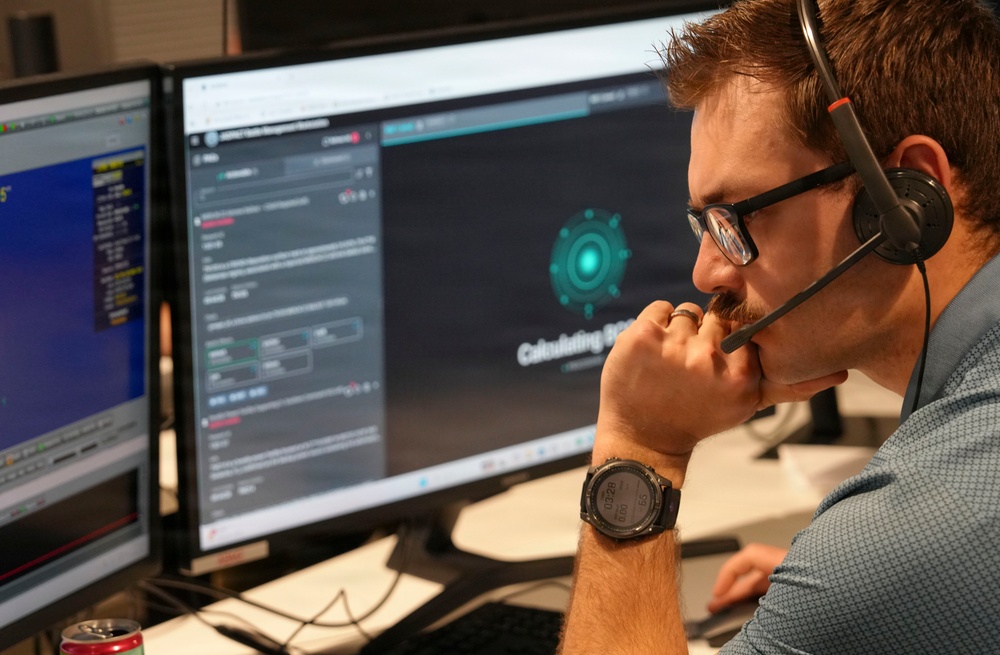
Photo By Debora Henley | A U.S. Air Force air battle manager participates in the Department of the Air...... read more read more
To secure mission dominance in a future, contested environment, the Joint Force must make decisions faster than any adversary. This imperative was the driving force behind the Multi-Decision Advantage Sprint for Human-Machine Teaming, or MASH, a complex, two-week experiment recently hosted in Las Vegas.
Building on the successes of previous single-function Decision Advantage Sprints for Human-Machine Teaming experiments, the MASH marked a significant evolution by integrating an ensemble of artificial intelligence and automation software services from the first three DASH events. For the first time, U.S. Space Force Guardians joined Airmen to work side-by-side with software developers, evaluating how these disparate tools can effectively integrate to solve complex problems across the air, space, cyber, maritime, and ground domains.
“The Combined Joint All-Domain Command and Control Campaign Plan demands that we make better, timelier decisions,” said U.S. Air Force Col. John Ohlund, Advanced Battle Management System Cross-Functional Team director. “By incorporating AI into our battle management architecture, we are ensuring our operators can rapidly process vast amounts of data and deliver lethal effects faster than ever before.”
Conducted within a dedicated Shadow Operations Center-Nellis facility in Las Vegas, the MASH experiment set the stage for this strategic collaboration, led by the Department of the Air Force’s Advanced Battle Management System Cross-Functional Team. The experiment was executed in partnership with the Air Force Research Lab, U.S. Space Force, and the 805th Combat Training Squadron, also known as the ShOC-N, further reinforcing the collaborative effort required to deliver decisive combat power for the Joint Force. Furthermore, four allied nations observed the experiment, gaining insights into the U.S. approach to integrated architectures and setting the foundation for future interoperability.
Space Force Integration: A Critical Milestone
A defining feature of the multi-decision sprint was the active participation of Space Force Guardians. Moving beyond observational roles, Guardians were "in the seat," directly influencing the development of battle management tools that encompass the space domain.
“Working with Air Force battle managers opened my eyes to how the air domain tackles these challenges. Their focus on tempo, synchronization, and rapid Courses of Action iteration mirrors what Space Force needs, especially when dealing with contested electromagnetic environments,” said U.S. Space Force 1st Lt. Abby Warner, 16th Electromagnetic Warfare Squadron deputy flight commander. “Turns out our decision-making headaches are similar across domains, and Transformational Model-based services adapt quickly to space ops.”
U.S. Air Force Lt. Col. Corey Ellsworth, ABMS Cross-Functional Team integration lead, agreed.
“There are parallels to decision advantage requirements between the air and space domains, especially during major combat operations where all domains are contested,” Ellsworth said.
He noted that the next step for the DAF’s solution to battle management is to continue integrating with each service’s modernization approach to data and decision-making. The battle management software solutions tested at the MASH are "directly translatable" to Navy, Marine Corps, and Army partners, emphasizing that this collaboration is the next pivotal step in providing "combat multi-domain power" for the "Total Joint Force."
U.S. Space Force Col. Teina Stallings-Lilly, ABMS Cross-Functional Team deputy director for space operations integration, emphasized the long-term impact of this integration.
"As the operations integrator between the services, my goal is to bridge the gap between our domains," Stallings-Lilly said. "By having our Guardians in the seat for this experiment, they are seeing the direct applicability of these AI tools and, in turn, are providing the expertise needed to build a truly integrated DAF Battle Network."
Stallings-Lilly explained that the DAF is moving beyond simple decision support systems to field capabilities that process information at machine speeds. This sprint, she noted, is fundamentally about building a human-machine team that ensures operators can think faster and stay decisively ahead of any adversary.
The need for deep, cross-service integration extends far beyond the air and space domains, shaping the future of command and control. “The reason we challenge the software to solve multi-domain problems is because that's the reality of the future fight,” said Ohlund. “An Air Force air battle manager doesn't have the authority to execute a space or cyber effect, but like any good staff officer, it's their job to prepare the information and package the options for the general. We want the computers to do that work, to ruminate over every possible multi-domain effect; that way we can present the highest quality menu of decisions to the right commander, faster than ever before.”
WARTECH: Co-Creation for Rapid Fielding
This deep integration of multi-domain warfighters into the development process is a key component of the larger AFRL process known as WARTECH, which brings together warfighters, technologists, planners, and acquisition personnel to collectively develop operational concepts motivated by future force design and enabled by high-payoff science and technology.
“The DASH to MASH series is really a textbook example of what WARTECH is intended to accomplish and right in line with the Command, Control, Communications, and Battle Management strategy for agile, rapid, and iterative fielding of software solutions to support immediate warfighter needs and long-term force modernization,” said Jeffrey Palumbo, AFRL C3BM Capability Area lead. “This approach of user-producer co-creation allows for proof of concept, energizes the industrial base, allows for early operator feedback to shape development, and sets us up to deliver chunks of decision advantage capability to the warfighter in a rapid and repeatable cycle.”
The MASH Ensemble: Perceive Actionable Entity, Match Effector, and Generate Battle COAs
The experiment challenged six industry software development teams and the ShOC-N’s own military software development team to build tools that address three core decision functions derived from the DAF’s Transformational Model:
A major breakthrough of the event was the successful integration of these disparate vendor tools.
“AFRL has done incredible work building an orchestrator that ensures these different companies can exchange data, ontologies, and metadata seamlessly,” Ohlund said. “We are proving that a true plug-and-play,modular approach not only works, but it fosters continuous competition and allows the government to select the best-of-breed software services as they mature.”
The Warfighter as Expert Evaluator
Throughout the sprint, the Airmen and Guardians were tasked not just as operators, but as expert evaluators. Their mission was to stress-test the AI's decision logic, identifying limitations and providing immediate feedback to the developers sitting directly behind them.
“This is a true co-creation environment where software developers work directly with warfighters to ensure the tools meet their exact needs,” said Elizabeth Frost, AFRL MASH lead. “The teams are eager for feedback and implemented changes rapidly. This collaborative effort paid off during the second week of the sprint, as we saw a remarkable increase in the volume and quality of courses of action submitted.”
The operational impact of this co-creation was immediate and undeniable for the tactical operators.
“A week ago, it took my team and me 50 minutes to an hour to get one tasking done. With the help of the tool, we were able to get five or six taskings done,” said U.S. Air Force Capt. Adam Sochia, 552nd Operations Support Squadron ABM. “Basically, in the amount of time that we can do one tasking, this tool gives us the data and accurate options to complete five or more additional taskings.
Delivering a Lethal, Integrated Future
The event also featured the ShOC-N's military software development team, who built their own solutions alongside industry. According to Carlos Dye, the ShOC-N MASH software development team lead, the military developers focused on applying their direct operational experience to the coding process. Their approach ensured that the machine took the brunt of the data processing, while the human operator remained firmly in control of the final tactical decisions.
This unique environment, which physically co-located military operators, Airmen developers, and industry partners, was critical to the event's success.
"The synergy we are seeing here... is what has been lacking in previous attempts to accelerate delivery of warfighter capability," said Lt. Col. Wesley Schultz, 805th CTS/ShOC-N commander. "Our mission at the ShOC-N is to remove barriers to creative problem-solving, allowing us to turn innovative concepts like human-machine teaming into tangible, lethal capabilities at speed."
A key factor in enabling that speed and synergy was the underlying technical framework. Elizabeth Frost, the AFRL MASH lead, noted that by establishing a common application programming interface and architecture, the team was able to provide a unified user interface. This meant that regardless of which vendor’s software was running in the background, the experience remained consistent and intuitive for the warfighter, proving that integrated tools deliver a far better outcome than isolated solutions.
Ultimately, the MASH experiment provided an actionable blueprint for the future of multi-domain operations. The event validated the DAF’s Transformational Model, proving that when battle management is broken down into specific decision functions with a common integration framework, machines can process data at a speed unmatched by humans.
Ohlund concluded, “By demonstrating that diverse, AI-enabled tools can integrate effectively within this model to accelerate the kill chain, the DAF has taken a critical step toward securing decision advantage for the Joint Force.”
| Date Taken: | 06.24.2026 |
| Date Posted: | 06.24.2026 16:08 |
| Story ID: | 568505 |
| Location: | LAS VEGAS, NEVADA, US |
| Web Views: | 579 |
| Downloads: | 0 |

This work, Space Force Integrates with Air Force in AI Sprint to Ensure Mission Dominance, by Debora Henley, identified by DVIDS, must comply with the restrictions shown on https://www.dvidshub.net/about/copyright.


No keywords found.





