
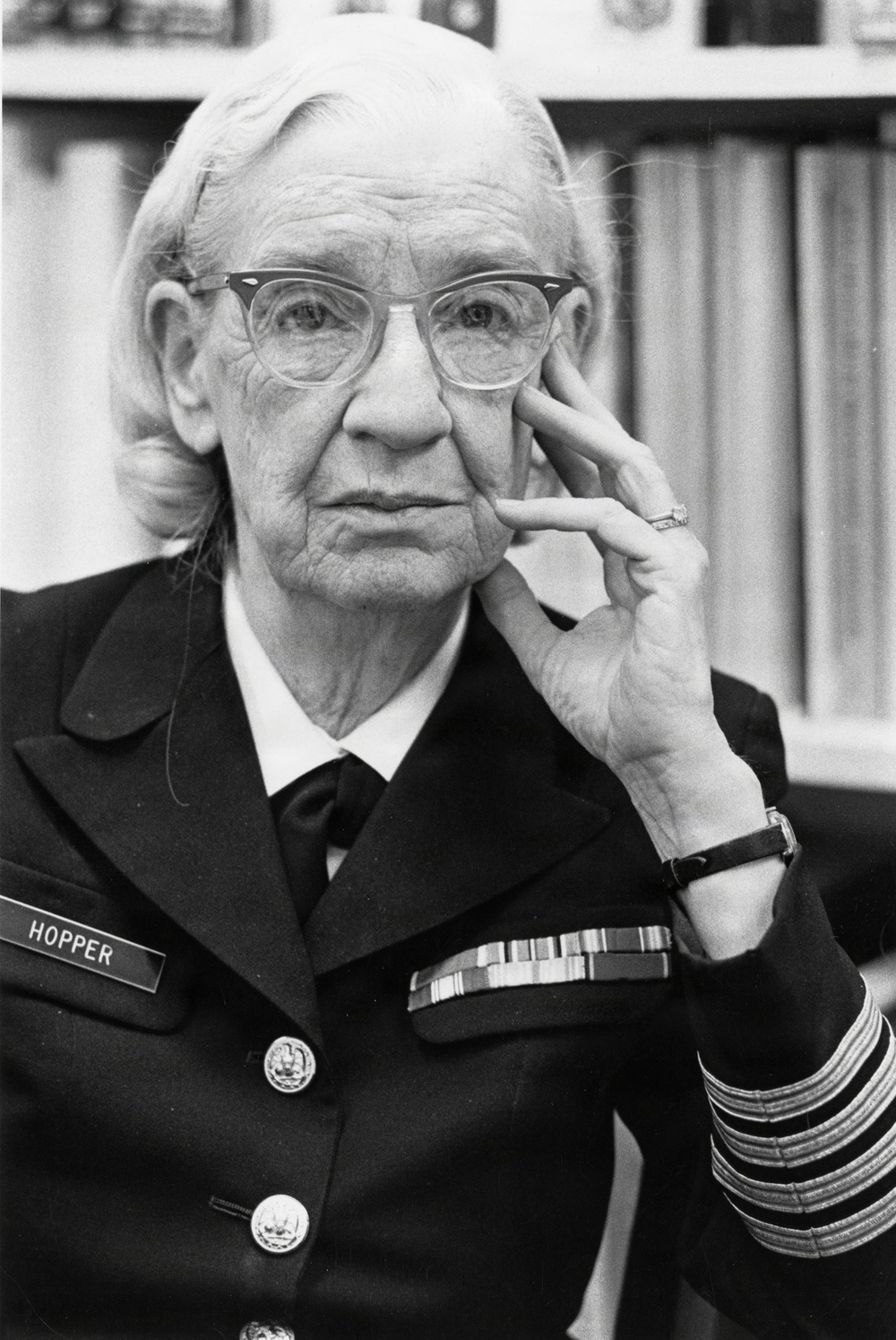
Courtesy Photo | Washington, D.C. - Capt. Grace Murray Hopper, Director of Programming languages for...... read more read more
 Subscribe
The phone rang in August 1967, piercing the quiet of retired U.S. Navy Cmdr. Grace Murray Hopper's civilian life. It was the Pentagon.
Just eight months earlier, she had been forced to hang up her uniform due to age limits, stepping away from the service she cherished. But the U.S. Navy had sailed into rough waters with its rapidly expanding computer systems, a chaotic, tangled mess of incompatible languages spread across the fleet. They didn't just need a programmer; they needed the Sailor known to many as "Amazing Grace" to bail them out. When the brass asked her to return to active duty to untangle the digital chaos, there was zero hesitation from the 60-year-old computing pioneer.
"They knew I would come running if they called," she later recalled.
This is the story of a relentless pioneer whose dedication to the U.S. Navy could not be severed by a standard-issue retirement certificate. From earning a rare doctorate in mathematics in the 1930s to her unprecedented recall to active duty, that eventually led to the rank of rear admiral, Hopper’s journey demonstrates how one visionary person reshaped the technological foundation of the U.S. armed forces and the computing industry.
Hopper's incredible ascent through the ranks to rear admiral began long before that phone call. Armed with a Ph.D. in mathematics from Yale University in 1934, an incredibly rare accomplishment for her day, Hopper was a respected professor at Vassar College when World War II broke out. Leaving the security of academia, she was determined to join the war effort. As President Barack Obama would later note, she was a gutsy woman who joined the U.S. Navy despite being 15 pounds below military health standards. Commissioned as a lieutenant (junior grade) in 1943, she dove headfirst into the bleeding edge of wartime technology, becoming one of the first programmers of the massive Harvard Mark I computer.
After the war, while continuing to serve in in the Navy Reserve, she conquered the civilian computing world. Joining the Eckert-Mauchly Computer Corp. in 1949, she worked on the UNIVAC I. Hopper saw a future that others could not. She faced immense pushback from a scientific community that believed computers were strictly calculators. Battling the mindset she famously despised, Hopper noted that the greatest obstacle to innovation is taking the stance, “we've always done it this way.” Heaven help anyone who uttered that thought in her presence.
She championed the radical concept that machines could operate using programs based on the English language instead of symbols. By 1952, she published the first paper on compilers, laying the direct groundwork for the common business-oriented language (COBOL) and earning her the affectionate titles "the Grand Lady of Software" and "Grandma COBOL." Through it all, her legendary reputation was fueled by her impatience with bureaucracy and her absolute belief in her mission. She operated by a fiercely independent code, epitomized by her famous quip: "It's easier to ask forgiveness than it is to get permission."
Her greatest professional setback came in December 1966 when age restrictions forced her onto the retired list. For Hopper, a patriot completely devoted to her country, leaving the service was a devastating blow. She described it as, "the saddest day of my life."
Yet, her heartbreak was short-lived. Following that fateful Pentagon phone call in 1967, she sprang back into action. Returning to active duty, she tackled the monumental struggle of standardizing high-level computer languages across the fleet. Through sheer technical brilliance and unwavering determination, she brought order to the chaos. Her relentless drive saw her continually promoted: to captain in 1973, commodore in 1983, and finally rear admiral in 1985.
When Rear Adm. Grace Hopper finally retired in 1986 at 79 years of age, she was the oldest commissioned officer in the U.S. Navy. Her formidable legacy included a Defense Distinguished Service Medal, an unprecedented "Man-of-the-Year" award in Computer Sciences, and dozens of honorary doctorates. Her impact was so profound that in 2016, she was posthumously awarded the Presidential Medal of Freedom.
"If Wright is flight, and Edison is light, then Hopper is code," President Obama proclaimed.
Yet, despite all the honorary degrees, the foundational software patents, and the praise of presidents, the ultimate measurement of her success was always tied to the uniform she refused to permanently take off. Looking back on a lifetime of awards, "Amazing Grace" often said that above all else, she was most proud of her service in the U.S. Navy.
| Date Taken: | 06.04.2026 |
| Date Posted: | 06.24.2026 12:16 |
| Story ID: | 568456 |
| Location: | US |
| Web Views: | 108 |
| Downloads: | 0 |

This work, Code, Commission, and Character: The Unstoppable Career of Rear Adm. Grace Hopper, by PO2 Maci Sternod, identified by DVIDS, must comply with the restrictions shown on https://www.dvidshub.net/about/copyright.


No keywords found.




