
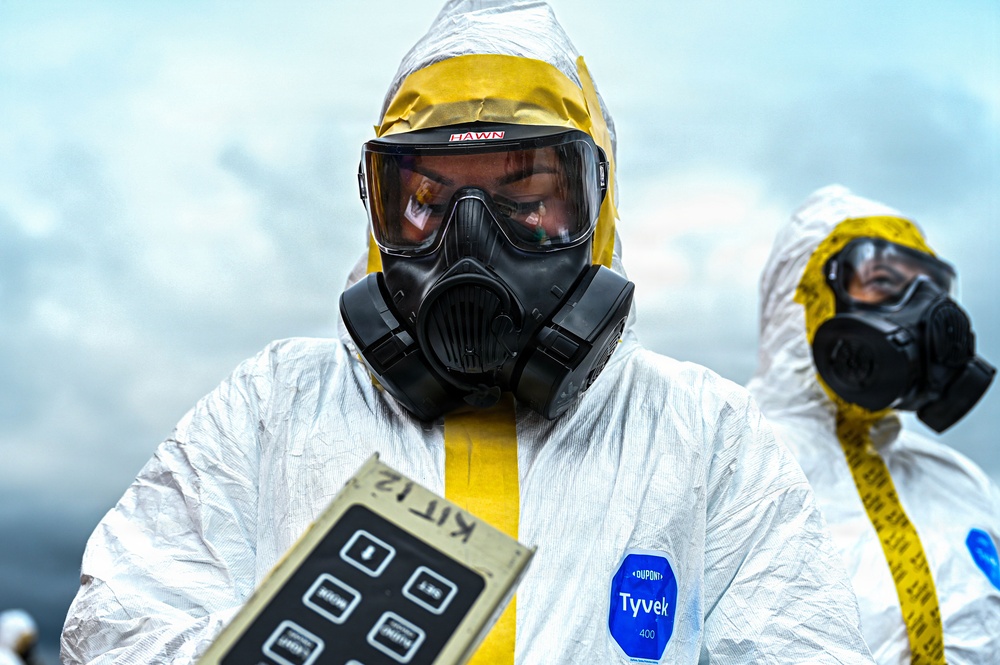
Photo By Senior Airman Mattison Cole | Two Air Force Global Strike Command Airmen participate in the HYDRA FURY exercise...... read more read more
 Subscribe
F.E. WARREN AIR FORCE BASE, Wyo. — The 90th Civil Engineering Squadron Explosive Ordnance Disposal flight hosted HYDRA FURY 26 at F.E. Warren Air Force Base on May 20, bringing together Department of War EOD personnel and interagency partners for a joint nuclear accident and incident response training exercise. HYDRA FURY is an annual training exchange sponsored by the Defense Threat Reduction Agency that strengthens coordination among departments and agencies including the Federal Bureau of Investigation, Department of Energy, state and local law enforcement, and Air Force Global Strike Command EOD flights. The exercise focuses on nuclear weapon accident and incident response operations, such as the identification of weapon components, communication with headquarters and national-level response teams, and consequence management procedures. “Hydra Fury, at its core, is a knowledge exchange sponsored by the Defense Threat Reduction Agency”, said Staff Sgt. Alex Guant, 90 CES EOD quality assurance noncommissioned officer in charge. “It brings DoW, FBI and DOE personnel together for a week and allows units to be face-to-face with each other while tackling scenarios in a controlled environment. This is crucial, as many of these units rarely interact with one another on this level and lends itself to aid in tactics, techniques, and procedures adjustments and familiarity of roles during an incident.” Teams from F.E. Warren AFB, Whiteman Air Force Base and Malmstrom Air Force Base participated in the weeklong exercise, each completing three training scenarios. This year marked the first time in seven years that F.E. Warren AFB hosted HYDRA FURY. All parties involved, spent more than nine months planning and coordinating the exercise to strengthen interagency partnerships and operational readiness. “As these types of responses are dealing with national level assets, failure to coordinate and communicate efficiently and effectively could lead to the incorrect posturing and usage of hundreds to thousands of personnel,” said Guant. “From the strategic level, this could lead to various violations of personnel safety, delayed response times of national level response teams, and could generate an incorrect site picture that could have high-level personnel making decisions with wrong information. Coordination is also critical as it will aid the various agencies involved in knowing when, where, who, what, and how they need to respond and the extent they need to respond.” By training in a realistic and collaborative environment, HYDRA FURY reinforced the importance of integrated response capabilities. The exercise ensured participating teams remain prepared to respond effectively in high-consequence scenarios while continuing to strengthen the partnerships critical to mission success. “Success in this instance can be answered with these questions: “Did you learn something new? Were you able to coordinate with the other agencies? Was this effort worth it? Are you able to take some lessons learned back to your unit with you? If the answer to any, ideally all of them, of those questions is a yes, then the event was a success,” said Guant. “Even if there were small amounts of new knowledge learned or minimal success in coordinating with the other agencies, I’d still call this a success as it’s just another building block for everyone involved.”
| Date Taken: | 05.20.2026 |
| Date Posted: | 06.23.2026 16:48 |
| Story ID: | 568426 |
| Location: | FRANCIS E. WARREN AIR FORCE BASE, WYOMING, US |
| Web Views: | 11 |
| Downloads: | 0 |

This work, F.E. Warren AFB Hosts HYDRA FURY 26, by SrA Mattison Cole, identified by DVIDS, must comply with the restrictions shown on https://www.dvidshub.net/about/copyright.


No keywords found.




