
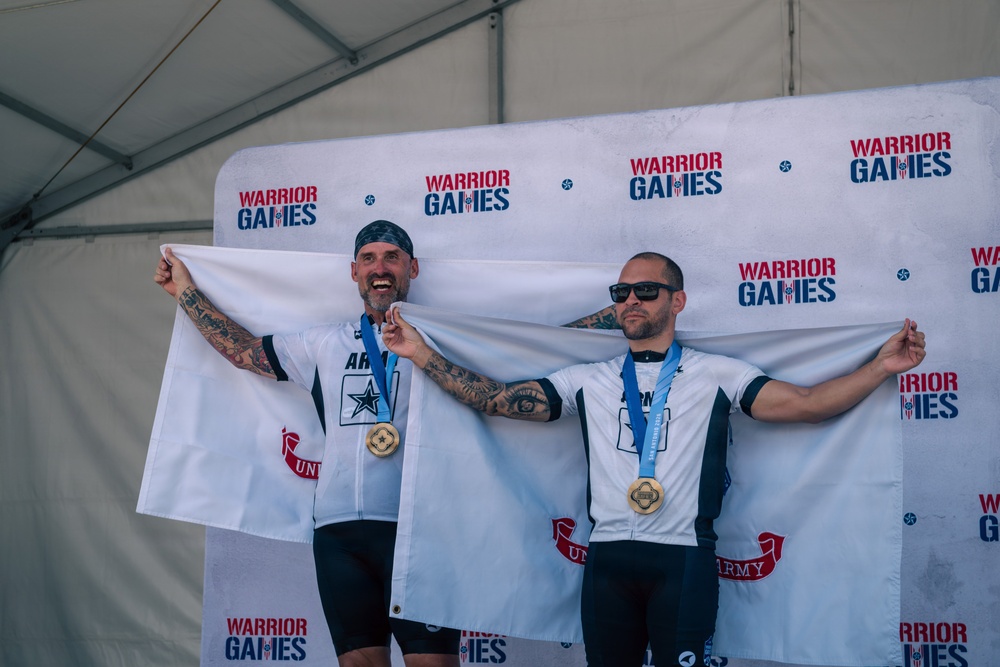
Photo By Spc. Jose Rolando Garcia | Retired U.S. Army Sgt. 1st. Class Greg Quarles, left, and Staff Sgt. Xavier Rodgers,...... read more read more
 Subscribe
UNION CITY, Ga. – June 23, 2026 – During Warrior Games competition, spectators see medals awarded, records broken and Team Army competitors representing their service on a national stage. What many don’t see are the coaches, mentors and subject matter experts working behind the scenes to help make those moments possible.
For wounded, ill and injured Soldiers, adaptive sports are about far more than competition. Through the Army Recovery Care Program, sports provide opportunities to rebuild confidence, restore purpose and reconnect with a team environment. Coaches and subject matter experts help guide that process, often becoming mentors who show competitors what’s possible beyond injury or illness.
Retired Sgt. 1st Class Greg Quarles understands that journey firsthand.
A retired Soldier who was injured during combat operations overseas, Quarles discovered adaptive sports during his own recovery and later found a new mission helping other Soldiers navigate the same path.
“Adaptive sports completely changed my life,” Quarles said. “After competing on Team Army and then moving on to Invictus, I was offered the opportunity to come back as a coach. It gave me a chance to come full circle and give back where I started while helping mentor Soldiers with similar or even worse injuries and showing them that the sky’s the limit.”
Now in his fourth year as a Warrior Games coach, Quarles serves as Team Army’s head rowing coach, assistant cycling coach and visual impairment pilot. His role allows him to support athletes across multiple sports while helping them discover strengths they may not have known they still possessed.
This year, Team Army competitors delivered several strong performances in rowing and cycling. While medals helped tell part of the story, Quarles said some of the most meaningful victories happened away from the podium.
“What stood out most was seeing athletes who didn’t think they could do anything because of their injuries or illnesses, believe in themselves,” Quarles said. “Everything the coaches were teaching them started to come together. Whether they won a medal or not, many of them set personal records. Seeing the smile on their faces when they realized what they could accomplish, that’s what this is all about.”
For Quarles, adaptive sports play a unique role in recovery because they challenge competitors both physically and mentally.
“The role sports play in recovery is both mental and physical,” he said. “It allows Soldiers to adapt and overcome. No matter what injury or illness they’re dealing with, they can still be competitive, they can still have a purpose, they can still have a mission, and they can still be part of a team.”
Those lessons extend beyond rowing machines, bicycles and competition venues. They often carry into everyday life as Soldiers continue navigating recovery long after Warrior Games concludes.
Another person helping support that mission this year is Paul LettBrown, an Army veteran who has served on Team Army’s medical team as a physical therapist assistant for the past three years.
Although LettBrown never competed in the Warrior Games, he said his prior service gives him a personal connection to the Soldiers he supports.
“I love working with injured Soldiers to get back to their highest level of function and sports competition,” LettBrown said.
This year, LettBrown also served as Team Army’s pickleball subject matter expert. Pickleball made its Warrior Games debut as an exhibition sport, giving competitors an opportunity to compete in one of the nation’s fastest-growing sports while showcasing its potential as a future official event.
For him, pickleball is more than a game. It became a way for him to remain active after his own injuries changed the way he participated in sports.
“It meant a lot to me as it became my stress relief and way to stay active once my injuries caused me not to be able to play other sports,” LettBrown said. “It’s a sport that you can play at any age or injury.”
Team Army finished first overall in the exhibition competition, earning unofficial bragging rights while helping demonstrate how quickly adaptive athletes can learn, adjust and compete in a new sport.
“Team Army impressed me with how fast they picked up the concept and skills of the game,” said LettBrown. “They took it out into competition and dominated,”
Although pickleball results didn’t count toward official Warrior Games standings, the event generated excitement among competitors and highlighted how adaptive sports continue to evolve to meet Soldiers where they are in recovery.
For both Quarles and LettBrown, some of the most rewarding moments have little to do with medals.
Quarles said one of his greatest measures of success is watching Soldiers discover confidence they didn’t know they still had.
“For me, success is taking those athletes who didn’t think they belonged here and helping them realize they do,” Quarles said. “When they have that moment where they finally believe in themselves, that’s what inspires me. Hopefully they’ll take what they’ve learned and one day come back and help the next generation of athletes.”
Looking beyond the medal count, Quarles said the true story of Warrior Games is one many people never fully see.
“Every Soldier here is dealing with something, whether it’s physical, mental, visible or invisible,” he said. “What people don’t see is everything they had to overcome just to get here. They put those challenges aside, dug deep, believed in themselves, believed in each other and became one team.”
Through coaching, mentorship and adaptive sports, leaders like Quarles and LettBrown help make that possible, proving that behind every performance is a recovery journey still being written.
| Date Taken: | 06.23.2026 |
| Date Posted: | 06.23.2026 10:43 |
| Story ID: | 568374 |
| Location: | UNION CITY, GEORGIA, US |
| Web Views: | 233 |
| Downloads: | 0 |

This work, Behind the Medals: Team Army Coaches and Mentors Help Soldiers Rediscover What's Possible, by Vernishia Vaughn, identified by DVIDS, must comply with the restrictions shown on https://www.dvidshub.net/about/copyright.


No keywords found.




