LINCOLN, Neb. — A massive cybersecurity exercise designed to test and strengthen the digital defenses of critical infrastructure concluded here on Friday, June 12, following two weeks of simulated, highly sophisticated cyberattacks.
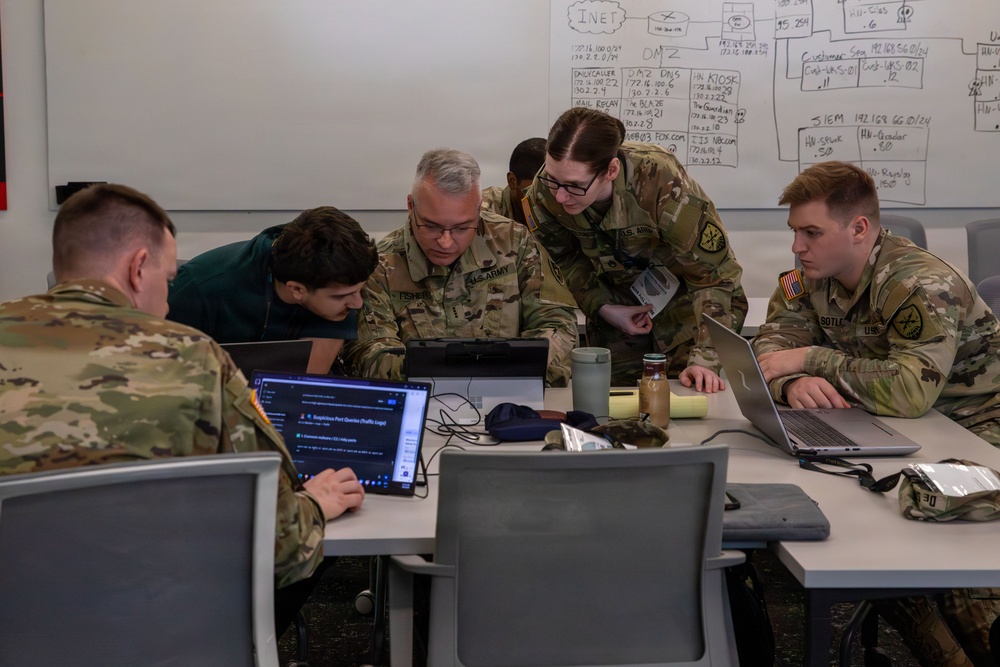
The fifth annual exercise, known as Cyber Tatanka 2026, brought together 243 participants from federal, state, military and private sector organizations at Kiewit Hall on the University of Nebraska-Lincoln campus. Running from June 1-12, the event served as a collaborative proving ground for defensive cyber operations.
"Cyber Tatanka is Nebraska's premier defensive cyber range exercise," organizers noted in planning documents, highlighting its mission to safeguard regional networks against emerging threats.
“When this started five years ago Cyber Tatanka was a military-led event,” said Brig. Gen. Robert Hargens, Nebraska Air National Guard assistant adjutant general. “It has since transformed into a civilian-led event. There’s an incredible amount of planning and work that goes into doing this event, so I want to thank Cyber Strong Nebraska for putting this on.”
The importance of the cyber realm is echoed in the exercise’s very name.
Tatanka is ancient word used by members of the Lakota tribes to describe the bison that ranged across a seven-state region of the central and northern American Great Plains, said Ryan Carlson, a retired Nebraska Army National Guard major who helped develop the original exercise concept with several leaders of Nebraska public infrastructure organizations to give cyber defense specialists an opportunity to learn more about current network protection efforts and collaborate with fellow computer and network defense specialists, while also testing their organization’s cyber response plans in a safe yet realistic virtual environment.
“The indigenous people relied on the bison for their way of life. It was their food. It was their shelter. It was their clothing. It was their tools…” Carlson said. “It was something they greatly respected, and it was something they realized they needed to protect to support their way of life.”
“We see interconnected systems as kind of that same thing,” Carlson added. “Interconnected systems are extremely important to maintaining our way of life. And they are something that we must protect.”
The exercise is led by Cyber Strong Nebraska, a non-profit organization developed to plan and carry out the exercise. The Nebraska National Guard participates and supports through the Army’s Innovative Response Training program and is one of several major partners including multiple private, public and educational institutions.
The first week of the event focused heavily on academic training and network validation. Participants engaged in specialized courses, including Antisyphon training and participated in "Backdoors & Breaches" tabletop exercises designed to reinforce tool proficiency and management frameworks.
The second week shifted to a live-fire range phase hosted on a simulated business enterprise network provided by Cloud Cyber Range. Defensive teams faced daily vignettes with threat actors that grew progressively more sophisticated. The scenarios, mapped to the industry-standard ‘MITRE ATT&CK’ framework, forced participants to actively detect, respond to and mitigate live network intrusions.
“The person is the program,” said Dana Turner, a director for Cyber Strong Nebraska. “If you’re not stress-testing your people on realistic conditions on a regular basis, you have no idea how they will perform when it actually matters.”
The multi-sector makeup of the exercise reflected the growing necessity of a unified response to digital threats. Defensive enclaves integrated National Guard and Active-Duty personnel from Nebraska, Arkansas, Colorado, Texas and Vermont alongside civilian specialists and local college students.
The exercise also drew key international partners through the National Guard's State Partnership Program. As part of the program, two service members from Tanzania and one from the Czech Republic integrated directly into the defensive enclaves to collaborate and share best practices with the Nebraska National Guard teams.
The exercise's global coalition of participating countries includes the United States, Austria, the Czech Republic, Jordan, Chile and Tanzania. Together, these participating nations represent a combined global footprint of approximately 511 million people. Domestically, the geographic diversity of attendees spanned five states and territories: Texas, Colorado, Vermont, Nebraska and Guam.
Czech Armed Forces 2nd Lt. Jakub Richder participated in this year's exercise. He graduated last year with a master’s degree in the cyber defense field and joined the Czech’s 92nd Cyber Warfare Group.
“Seeing the threats in real time and going through the tools that we have together has helped me understand it better,” Richder said. “This has been a great experience, seeing how another military works and how they communicate. This experience will definitely help me come back home as a better cyber soldier.”
A broad coalition of Nebraska infrastructure and business pillars anchored the civilian side. Entities such as the Nebraska Public Power District, Lincoln Electric System, Metropolitan Utilities District, Union Bank & Trust, Bryan Health and Union Pacific Railroad worked side-by-side with state agencies like the Nebraska Emergency Management Agency and the State of Nebraska Office of the Chief Information Officer.
“Nation states used to go after each other's military targets and government systems,” Turner said. “That has shifted. They now go after utilities in small Nebraska towns, the regional hospital, the corner pharmacy, the community bank. The target set has expanded to include everyone, people who never signed up to be on the front lines of a geopolitical conflict.”
“You cannot defend a threat landscape that broad with a single organization, a single organization or chain of command, you need a coalition,” Turner added.
Over its five-year run from 2022 to 2026, Cyber Tatanka has directly trained 750 military, civilian, academic and government professionals. That cohort includes 250 U.S. military personnel and over 50 international allied military personnel. Ultimately, the cumulative reach of Cyber Tatanka's domestic training serves and protects more than 62 million Americans across eight states, stretching from the Northeast to the Mountain West and the South, while directly safeguarding over 2 million Nebraskans.
“We are stronger together than we are apart,” Turner said. “Cyber Tatanka is the answer to that problem.”
| Date Taken: |
06.17.2026 |
| Date Posted: |
06.22.2026 14:45 |
| Story ID: |
568330 |
| Location: |
NEBRASKA, US |
| Web Views: |
201 |
| Downloads: |
0 |
PUBLIC DOMAIN

This work, Defending the Heartland: Cyber Tatanka strengthens shield over vital infrastructure, by SSG Gauret Stearns, identified by DVIDS, must comply with the restrictions shown on https://www.dvidshub.net/about/copyright.

 Subscribe






