
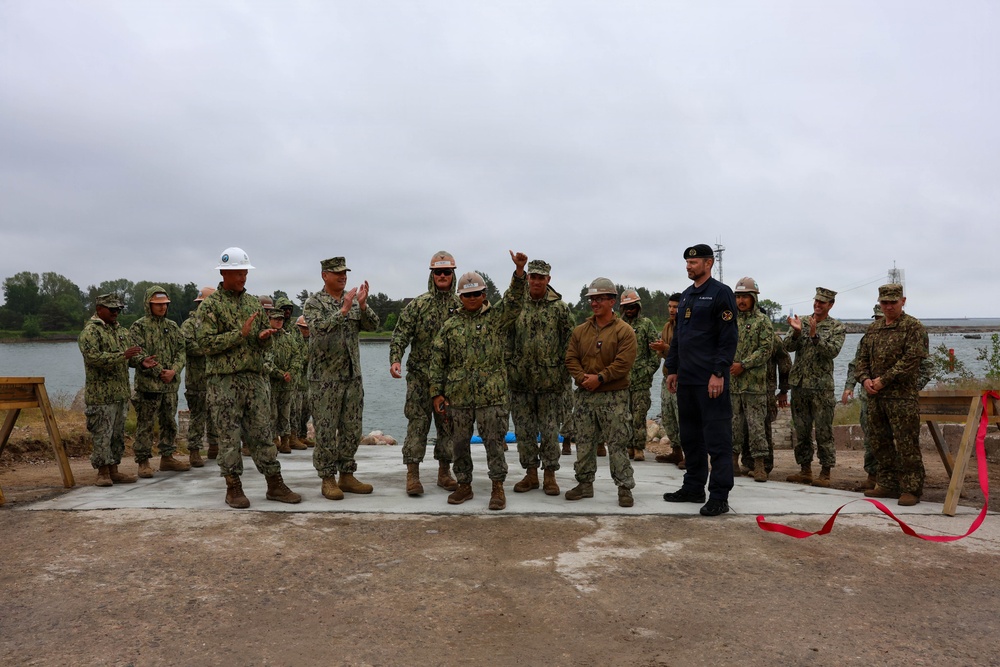
Photo By Petty Officer 3rd Class Sisi Lopez Barahona | 260618-N-HS756-1014 LIEPAJA, Latvia (June 18, 2026) U.S. Navy Sailors, assigned to...... read more read more
For years, launching a vessel into the Baltic Sea from Camp Turtle required U.S. Navy and allied forces to roll a massive aluminum ramp into the water and haul it back out after each use.
During Baltic Operations (BALTOPS) 2026, that process changed.
U.S. Navy Seabees assigned to Amphibious Construction Battalion (ACB) 1 and divers from Underwater Construction Team (UCT) One, Construction Dive Detachment Charlie (CDD/C), built a joint construction management system boat ramp at the temporary training site, transforming it from an expeditionary launch point into a more durable shoreline access capability.
“This ramp enables the Latvians to deploy ships close to their base,” said Construction Electrician Chief Elliot McFeely, ACB 1’s project lead. “It gives the Latvians, and future BALTOPS exercises, the possibility to deploy ships close to Camp Turtle using a more permanent structure.”
The completed ramp gives Latvian forces and future BALTOPS participants a fixed launch and recovery point near Camp Turtle, improving access to Karosta harbor and supporting training, response and sustainment operations in the Baltic region.
“This project will assist the Latvians with training and operations at their dive school, and other naval operations, by giving them an access point to launch craft into the Karosta harbor,” said Lt. j.g. Alice Morgan, UCT One CDD/C officer in charge. “Overall, this project supports a strong partnership between the U.S. and Latvian Navy.”
The ramp also served as a test of a pre-engineered design intended to support future expeditionary construction and ship-to-shore logistics. By prefabricating materials before arriving on site, ACB 1 can evaluate how quickly similar ramps could be assembled to support seaports of debarkation in other locations.
“It’s kind of an experimental design meant to be utilized throughout the world in different environments,” McFeely said. “ACB 1 is out here testing the construction in this theater.”
Building the ramp required coordination between surface construction and underwater engineering. While ACB 1 led construction from the shoreline, UCT One divers handled the underwater foundation work needed to prepare the site.
“Our divers were responsible for supporting the concrete toe cap, which is the end of the boat ramp in the water,” Morgan said. “We have been dredging the seafloor to the appropriate depth, and we assisted with placement of the toe cap and the concrete pour.”
Morgan said the handoff point between the two teams came where ACB 1 personnel could safely and effectively work from the surface.
“Even slightly below the water line, it was most efficient to have divers with water mobility keeping their heads in and making sure everything was being installed according to the drawings,” Morgan said.
The project also relied heavily on host-nation logistical support. When material challenges arose, coordination between U.S. forces and Latvian logistics personnel helped keep the project moving.
“Anytime we needed materials, Latvian logistics personnel would go out to town and get us everything we needed,” McFeely said. “Without that logistical support, our project would be pretty much nowhere.”
That support also extended to the U.S. and Royal Netherlands dive team.
“The Latvians have been a great support for our overall project needs,” Morgan said. “We have also been working with the Royal Dutch Navy divers from their Mobile Salvage Team. They assisted on the boat ramp, bubble curtain placement, and made a lot of progress on a salvage project that we were tasked with so we could continue to support the boat ramp. They are a very impressive team of skilled divers, and we would love to work with them again.”
While BALTOPS 2026 showcased combined maritime capabilities across the NATO alliance, the completed ramp in Liepāja provides a tangible example of what that cooperation can produce. The project improved shoreline access for training and operations while giving U.S. and allied forces practical experience building expeditionary infrastructure in a contested maritime region.
“Our culmination moment was when we fit the last pre-fabricated panel into place and saw the boat ramp starting to come out of the water,” said McFeely. “Everybody sighed with relief. It was a great learning experience, and my team did an outstanding job.”
BALTOPS 2026 is the premier maritime-focused exercise in the Baltic Sea region, providing a unique training opportunity to strengthen combined response capabilities critical to preserving freedom of navigation and security in the Baltic Sea.
Commander, U.S. Sixth Fleet, headquartered in Naples, Italy, conducts the full spectrum of joint and naval operations, often in concert with allies, international partners and other U.S. government departments and agencies to advance U.S. national interests, security and stability in Europe and Africa.
| Date Taken: | 06.17.2026 |
| Date Posted: | 06.19.2026 15:38 |
| Story ID: | 568237 |
| Location: | LIEPAJA, LV |
| Web Views: | 259 |
| Downloads: | 0 |

This work, Seabees, Divers Turn Temporary Launch Site into Lasting Baltic Access Point, by PO3 Sisi Lopez Barahona, identified by DVIDS, must comply with the restrictions shown on https://www.dvidshub.net/about/copyright.


No keywords found.





