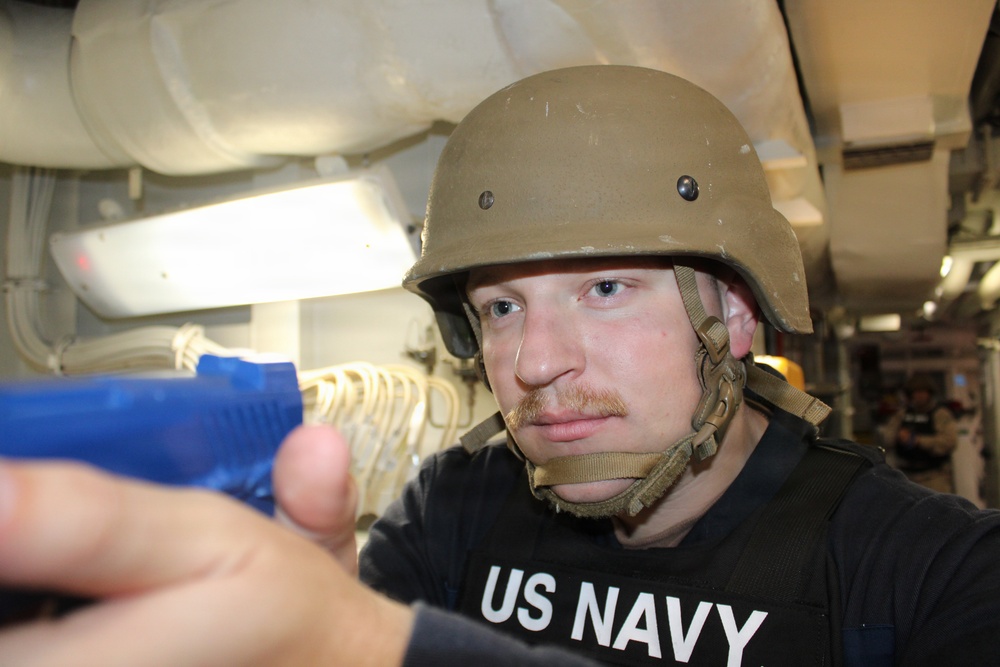
Photo By Petty Officer 1st Class Chelsea Palmer | Machinist’s Mate 1st Class Gavin Gay assigned to the USS John Basilone (DDG 122) participates in an active shooter response drill during the Force Protection Exercise (FPEX) aboard the ship in Mayport, Florida, June 16, 2026. CSG 4-led Force Protection Exercises (FPEX) assess a unit’s readiness to securely conduct foreign port visits during global deployments. Carrier Strike Group 4 trains and mentors Carrier Strike Groups, Amphibious Readiness Groups/Marine Expeditionary Units (ARG/MEU), and independent deployers, ensuring the delivery of combat-ready naval and joint forces to numbered fleets.
(U.S. Navy photo by Ensign Samuel Wright) see less
| View Image Page
NAVAL STATION MAYPORT, Fla. – Three U.S. Navy ships completed a rigorous, two-day force protection exercise pierside at Naval Station Mayport, June 16.
Led by Carrier Strike Group (CSG) 4, Force Protection Exercise (FPEX) evaluates and certifies CSGs, Amphibious Readiness Groups (ARGs), and independent deployers. The training ensures units are fully prepared to maintain strict force protection and security protocols during foreign port visits while deployed globally.
“FPEX is a series of realistic drill events designed to test the physical security capabilities of deploying units,” said Lt. Petermartin Noska, CSG-4 FPEX lead. “Physical security of ashore, afloat, and expeditionary units is imperative to the Navy’s Force Protection mission.”
The guided-missile destroyer USS John Basilone (DDG 122) and Littoral Combat ships USS Indianapolis (LCS 17) and USS St. Louis (LCS 19) participated in the drills. The training featured complex pierside, shipboard, and waterborne scenarios designed to test each crew's anti-terrorism and integrated force protection capabilities.
FPEX utilizes complex, cascading scenarios that serve as the culmination of a unit's integrated training phase. These complex scenarios present covert threats, hostile actors, or simultaneous attacks across multiple locations. The cascading nature of the drills forces the training audience to respond to evolving, simultaneous threats with limited resources.
During the exercise, the CSG-4’s Navy Reserve unit served as a critical support element to the active-duty antiterrorism staff. CSG-4 Reserve personnel filled vital roles as command and control officers, logistical support, evaluators, and safety observers.
“Ensuring the protection of our deployed Sailors starts with thoughtful, rigorous training,” said Capt. Jason Israel, Reserve Commanding Officer of CSG-4 Force Protection. “Our reserve professionals proudly provide leadership and expertise to help ensure the fleet is prepared to sail into harm’s way.”
The participating ships bring diverse operational backgrounds to the training environment.
In November 2024, USS Indianapolis returned to Mayport following an 18-month deployment spanning the U.S. 2nd, 5th, and 6th Fleet areas of operations. USS St. Louis recently returned from a surge deployment to the Gulf of Mexico in November 2025, supporting a U.S. Northern Command (NORTHCOM) mission. Freedom-variant littoral combat ships like Indianapolis and St. Louis are fast, agile, mission-focused platforms designed for both near-shore and open-ocean operations.
Meanwhile, the Arleigh Burke-class guided-missile destroyer USS John Basilone was commissioned in New York in November 2024. These destroyers form the backbone of the U.S. Navy surface fleet, providing highly capable, multi-mission warfighting capabilities across air, surface, and subsurface threats.
Maritime diplomacy and integration remain a top priority for CSG-4's pre-deployment training. Alongside its subordinate commands—Tactical Training Group Atlantic (TTGL), Expeditionary Warfare Training Group Atlantic (EWTGL), Training Support Vessel Squadron (TSVRON) 4, and CSG-4 Navy Reserve units—CSG-4 continues to foster a realistic training environment that accelerates tactical and operational warfighting readiness across the fleet.