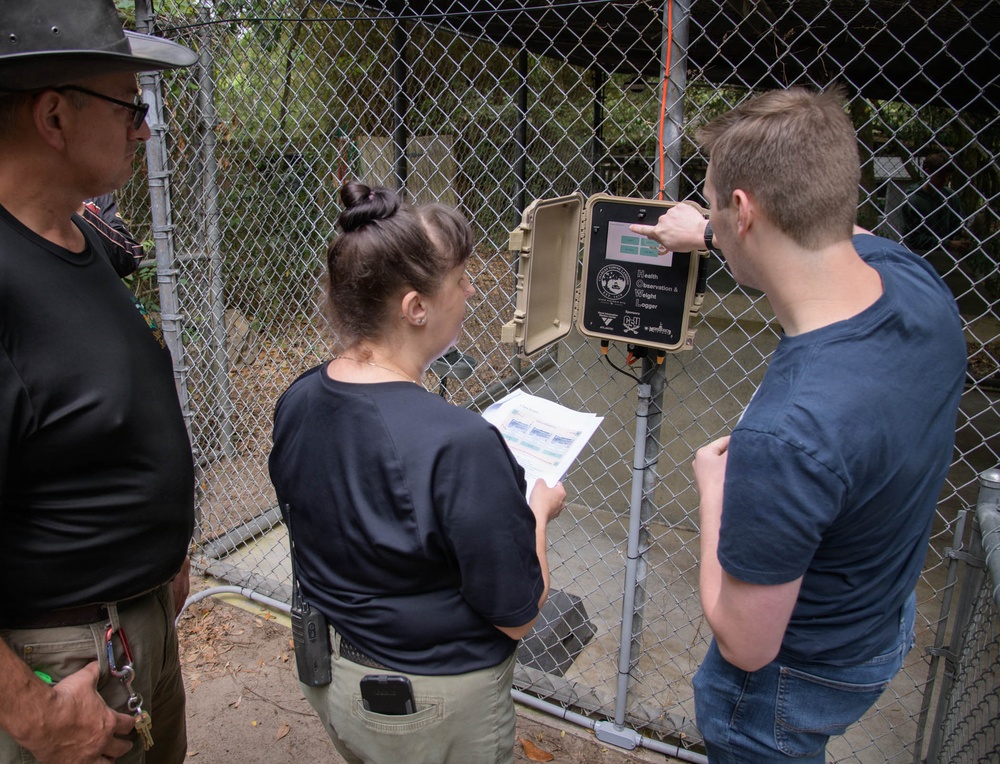
Photo By Joseph Bullinger | Naval Information Warfare Center (NIWC) Atlantic played a key mentorship role in a collaborative effort with Charleston Southern University (CSU) and Charles Towne Landing to develop the Health Observation and Weight Logger (HOWL), an innovative system that enables caretakers to collect health and weight data from endangered Red Wolves without sedation or direct human interaction. Throughout the project, NIWC Atlantic engineers provided technical guidance, manufacturing expertise, and hands-on mentorship to CSU engineering students, while they developed the technology and gained real-world engineering experience. The resulting technology, supports Red Wolf conservation by reducing animal stress and improving data collection. This collaboration advanced NIWC Atlantic’s commitment to developing the next generation of STEM talent, strengthening community partnerships, and cultivating a skilled workforce capable of delivering future information warfare solutions for the Navy. see less
| View Image Page
Students Seek Mentorship from Naval Engineers to help Endangered Red Wolves
Three separate organizations in Charleston, South Carolina, collaborated to develop technology that has reshaped research and care of the endangered Red Wolf species. Charleston Southern University (CSU) engineering students - the problem solvers, Naval Information Warfare Center (NIWC) Atlantic - the mentors, and Charles Towne Landing - the end users and wolf caretakers, successfully worked together to solve a long-standing problem around collecting and tracking weights of Red Wolves.
The Red Wolf was listed as threatened with extinction under the Endangered Species Preservation Act in 1967 and is considered the most endangered wolf in the world. According to the United States Fish and Wildlife Service, only about 17 wild Red Wolves exist in their natural habitat today, and approximately 241 Red Wolves are maintained in 45 captive breeding facilities throughout the United States. In 2013, the Animal Forest within the Charles Towne Landing State Historic Site opened a Red Wolf habitat. This habitat has since contributed to research and participated in the Red Wolf Species Survival Program.
A general practice for animal caretakers at Charles Towne Landing has been to use a sedative in order to safely collect weight measurements of the undomesticated Red Wolves. According to animal forest curator Jillian Delorge-Davis, this practice was not ideal for them or the wolves.
“Since the overarching goal of the SAFE Program is to ready captive Red Wolves for release into the wild, institutions want to set them up for success.\\ This entails reducing our footprint around them. Zookeepers and veterinarians need current weights to properly care for them.”
Charles Towne Landing reached out to CSU to see if their senior engineering students could help develop a solution, which is how Matthew Lauer, a recent CSU engineering graduate, and three other students - Harrison Majors, Esdras Juarez, and Piper Reid - were tasked with this problem as their senior project. When Matt and the team ran into challenges regarding the design and molding of metal parts on the scale, he thought of the capabilities he knew existed at NIWC Atlantic.
This was not a random connection. Matt has been involved with NIWC Atlantic since he was young through the command’s Science, Technology, Engineering, and Mathematics (STEM) programs, such as the Palmetto Cybersecurity Summer Camp. “Not only have I been a part of the cyber camp for years, but [for] the past three years, I've actually been an instructor for it," Matt said.
Matt’s father Dr. Don Lauer, a NIWC Atlantic lab manager, became one of the mentors to Matt’s team. The father and son duo worked together to liaise connections and learning between NIWC Atlantic engineers and CSU engineering students. “The whole totality of working with all of these kids ... it's almost like I'm a proud parent of several kids,” Dr. Lauer said.
Throughout the academic year, the CSU students developed the Health Observation and Weight Logger (HOWL). The technology that makes this scale unique is the combination of dynamic loading and hands-free data collection. Dynamic loading for weight refers to the ability for the scale to sense a weight measurement while the animal walks across the platform. There is no need for the animal to remain still on the scale. This allows the caretakers to have minimal involvement with the wolves so they can maintain an undomesticated way of life.
The hands-free data collection includes the ability for the scale to record images of the wolves, which can then recognize each wolf individually and log weight measurements specific to that wolf. The system analyzes the data and puts it together for the user to see, as well as a 10-second video clip. The recognition technology also eliminates branches or other animals that may move across the scale from being logged as Red Wolf data.
NIWC Atlantic was essential in providing the students with hands-on experience to learn the nuances behind bending and designing certain types of metal for the top of the scale.
"The first thing that I learned from them was about sheet metal and bending,” Matt said. “[As] part of our design, we not only [had] to cut out sheet metal, but we had to bend it. So, in talking with [NIWC Atlantic engineers, [they] recommended the bend radius, like how much you can bend or how much is allowed to bend. That helped affect my design so that it was all going to work when [the engineers] actually went to manufacture it."
NIWC Atlantic has an On Demand Manufacturing (ODM) Lab used for a variety of Naval manufacturing needs, to include shaping and designing metal to create parts and technology for the warfighter. The students worked closely with the ODM Lab to produce the essential metal piece for the scale. An existing educational partnership agreement (EPA) with CSU allowed NIWC Atlantic to support the research and efforts of HOWL. Engineers throughout the command also provided mentorship to the students to assist in certain coding elements of the technology a challenging part of the project, according to Matt.
“Coding was the most intense part of the process. It took a while to figure out how to develop a system that creates a rolling buffer for the video feed - also, the analysis of the information,” he said.
The students finished HOWL in April and were able to deliver and install the logger at the Red Wolf habitat in Charles Towne Landing on April 28, 2026. As a result, caretakers and veterinarians have gained educated decisions about the animals’ current diet and will be able to utilize the weight data to prescribe any future dietary supplements and/or medications.
“The technology is absolutely amazing. I am thoroughly impressed with the students' vision and the exceptional execution of their design. Staff is able to capture the animals' current weights without having to intervene in the wolves' daily life,” said Davis. “This reduces our footprint, our presence, and any undue stress that may press upon the animal. Being able to conduct zookeeping practices from afar on animals who someday may be released into the wild is invaluable.”
Red Wolf research and the ability for the animals to avoid multiple sedations are not the only benefits from this technology. The students have gained invaluable connections and real-world experience to deliver a professional product to a client. They learned to manage constraints similar to Navy projects, including limited funding and security protocols, all valuable skillsets to take with them to their next professional project.
“[The students gained] experience working with seasoned engineers and computer scientists to take something from vision to tangible products and then deliver it, [which] parallels a lot of what we do professionally here ... and students were able to have touch-points with hiring managers,” Dr. Lauer said.
Dr. Lauer also described how the NIWC Atlantic engineers cultivated their leadership skills and gained fresh problem-solving perspectives from the younger generation of engineers. “It was valuable for [we] experienced professionals to have touch back to younger talents to see how they were coming up with solutions! They don’t have any pre-conceived notions. You gain as much from your mentee as they do from you mentoring them. It’s symbiotic learning.”
The warfighter also benefits from this collaboration, as contributing to HOWL furthers NIWC Atlantic’s priority of attracting top talent to create naval technology used in critical information warfare solutions. Dr. Lauer makes the connection on how essential it is to reach out to talented college graduates and top-qualified individuals. This effort between NIWC Atlantic, CSU and Charles Towne Landing exposed four top-tier students to opportunities working within the U.S. Navy at a minimal cost to the command.
“The fact that we can pull from a pool of qualified engineers and computer scientists within the tri-county area reduces our talent acquisition costs greatly! We know that we have a workforce that has ebbs and flows of people hiring and leaving. We want the very best and the very brightest. [These students are] local diamonds in the rough,” Dr. Lauer said.
This project also provided an efficient way for NIWC Atlantic to give back to the local community. “We are Navy, but also part of the community of Charleston. This is being a responsible, active member of the community,” Dr. Lauer said.
In addition to delivering a final product, the students also created a comprehensive manual and trained Charles Towne Landing staff on system operations. In the future, the CSU engineering department will serve as the main contact for any technical issues that may arise.
Unsurprisingly, the CSU engineering student team received an “A” on their project.
With an excellent final grade, a professional product delivered and established connections with NIWC Atlantic, a wide net of benefits has been cast.