
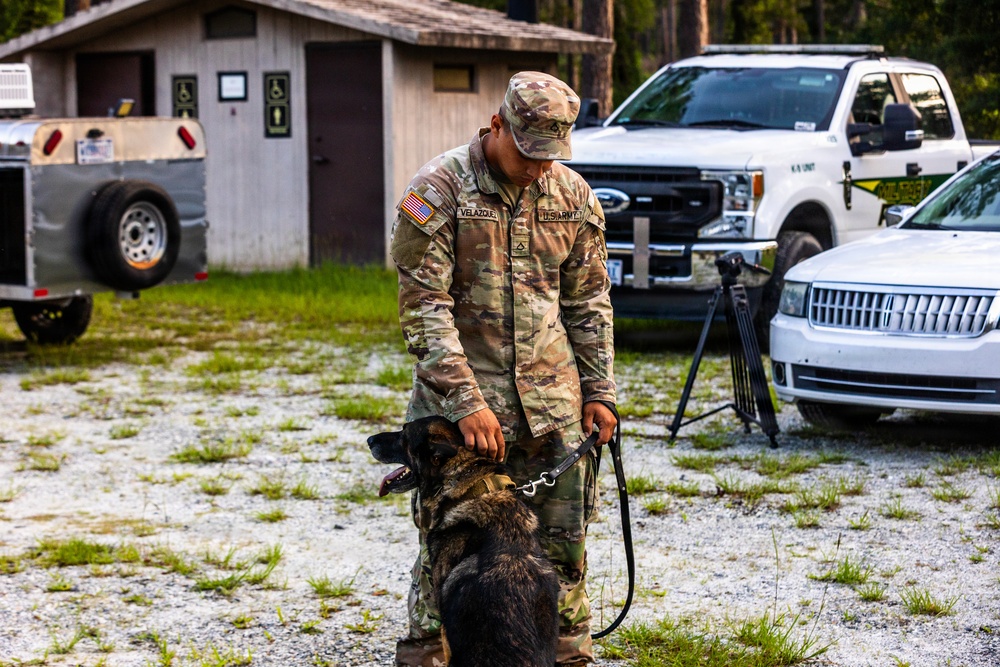
Photo By Joey Rhodes II | U.S. Army Pfc. Jacob Velasquez, a military working dog handler assigned to the 904th...... read more read more
 Subscribe
FORT BENNING, Ga. — In the quiet dawn hours before the installation stirs to life, a profound connection is quietly reinforced at the 904th Military Working Dog Detachment kennels. It is a bond measured not in years, but in countless hours of patience, repetitive commands and the shared understanding between a Soldier and their four-legged partner. For the relationship between a handler and a military working dog, the leash is less about restraint and more about connection — a vital lifeline through which commands, trust and mutual protection flow.
It is easy to think of the U.S. Army solely in terms of conventional roles like infantrymen, mechanics, and logisticians. But patrolling the gates, clearing training areas, and standing between hidden dangers and the community is a specialized, tight-knit group of Soldiers who go to work every day with man’s best friend. They are military working dog teams, and their bond is a force multiplier that cannot be replicated by technology. For the handlers assigned to the detachment, perfecting this capability comes down to a single, foundational process known simply as rapport. "The bond that a handler builds with the dog, or the dog builds with the handler, is an unbreakable bond," said Sgt. 1st Class Cyrus Vaughn, kennel master for the 904th MWD Det. "It's like being a parent to the dog; they naturally develop a deep loyalty to that one person."
As a military working dog kennel master, Vaughn oversees a specialized unit tasked with securing the installation. Currently, Fort Benning is home to nine military working dogs. These animals are dual-purpose assets, trained in both patrol work — such as controlled aggression and biting capabilities — and either explosive or drug detection.
Assigning the right Soldier to the right dog is a deliberate calculus managed by Vaughn and his plans and operations noncommissioned officer. "I look for the skill level of the Soldier and the skill level of the dog," Vaughn said. "If you are a brand-new Soldier coming into it, I want to give you a dog that maybe has a little bit more skills, and that will help develop the Soldier. And then it’s vice versa. If it's a brand-new dog, I try to get them paired with a Soldier who has done this for a while so they can help develop that dog to be successful."
One of those developing partnerships belongs to Pfc. Jacob Velasquez and his partner, Next, a 6-year-old German shepherd sporting tattoo number Delta 050. The pair has been together for just two months and is currently preparing for the rigorous certification process required to work the road.
When they first met, the dynamic was anything but smooth. "When I pulled him on a leash for the first time, he was pretty much just dragging me around and pulling me everywhere," Velasquez recalled. "He wasn't listening to anything I was saying." Next, whom Velasquez describes as a "big goofball" and a "knucklehead" compared to the more serious, task-oriented dogs in the unit, required a heavy investment of time and energy.
"It’s a lot of rapport building," Velasquez said. "You spend a lot of time with your dog, just to get them to see you as a friend or to be comfortable around you. The more time you spend with your dog, the more trust you’ll build with each other — just like being a friend with somebody."
That investment of time has transformed their dynamic, turning raw energy into disciplined obedience. Next no longer fights the leash; he listens to his handler. Once certified, the German shepherd will ride in Velasquez's patrol vehicle, ready to search buildings, track suspects and secure major installation events. For Velasquez, that mutual trust is not just about passing an evaluation — it is a matter of survival. "I have to rely on him a lot," Velasquez said. He explained that during a real-world search, he puts his life entirely in his dog's hands, trusting Next to locate explosives before they pose a deadly threat.
The commitment to the mission means the job never truly stops. While the dogs live in a structured kennel compound rather than going home with handlers at night, the daily routine is demanding. A typical day begins with feeding, walking, and basic human interaction, followed by obedience training, controlled aggression work and real-world environmental detection scenarios. Furthermore, the operational tempo is entirely dependent on the well-being of the animals, requiring a constant partnership between handlers and veterinary staff.
"Because they are live animals, there's never really a time you're taking a break," Vaughn said. "There's always someone that has to be here to take care of these dogs. It takes a lot of patience, long days, long hours. It can take a toll, but it's very, very rewarding."
That reward often extends beyond a single duty station. Under the Army's "Dog for Life" program, teams that demonstrate exceptional success and potential can be paired for the duration of the dog's career, allowing the animal to PCS alongside the handler to their next assignment. When the time comes for an MWD to retire, the Army opens adoption up to former handlers and the public to ensure they spend their final years resting in a safe home.
For Velasquez, who discovered the 31K military occupational specialty at a recruiter's office while initially planning to be a traditional military policeman, the journey is just beginning. Passing certification will be his most defining moment yet, but the daily progress is what keeps him moving forward. "Really, just me and Next spending time together and building a bond is really rewarding to me," Velasquez said.
For the community at Fort Benning, these dogs are a common sight, but the kennel master reminds the public that despite their approachable appearance, they are active-duty personnel executing a mission. "They fall into the realm of a Soldier," Vaughn said. "A lot of people may think they're like pets, but they have a duty the same way that I do. It’s probably the best job in the military."
| Date Taken: | 06.18.2026 |
| Date Posted: | 06.18.2026 12:31 |
| Story ID: | 568144 |
| Location: | FORT BENNING, GEORGIA, US |
| Web Views: | 162 |
| Downloads: | 0 |

This work, It’s a ruff mission, but military working dogs got to do it., by CPT Stephanie Snyder, identified by DVIDS, must comply with the restrictions shown on https://www.dvidshub.net/about/copyright.


No keywords found.




