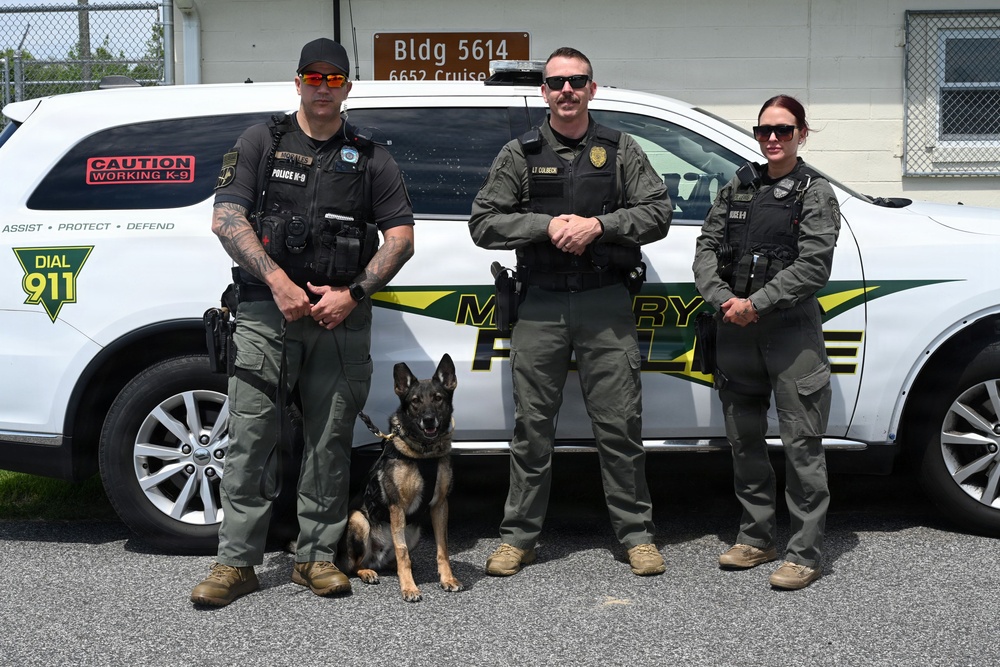
Unwavering Guardians: Inside the Aberdeen Proving Ground military working dog program
Photo By Hannah Miller |
(From left to right) Cpl. Morales and his K9 partner Jaffa, Lt. Colbeck, Kennel Master......read moreread more
Photo By Hannah Miller | (From left to right) Cpl. Morales and his K9 partner Jaffa, Lt. Colbeck, Kennel Master and Cpl. Lewis. see less
| View Image Page
Unwavering Guardians: Inside the Aberdeen Proving Ground military working dog program
ABERDEEN PROVING GROUND, Md. — At the heart of the Aberdeen Proving Ground Directorate of Emergency Services lies a highly specialized, intensely dedicated team. They work long hours through Maryland’s sweltering summers and freezing winters. They are the first to enter a dangerous environment and the last to lose focus. They are the military working dogs of APG, and alongside their human handlers, they form an unbreakable line of defense for the installation’s service members, civilians and critical testing missions.
This is an inside look at the inspiring APG Garrison military working dog program, guided by the firsthand experiences of K-9 section handlers Sgt. Nicholas Vertz, Cpl. Peter Morales and Cpl. Paige Lewis.
The APG kennels are home to a diverse roster of highly trained German shepherds, each bringing a unique set of skills to traditional law enforcement and force protection operations. The handlers are currently in the process of adding two more dogs to their growing ranks, but the operational roster includes these incredible partners:
Jaffais a 7-year-old German shepherd who serves as a specialized drug detection dog.
Maxis a 6-year-old German shepherd operating as a patrol explosive detection dog, making him dual-purpose for both law enforcement patrol work and explosive detection.
Olliis a 3 1/2-year-old German shepherd dedicated to the mission as a patrol explosive detection dog.
Don was a German shepherd who served with distinction as a patrol explosive detector dog, leaving a lasting mark on the APG K-9 program during his roughly five years of life.
Becoming a military working dog handler is more than a job assignment; it is a calling that requires immense patience, emotional intelligence and tactical acumen. For Morales, the journey began while working security at Walt Disney World. Encouraged to apply for a K-9 position, Morales immediately fell in love with the profession.
"Being a handler for DES allows me to combine traditional policing with a highly specialized, dynamic skillset," Morales said. "It is a unique challenge because you aren't just managing yourself and your gear; you are responsible for a highly driven, living partner. The bond you have with your dog is like one of a parent with their child, it's unmatched."
For Lewis, the inspiration struck while serving as a military police officer at The Old Guard. After working closely with military working dog teams, she adopted a retired dog and became determined to give back. This drive eventually led her to Fort Irwin and ultimately to her partnership with Don.
When a handler and a dog are first paired, the initial weeks are purely about building rapport. They do not jump straight into complex detection scenarios. Instead, handlers focus on feeding, grooming, walking and basic obedience. As Lewis noted, this positive environment is crucial before asking the dog to perform tactical work.
"It takes time, consistency, fairness and patience," Morales said. "There’s a saying in the K-9 community that 'emotion travels down the leash.' If I am stressed or frustrated, Jaffa feels it and her performance drops. Maintaining trust means keeping my composure, setting clear expectations and always rewarding her when she does the right thing."
A typical shift for a DES K-9 team is meticulously structured to ensure the health of the animal and the security of the installation. The handlers balance traditional law enforcement duties — like traffic stops and responding to calls — with specialized K-9 operations. The dogs act as an incredible force multiplier, offering early warning detection and a strong psychological deterrent that can de-escalate situations rapidly.
Here is a look at a standard operational shift for the APG teams:
Morning routine
The day typically begins at 6 a.m. with the morning feed, followed by a mandatory one-hour rest period to prevent canine bloat. During this time, handlers clean the kennel runs, prepare their vehicles and gear up for the day ahead.
Pre-patrol readiness
Once the dogs have properly rested, handlers conduct thorough health and welfare checks. They also run through basic obedience training to set the tone before hitting the road.
Active patrol and security
Teams conduct random antiterrorism measures for up to three hours at APG’s gates or critical facilities. The rest of their time is spent on active patrol, remaining ready to respond to dispatch calls at a moment's notice.
Daily training
To maintain strict Department of Defense certifications, teams engage in mandatory daily training. This includes hiding narcotic or explosive training aids for detection drills, conducting bite work and practicing controlled aggression to keep their skills sharp.
During crisis situations, such as a bomb threat, the interoperability of these teams’ shines. While the fire department and explosive ordnance disposal stage nearby, K-9 teams are often the first ones in to sweep and clear the area.
Providing security at a major testing and evaluation installation like APG presents unique environmental challenges. The installation features massive testing ranges, diverse terrain and highly sensitive laboratory environments.
Adapting to this variety keeps the K-9 teams constantly on their toes.
"I must ensure Jaffa is desensitized to sudden loud noises from the ranges but also disciplined enough to sweep a sterile laboratory environment without disturbing sensitive equipment," Morales said.
This requires relentless, realistic training to ensure the dogs can transition smoothly into any real-world scenario.
Despite the serious nature of their work, military working dogs are driven by a simple, joyful motivation: play. Keeping the dogs focused during long shifts or extreme Maryland weather requires a deep understanding of what makes them happy. Handlers monitor work-to-rest ratios closely, utilize climate-controlled vehicles and frequently offer rewards to keep morale high.
"For Jaffa, her absolute favorite paycheck is her Kong toy," Morales said. "When she successfully locates a hidden odor and sits to alert me, I toss her that Kong and we play an intense game of tug-of-war. That brief moment of play, combined with high-pitched verbal praise, is exactly what motivates her to go to work every day."
For Lewis's partner, Don, his favorite reward was his Wubba and tug toy. Lewis affectionately noted that keeping the job fun with "pup cups" and help from patrol officers went a long way in maintaining his focus and motivation.
There are also misconceptions the handlers want to clear up. The public often views working dogs as vicious or constantly overworked.
Vertz clarified this perfectly: "The biggest misconception is that these dogs are mean, vicious animals. In reality, they are highly disciplined athletes and incredibly social creatures. They are trained to turn their drive on and off. When the harness goes on, they are strictly business, but at the end of the day, they just want to be loved and praised by their handler like any other dog."
The proudest moments for these handlers are when the training flawlessly kicks in. Morales recalled Jaffa working for over an hour through a complex, multi-level building and parking lot to secure a massive narcotics recovery during a force protection sweep. For Lewis, a standout moment was watching Don locate a hidden handgun under a driver's seat during their very first U.S. Secret Service mission.
Ultimately, the goal for every handler is to see their partner enjoy a peaceful retirement after a career of service. Morales hopes that Jaffa's legacy will be keeping the APG community and critical missions completely safe on her watch. When her working days are over, Morales's goal is to adopt her so she can transition to just being a regular dog, sleeping on the couch and chasing the kids around.
The APG military working dog program continues to stand watch, driven by the profound bond between human and animal, and ensuring the safety of the entire APG community.