
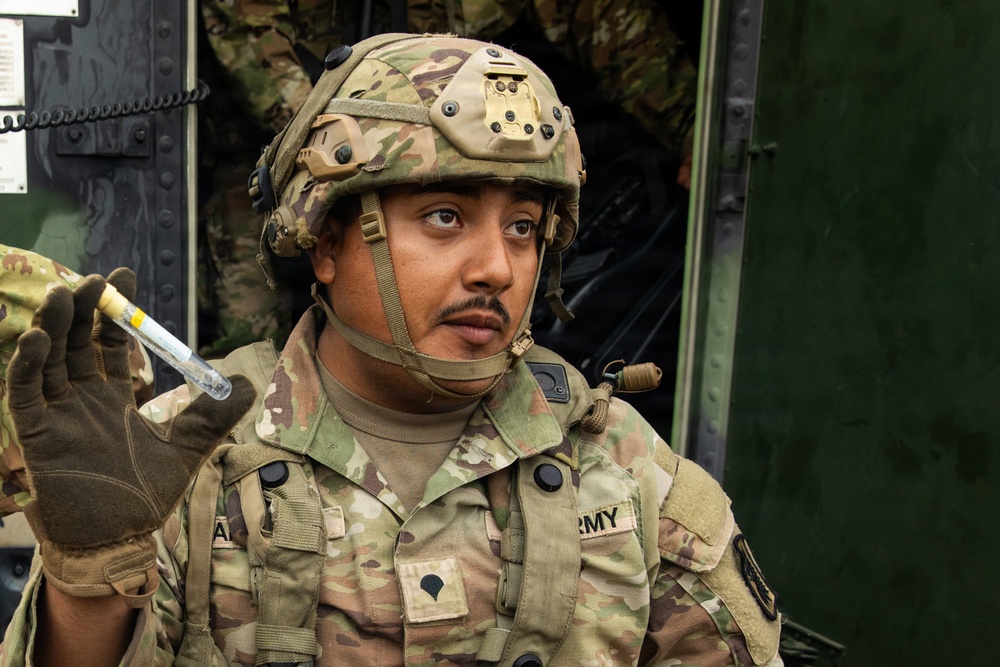
Photo By Sgt. Xavier Chavez | U.S. Army Reserve Spc. Miguel Arreguin-Silva, a chemical, biological, radiological,...... read more read more
 Subscribe
CAMP SHELBY, Miss. – The early Continental Army of the Revolutionary War was ravaged in 1775 by the smallpox virus, with General Washington saying that the disease was more destructive to an army than the enemy. 251 years later, The United States Army has continued to develop technology in its fight against pathogens. One of those technologies is the Joint Biological Point Detection System operated by the 307th and 308th Chemical Companies at Camp Shelby, Miss., June 15, 2026, during Operation Sentinel Justice.
First extensively tested in the early 2000s, the JBPDS works by gathering air samples from an area via exterior intakes and then funneling them through a spectrometer. When the light reflects against certain biological agents, such as bacteria, an alarm is sounded. Once the alarm begins, air is rapidly collected and compressed into a sample vial, which is then properly secured against contamination or leaks, labeled, and sent through the proper chain of command to a lab where testing can confirm which bacterial agents were detected.
“It is supposed to detect up to 10 biological selected agents that are known to be of concern and can be aerosolized,” said U.S. Army Reserve 2nd Lt. Justin Kelleher, assigned to the 307th Chemical Company. “As the officer, I have read the publications. The NCOs (Non-Commissioned Officers) and the junior enlisted have hands-on experience with the machinery. We must marry this knowledge to make our unit mission capable.”
Training and field experience are important for keeping Soldiers’ skills sharp. Operation Sentinel Justice is a large-scale U.S. Army Reserve training exercise that enhances Soldier and unit readiness, validates capabilities, and improves mission effectiveness through realistic, multi-echelon training in a dynamic operational environment.
U.S. Army Reserve Spc. Miguel Arreguin-Silva, a Chemical, Biological, Radiological, and Nuclear Specialist assigned to the 308th Chemical Company, led a field training class on the JBPDS for Soldiers as part of the operation, where he showed Soldiers the proper steps for running the machine, testing the air, and securing the samples for transport. Biological agents can be used against Soldiers at any time in the field, and this training prepares them to respond quickly and effectively to such events.
“Our mission is to protect the outskirts of our area of operation,” said Silva. “So, our main duty is to detect anything before it hits anyone else, that way they can be ready for what’s coming.”
| Date Taken: | 06.15.2026 |
| Date Posted: | 06.16.2026 17:58 |
| Story ID: | 567956 |
| Location: | CAMP SHELBY, MISSISSIPPI, US |
| Web Views: | 301 |
| Downloads: | 0 |

This work, Biological Detection Systems Create Safety for Soldiers, by SGT Xavier Chavez, identified by DVIDS, must comply with the restrictions shown on https://www.dvidshub.net/about/copyright.


No keywords found.




