
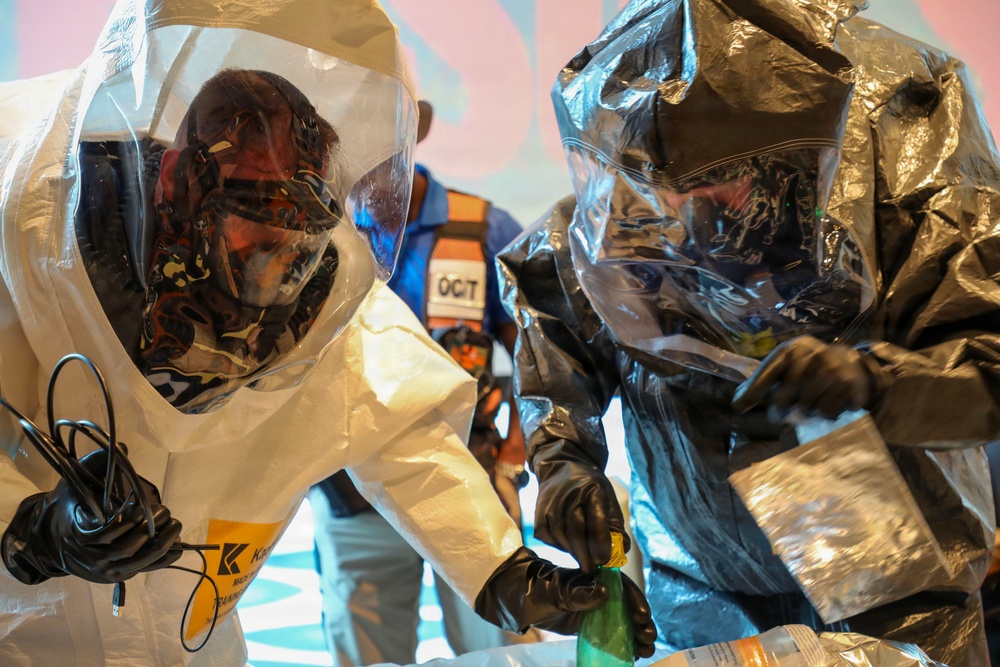
Photo By Petty Officer 1st Class Stephanie Butler | New York National Guard 2nd Civil Support Team, Sgt. 1st Class Joshua Slish, decon...... read more read more
 Subscribe
AMSTERDAM, N.Y.- Local police and fire had reports of radioactive material at Amsterdam, New York’s Shuttleworth Park.
Now, the 21 Airmen and Soldiers of the New York National Guard’s 2nd Civil Support Team had to find the radiation source and identify it for local first responders and state agencies.
The survey team members, Air Guard Tech Sgt. Karlie Foster and Army Guard Sgt. Jacob Crocetta, put on breathing apparatus and hazmat suits with the help of other team members.
Then they boarded a utility vehicle loaded with gear and went into the park to find the radiation source.
They identified the radiation source, but then Crocetta hit his head and was down, simulating a man down event. Now the team had to extract him as well.
This was the day-one scenario for a two-day evaluation conducted by the National Guard’s Civil Support Training Activity.
There are 11 collective tasks a CST—officially known as a Weapons of Mass Destruction Civil Support Team—must demonstrate proficiency in during an evaluation, explained Willie Coleman, the head of the evaluation team.
Civil Support Teams were established to provide expertise in identifying chemical, biological, and radiological hazards to local governments in each state. Additionally, they assess the hazard, advise local incident commanders and assist with requests for additional support. Some states, like New York, have two.
The 2nd CST is based out of the Stratton Air Base in Scotia, N.Y. It handles mission in upstate New York and is prepared to travel anywhere in Federal Emergency Management Agency region II. The 24th CST, based out of Fort Hamilton in Brooklyn, and is responsible for New York City and Long Island.
Every 18 months the CST personnel must demonstrate their proficiency.
The members of the 2nd CST started the day not knowing when the emergency call would come in or where they would go.
Once they got to the location with their vehicles, they deployed just as they would in a real-world situation.
The complication was the simulated head injury, said Sgt. Evan Cunningham, a 2nd CST survey team member.
Cunningham’s survey team was sent in to retrieve Crocetta and take him back to the decontamination station. Then another team took over and put him through the decon process so that he could be safely moved to get further care.
That process went smoothly, Cunningham said.
“My partner was super helpful. We were able to communicate well,” he said.
“We got him on the sked stretcher, which is what we used to drag him out, and got him out, handed off the medical team, and it was pretty seamless didn't really have any major issues,” Cunningham added.
Lt. Col. Andrew McClure, the commander of the 2nd CST, said he was really pleased with his Soldiers and Airmen.
“I saw a flawless extraction of the man down, there was zero hesitation, which is what we're talking about, when saving a life, we can't hesitate,” McClure said.
He wasn’t surprised because the CST trains regularly, McClure added.
“As always, the military is always improving our processes and how we do things. The more we do it, the more confident we are and we will find out whether something's working the way we wanted to,” said McClure.
The 2nd CST trains habitually with local fire departments and police, state agencies and federal agencies like the Federal Bureau of Investigation, McClure said.
During the June 9 exercise members of the New York State Police Contaminated Crime Scene Emergency Response Team—the State Police version of the CST—were on hand as well, as they would likely be in real life.
“We want to make sure our processes, our standard operating procedure, and the way we do business are prepared for a real-world response,” explained Lt. Ian Turner, the 2nd CST’s, entry control officer.
During a response Turner controls the entry and exit of the survey teams into and out of the contaminated “hot” zone.
The second part of the two-day evaluation took place on June 11 in a Schenectady, New York hotel.
The training scenario on June 11 focused on working inside a building. The CST members found the dangerous material and then set up a lab in place to analyze it.
At the end of both days, the evaluators determined that they had once again met the standard, said Air Guard Lt. Col. James McCauley, the training officer for the New York National Guard’s joint operations directorate.
The 2nd CST’s evaluation was also observed by five members of the Swedish Army, who were there as part of the New York National Guard’s training partnership with Sweden’s military.
Sweden and New York have been paired through the National Guard’s State Partnership Program since 2024.
Sgt. Sanna Johansson, a Swedish Army decontamination specialists noted a couple of differences between the way her Army does things versus the National Guard.
“The most significant difference between how we do this in Sweden, is that you throw everything away afterwards,” she said.
“In Sweden, we try to take everything back and reuse,” she explained.
“Also, when we are going in, we're going in armed, that is the huge difference,” she said.
The Swedish Army focuses more on the wartime aspects of a Chemical, Biological, Radiological or Nuclear (CBRN) explained Capt. Anton Palmgren, who is assigned to Sweden’s CBRN Defence Center.
“We are equipped to do warfare, so we go in armed, we're a little more army heavy,” he explained
“From peacetime, all the way through wartime, prepared for mass deconing for both scenarios, Palmgren added.
“In Sweden, we usually train for mass decon, up to 100 people, here it's 2 to 4 people,” explained Johansson.
“The decon line is also a bit smaller than ours. In Sweden, it can be up to from 10 meters to 300 meters long,” she added.
| Date Taken: | 06.16.2026 |
| Date Posted: | 06.16.2026 14:24 |
| Story ID: | 567925 |
| Location: | AMSTERDAM, NEW YORK, US |
| Web Views: | 226 |
| Downloads: | 0 |

This work, Specialized NY Team Masters Evaluation Challenge, by PO1 Stephanie Butler, identified by DVIDS, must comply with the restrictions shown on https://www.dvidshub.net/about/copyright.


No keywords found.




