
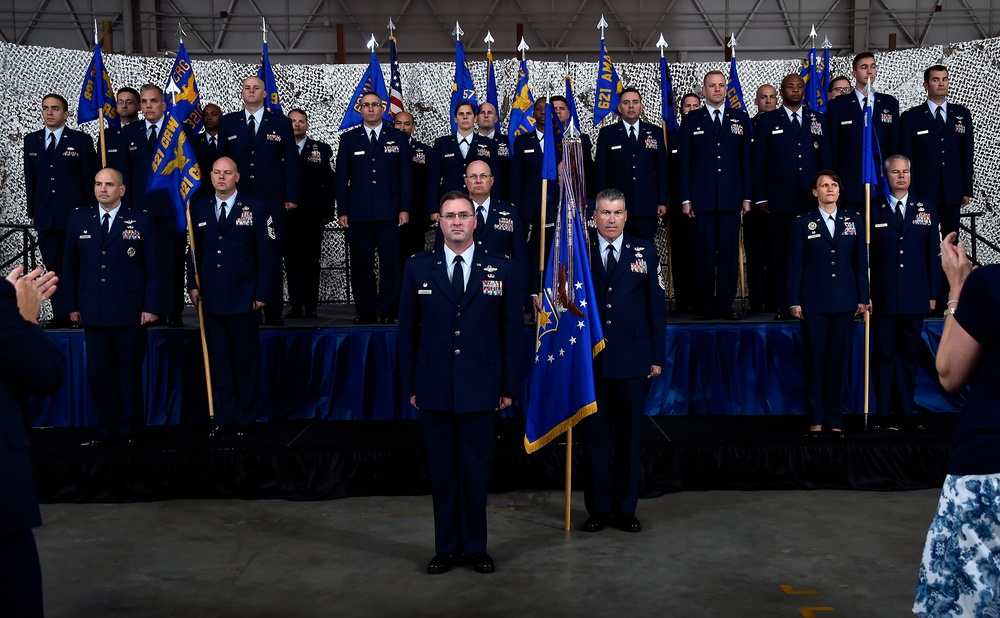
Photo By Tech. Sgt. Matthew Hannen | 621st Contingency Response Wing leadership represent the newly reorganized wing...... read more read more
 Subscribe
The 621st Contingency Response Wing has transformed multiple times since its activation in March 2005, culminating in its most significant reorganization in June 2015. While most changes resulted in the addition or inactivation of individual units, several factors prompted a major reorganization, notably the inactivation of the 615th Contingency Response Wing in July 2012.
When the wing absorbed West Coast units and their associated air mobility liaison officer operating locations, little changed in the wing's organization. Groups and squadrons looked similar on paper, but significant administrative and operational differences existed between the East and West coasts. Initial discussions for the reorganization began in May 2012, after the wing chartered an Air Force Smart Operations 21 event to restructure units and align them with new Air Force policies.
In 2010, the Air Force mandated minimum personnel sizes of 1,000 for wings, 400 for groups and 35 for squadrons. Several contingency response groups struggled to meet the minimum size, prompting a move to inactivate multiple groups across the wing to redistribute personnel. Historically, squadrons also struggled to maintain enough personnel to fill funded positions.
Along with the mandatory changes required for administrative compliance, wing leaders wanted to redefine the roles and responsibilities of groups and squadrons, increase efficiency to streamline tasking activities and develop mobility advisors. A key consideration included the decision to have each contingency response group own the equipment its respective squadrons used. Additional goals included standardizing Unit Manning Documents across the groups, fully equipping contingency response elements and presenting a common voice for contingency response group and air mobility advisory group issues at higher headquarters. These challenges lingered after a 2010 reorganization that helped but did not solve management and organizational issues for wing units.
Following the Air Force Smart Operations 21 event and discussions with Air Mobility Command representatives, the wing determined to inactivate the Contingency Operations Support Group and four contingency response groups: the 570th, 571st, 817th and 818th. This restructuring resulted in the creation of the 821st Contingency Response Group and the 621st Air Mobility Advisory Group, the first U.S. Air Force group dedicated solely to the mobility advisory mission. Concurrently, the Global Mobility and Global Mobility Readiness squadrons combined personnel positions to become contingency response squadrons, while the Global Support squadrons became contingency response support squadrons.
Because each contingency response squadron was formed from multiple units, the groups had to activate new units instead of inheriting the lineage and honors of existing squadrons. The 621st Air Mobility Advisory Group created the 621st Mobility Support Operations Squadron for air mobility liaison officers and changed the designation of the 615th Air Mobility Operations Squadron to the 321st Air Mobility Operations Squadron. With the exception of the 621st Air Mobility Operations Squadron and both mobility support advisory squadrons, the new unit designations used "21" to identify them as sub-organizations of the 621st Contingency Response Wing.
Following the reorganization, the 621st CRW consisted of three groups, with one contingency response group per coast and the 621st Air Mobility Advisory Group, which established dual headquarters at Joint Base McGuire-Dix-Lakehurst, New Jersey, and Travis Air Force Base, California.
Establishing the contingency response squadrons made it easier for the wing to present forces to combatant commands with predefined capabilities and reduced the administrative burden required to identify personnel and equipment before each mission. Furthermore, activation of the 621st Air Mobility Advisory Group placed mobility advisory roles on equal footing with contingency operations and increased advocacy for those missions at higher headquarters. In particular, the 621st Mobility Support Operations Squadron provided proper administrative control for air mobility liaison officers for the first time, significantly improving training and equipment acquisition.
| Date Taken: | 06.16.2026 |
| Date Posted: | 06.16.2026 13:48 |
| Story ID: | 567913 |
| Location: | JOINT BASE MCGUIRE-DIX-LAKEHURST, NEW JERSEY, US |
| Web Views: | 200 |
| Downloads: | 1 |

This work, Reorganization History of the 621st Contingency Response Wing, by Jamien Parks, identified by DVIDS, must comply with the restrictions shown on https://www.dvidshub.net/about/copyright.


No keywords found.




