
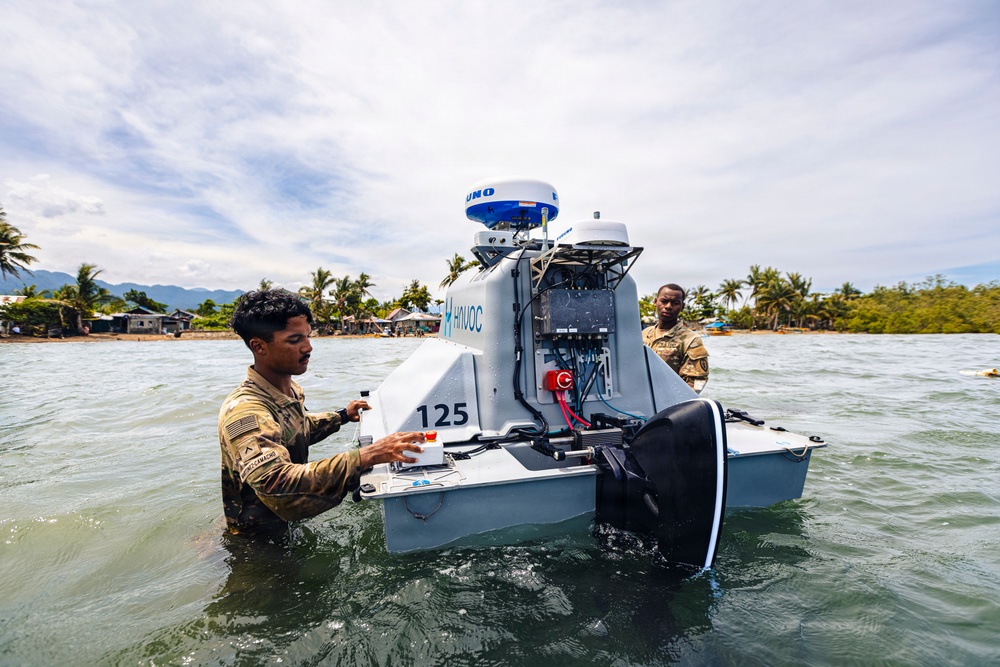
Photo By Pfc. Peter Bannister | U.S. Army PV2 Jose Martinez-Camacho (left) and Pfc. Murana Bannister (right), assigned...... read more read more
 Subscribe
CASIGURAN, Philippines — Soldiers assigned to the 25th Infantry Division partnered with Philippine Army forces and industry representatives during Salaknib 2026 to demonstrate how autonomous maritime systems can enhance security and protect critical transportation operations in contested environments.
The maritime screen operation, conducted in the waters of Casiguran Sound, showcased the ability of U.S. and Philippine forces to integrate emerging technology into combined operations while strengthening interoperability between the longtime allies.
At the center of the mission were unmanned surface vessels, or USVs, operated by Soldiers from the 125th Intelligence and Electronic Warfare Battalion, 25th Infantry Division. Soldiers deployed a swarm of autonomous boats to establish a security screen across the waterway as a U.S. Army Logistics Support Vessel approached Casiguran Port.
The mission supported the movement of Philippine Army vehicles and personnel, including armored personnel carriers, from Port Tobaco to Port Casiguran, more than 260 miles, using a U.S. Army Logistics Support Vessel. As the vessel transited Casiguran Sound, the autonomous boats spread across a wide perimeter, continuously monitoring the maritime environment and relaying information to onshore personnel.
The operation demonstrated how autonomous systems can extend situational awareness beyond what is possible through traditional means, providing commanders with a clearer understanding of activity throughout the area of operations.
“I think it's great to integrate this emerging technology in these exercises; it builds trust in the U.S. and partner Soldiers; it also allows us to showcase and validate our systems interoperability between next-gen command and control nodes across all partner nations,” said Ben Outlaw, an industry partner representative supporting the operation. “These boats provide situational awareness to commanders with their ability to find, fix, target, kill, and confirm. With the information the USV provides, the commander's decision-making process has been compressed from hours to seconds.”
The maritime screen mission highlighted the growing role autonomous technologies can play in future military operations. Rather than relying solely on manned platforms, commanders can use multiple autonomous vessels operating simultaneously to maintain persistent awareness across large maritime areas.
During the operation, the USVs autonomously navigated while using onboard sensors to detect and report potential threats or anomalies within the operating area. Information collected by the vessels was transmitted in near real time, a capability that will allow commanders to maintain continuous awareness of the maritime domain and make informed decisions.
For Soldiers operating the systems, the exercise provided valuable experience integrating advanced technology into a multinational environment.
“I’ve really enjoyed working with the USVs during Salaknib 2026,” said Pvt. Caleb Hannah, 125th Intelligence and Electronic Warfare Battalion, 25th Infantry Division. “We deployed the autonomous intelligence, surveillance, reconnaissance boats to provide security for landing craft today. They escorted the LSV to port from about six miles out, allowing Philippine vehicles to roll onto the dock.”
Salaknib 2026 provides U.S. and Philippine forces with opportunities to train in partnership across multiple domains, enhancing readiness and strengthening the alliance between the two nations. The maritime screen mission served as an example of how emerging technologies can be integrated into combined operations to improve security, increase operational flexibility, and expand commanders’ options during future contingencies.
The maritime screen mission ultimately showcased more than just the capabilities of autonomous vessels. It reflects the goals of the larger mission; Salaknib highlights the enduring U.S.-Philippine alliance, enhancing interoperability and readiness through combined arms operations, multi-domain integration, and humanitarian assistance efforts for regional stability.
| Date Taken: | 06.11.2026 |
| Date Posted: | 06.13.2026 03:17 |
| Story ID: | 567697 |
| Location: | PH |
| Web Views: | 370 |
| Downloads: | 0 |

This work, Salaknib 2026: USV Swarm Demonstrates Maritime Security Capabilities, by SSG Erik Warren, identified by DVIDS, must comply with the restrictions shown on https://www.dvidshub.net/about/copyright.


No keywords found.




