
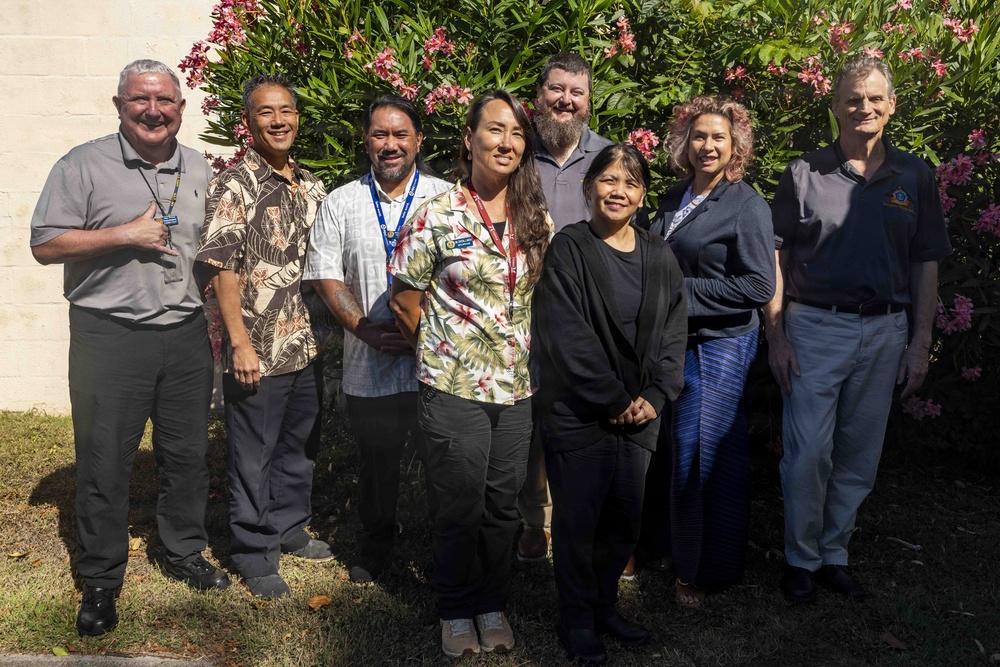
Photo By Raquel Cloma | Civilian members of the Commander, Navy Region Hawaii (CNRH) emergency management team...... read more read more
Flooding from two Kona Low storms in March caused an estimated $1 billion in damage across Hawaii. Striking within days of each other, the back-to-back systems saturated the islands, triggering the state's worst flooding crisis in over 20 years and upending the lives of thousands of residents.
With the Pacific hurricane season running from June 1 to Nov. 30, National Oceanic and Atmospheric Administration (NOAA) forecasters are predicting an “above-normal” season. Strong El Nino conditions could fuel up to 13 cyclones in the central Pacific.
According to Will Luna, Commander, Navy Region Hawaii (CNRH) emergency manager, the recent devastation caused by the Kona Lows should serve as a wake-up call.
“The longer we go in between major disasters, the more people become complacent. With a possible super El Nino coming this year, there will be more potential for a hurricane,” Luna explained. “Will any of them hit Hawaii? We just don't know, but continuing to be prepared is the name of the game.”
People-First: The Ready Navy Model
The CNRH emergency management team – made up of civilians, contractors, dispatchers, and military personnel – works year-round to ensure CNRH can support fleet requirements regardless of the weather. But community resilience begins at home.
“Preparedness is really important from a people perspective,” Luna said. “We want to save as many lives as possible. The more prepared the community is, the less likely they are to be significantly impacted by a storm.”
To keep households safe, Ready Navy, the Navy’s official disaster preparedness program, outlines a four-step process:
Be Informed:Closely monitor weather updates via the National Weather Service and local news. Ensure you receive emergency alerts from the state, county, and through AtHoc, the Navy’s Emergency Mass Notification System, which sends critical updates via automated calls or text messages.
Make a Plan:Establish an agreed-upon meeting place in case family members are separated. Designate an out-of-state point of contact who can relay news among relatives if local communications go down.
Build a Kit:The Hawaii Emergency Management Agency recommends a 14-day supply of food and water per person. CNRH Deputy Emergency Manager Neil Fujioka also recommends a 72-hour "go-bag" for evacuations that contain clothes, small denomination bills, jumper cables, important legal documents and other essential supplies. Don't forget an at-home kit with medications, pet supplies, batteries, an emergency radio and a printed list of phone numbers of family members and key contacts.
Stay Informed:Know the emergency plans for your department and building. Participate in disaster training, such as the annual Hurricane Exercise (HURREX), to ensure you are ready when it counts.
Know Your Safe Havens and Shelters
If a storm damages your home, knowing where to go is critical.
Emergency Shelters:Provide immediate temporary relief and protection. These arenotlocated on military installations. During a disaster, find shelter locations by calling the American Red Cross hotline: 800-733-2767.
Safe Havens:Pre-designated facilities activated by Emergency Management for temporary protection. On Oahu, six temporary safe havens would be activated at Joint Base Pearl Harbor-Hickam. On Kauai, a safe haven would be activated at Pacific Missile Range Facility, Barking Sands.
A Resilient Community
Looking back on the recent Kona Low storms, Luna praised the seamless coordination between the city, counties, state, and the Department of War. He noted that the Army, Marines, Navy, Air Force, and Coast Guard were immediately ready to support local authorities.
Ultimately, however, personal responsibility is the foundation of disaster readiness.
“People who are caught off guard have a far greater potential of being in a crisis that requires first responders,” Luna said. “For every person who we can pull out of that pool because they've prepared enough, that's a win for the community as a whole.”
Helpful Resources
Hawaii Emergency Management Agency https://dod.hawaii.gov/hiema/ NOAA http://www.noaa.gov/hurricane-prep Ready http://www.ready.gov/hurricanes Ready Navy https://www.ready.navy.mil/ American Red Cross hotline: 800-733-2767 (for available shelter locations) Emergency Radio Stations: KSSK (590 AM) and KHKA (1500 AM)
| Date Taken: | 06.12.2026 |
| Date Posted: | 06.12.2026 17:15 |
| Story ID: | 567657 |
| Location: | JOINT BASE PEARL HARBOR-HICKAM, HAWAII, US |
| Web Views: | 265 |
| Downloads: | 0 |

This work, Don't Wait for the Next Storm: CNRH Emergency Management Urges Preparedness for 'Above-Normal' Hurricane Season, by Kyler Hood, identified by DVIDS, must comply with the restrictions shown on https://www.dvidshub.net/about/copyright.

No keywords found.





