If you want to see exactly how the United States Navy learned to layer wireless networks over its heavy iron, you just need to look at the 33-year career of Capt. Remil Capili. When he retires on June 11, 2026, he won’t just be ending his own time in uniform. He will be offering a clear window into how the Fleet transformed into a networked combination of muscle, artificial intelligence and fighting power.
Capili, born and raised in Quezon City, Philippines, immigrated to California as a teenager. After joining the Navy in 1993, he started out as an enlisted aviation electrician, learning the Fleet from the flight line as a reservist with the “Firebirds” of Attack Squadron 304 (VA-304) and the “Minutemen” of Fleet Logistics Support Squadron 55 (VR-55).
“I was a poor starving college student. I needed supplemental income to pay my college bills,” recalled Capili. “I remember going to the recruiter, and he sold me on the Sea and Mariner Reserve Program – basically, go to bootcamp for eight weeks as active-duty sailor, complete a three-week apprentice school and then become a ‘weekend warrior’ reservist.”
After college, Capili went to work for Lockheed Martin flying Air Force satellites. The pay was good, but for Capili, something about the Navy kept “calling.” “I had a desire to do something bigger, with a sense of fulfillment, something that was lacking at Lockheed,” said Capili.Another major attraction was the opportunity to travel. “A lot of Sailors say they joined the Navy to ‘see the world’. We - not just me, but the entire family - certainly did.”
After earning his commission, he became a surface warfare officer and was sent to his first assignment aboard USS SACRAMENTO (AOE-1). Around the turn of the century, Capili was assigned to the USS MCCLUSKY (FFG-41), a 453-foot, 4,100 ton Oliver Hazard Perry-class guided-missile frigate. As the frigate’s auxiliaries officer, Capili spent his days worrying about the hull, mechanical and electrical systems. The McClusky’s material condition wasn’t the best, and keeping the ship alive took raw, physical labor in the engineering spaces. It was a ship kept afloat with sweat and grease, but the crew worked hard enough to pass their Board of Inspection and Survey assessment with flying colors.
The physical demands on Sailors to keep the Navy operating haven’t gone away. Sailors today still turn wrenches and bust rust to keep the fleet afloat. But as the 20th century turned into the 21st, the Navy woke up to the reality that the next fight wouldn't just be about who had the best seamen; it would be about who had the fastest data. Capili saw that shift coming and adjusted his own course, redesignating as an engineering duty officer.
“I was ready to get out of the Navy to pursue a master’s degree until the officer I relieved on the McClusky told me about the [engineering duty officer] community,” said Capili. “As an EDO, I volunteered to serve aboard the USS Mount Whitney and USS Nimitz. Those EDO operational tours really defined my career.”
To help build a Fleet that could fight in the digital domain and at sea, Capili went back to the classroom – a lot. The Navy sent him to earn five graduate degrees, including a master’s in electrical engineering from the Naval Postgraduate School and a master’s in cybersecurity risk and strategy from New York University. He was learning to build the digital architecture that would eventually run atop the modern battlespace.
“I was raised with a mindset that education opens up opportunities, and I truly believe that was the case for me,” said Capili. “When I mentor junior officers, I always tell them to never be content with whatever degrees they have – keep growing and learning, and I encourage them to keep pursuing new knowledge.”
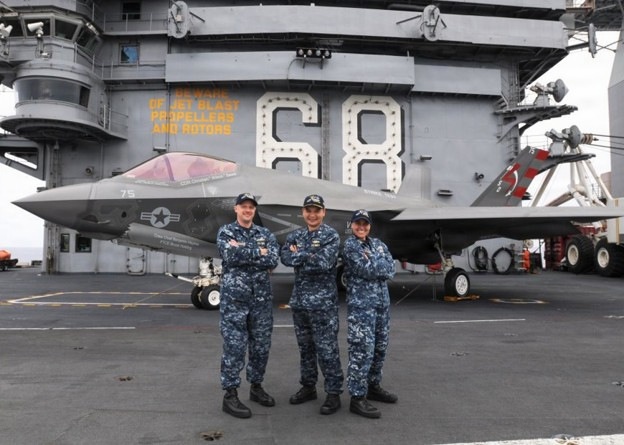
Those two worlds—the heavy iron of the hull and the invisible code of the future—crashed into each other in November 2014. Capili was serving as the combat systems officer aboard the aircraft carrier USS NIMITZ (CVN-68). His team was tasked with landing the new F-35C Lightning II on the flight deck for the very first time. The F-35 was a flying computer hub, and forcing it to talk to a legacy, nuclear-powered aircraft carrier was a massive hurdle in network integration. The flight deck was packed with media, and the pressure was immense because every single launch and recovery system had to work perfectly. Failure simply was not an option. When that jet safely caught the arresting wire, it proved the Navy could fuse its digital future to its analog foundations.
In February 2021, he received an unexpected chat message telling him to call Vice Adm. William Galinis, the commander of Naval Sea Systems Command (NAVSEA). Galinis wanted to interview Capili to be his executive assistant. Capili was nervous about the prospect. He was a career network officer, making him a total outsider to the NAVSEA shipbuilding and maintenance community.
After asking for five minutes to call his wife to get her green light, he took the interview and landed the job. It was one of the hardest tours of his career, but all the more fulfilling because of it. That assignment was emblematic of how a ship and its network could no longer be built in isolation. The Navy needed leaders who understood the data just as well as the steel.
“Being the EA for Vice Adm. Galinis was such a blessing, and I learned quite bit from him as he epitomized the phrase ‘servant leadership,’” said Capili. “From dealings with the Pentagon leadership to congressional hearings, I was exposed to all the challenges the Navy faced in the shipbuilding and maintenance realm. Through it all, Galinis’ competency, grace and humility was front and center, and I will always be thankful for that opportunity to have worked for one of the very best leaders of the Navy.”
Capili’s personal career and the Navy’s technological progression fully merged in July 2022. He took command as the major program manager for Project Overmatch. Overmatch’s mission is to give the Navy a decisive edge by operationalizing artificial intelligence and delivering a unified digital ecosystem straight to the tactical edge.
“Having the operational experiences really helped me understand certain gaps out in the Fleet, and I was fortunate enough to be able to address some of those gaps with the Project Overmatch team,” said Capili.
Under Capili’s leadership, his team successfully built a software pipeline that allowed the Navy to push over-the-air updates directly to ships engaged in the fight. Capili's command delivered AI and command and control capabilities to units in the U.S. Central Command area of operations. Those systems were in high demand and greatly contributed to the success of the missions. Capili, typically humble, will say he was simply the Overmatch team’s lead cheerleader, clearing hurdles so the “doers” could execute the mission. The young officer who started out fixing electrical systems on an aging frigate was now delivering combat-ready code to the forward edge of battle.
“Supporting the warfighter means giving the Sailors at sea, simple, intuitive and effective systems that allow them to perform their mission, increase efficiency, and that they are able to fix themselves,” said Capili.
When his watch is officially relieved, Capili plans to head to Hawaii for some quiet downtime. He will finish his doctorate in artificial intelligence at George Washington University and stay in the San Diego area until his two kids finish high school. He even jokes about finally getting a real job.
But if you ask him to look back at the highlights of his 33 years, he doesn't talk about the networks, the artificial intelligence or the advanced aircraft. He talks about the people. He talks about meeting his wife at the Naval Postgraduate School, crediting her for straightening out an unmotivated young lieutenant. And he talks about watching Engineman 3rd Class Jimmy Giles use the Seaman to Admiral 21 program to rise through the ranks to eventually command the destroyer USS LENAH SUTCLIFFE-HIGBEE (DDG-123).
“I’m just proud to have been able to serve for 33 years, something I never imagined I’d be able to do,” said Capili. “The Navy has given me all the opportunities to grow as a naval officer, an EDO, a husband and a father, and I never took them for granted. My family and I are forever grateful for the travels, experiences, education, and most especially, the people that we crossed paths with over the years. The U.S. Navy is a journey of a lifetime and for the past 33 years, I’m just really proud to have been part of that journey.”
The Navy has changed a lot since Capili joined in 1993, but maybe the most remarkable thing is how it has stayed the same. “The Navy, as an institution, has been rock solid for the 33 years that I have served,” said Capili. “Sailors have come and gone over the 250 year history of the Navy, but the Navy ethos, embraced by every Sailor, is truly the reason why the U.S. Navy is the best Navy in the world.”
The Navy didn't trade the wrench for the keyboard; it learned to use them both at the same time. Capili’s story is a reminder that behind every piece of cutting-edge technology, and deep inside the belly of every steel ship, there is still a sailor standing the watch.
| Date Taken: |
06.12.2026 |
| Date Posted: |
06.12.2026 15:49 |
| Story ID: |
567631 |
| Location: |
SAN DIEGO, CALIFORNIA, US |
| Web Views: |
846 |
| Downloads: |
1 |
PUBLIC DOMAIN

This work, From the Flightline to the Deckplates and the Digital Edge: A 33-Year Journey Through the Navy’s Technological Evolution, must comply with the restrictions shown on https://www.dvidshub.net/about/copyright.

 Subscribe






